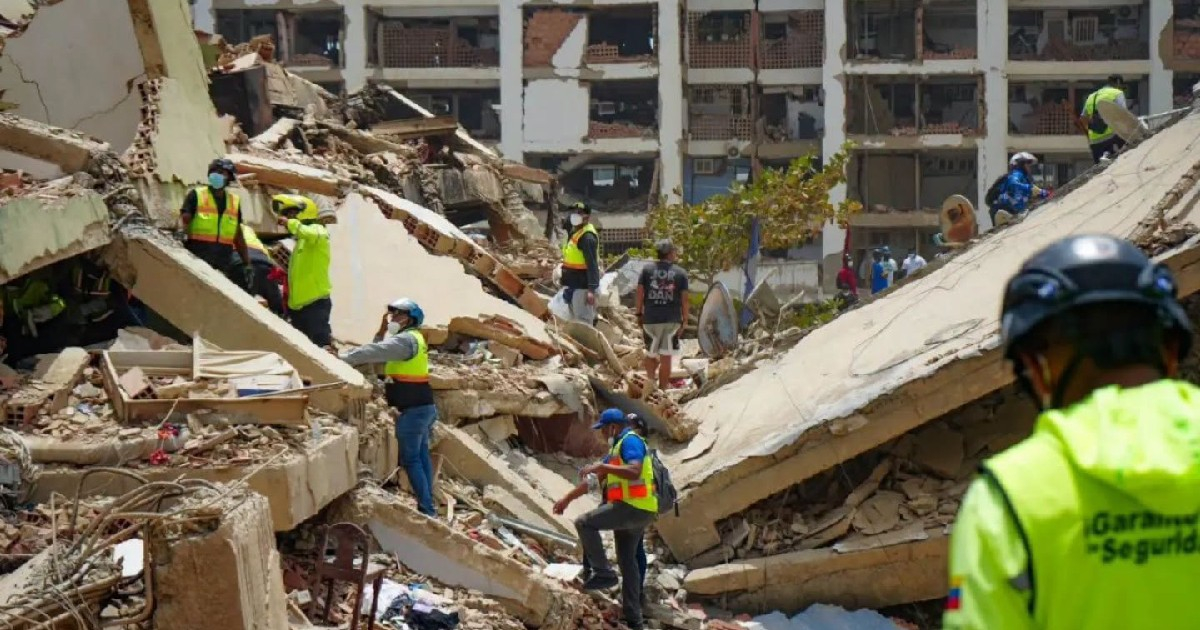
On Sunday, the Venezuelan government updated the death toll from the twin earthquakes on June 24, reporting a total of 3,342 casualties. Additionally, the number of injured individuals has risen to 16,740 following the disaster.
In an official statement, Jorge Rodríguez, President of the Venezuelan National Assembly, revealed an increase of 388 deaths compared to Saturday's report, when 2,954 deaths and 16,592 injuries were confirmed. These catastrophic earthquakes, which struck northern Venezuela 11 days ago, are deemed the most significant seismic disaster in over a century by experts.
Rescue and Relief Efforts Intensify
The official report states that 6,462 people have been rescued, 86,794 families have been assisted, and medical care has been provided to 23,820 patients.
Venezuelan authorities report that 17,345 individuals remain homeless, as many buildings have either collapsed or suffered substantial damage, rendering them uninhabitable. Out of the 856 affected structures, 190 have completely crumbled. To support the displaced, 79 temporary camps have been established.
The rescue operation has mobilized 4,088 international rescuers from over 15 countries, alongside 29,567 personnel and 27,482 volunteers.
Humanitarian Aid and Ongoing Challenges
Authorities have also distributed 9,585 tons of food and 669,008 liters of water. Since the initial quakes, 995 aftershocks have been recorded.
The state of La Guaira has witnessed the greatest devastation, with 158 of the 190 completely collapsed buildings located there. A NASA satellite analysis identified 58,870 damaged structures and estimated 1.2 million tons of debris solely in this region. The Simón Bolívar International Airport in Maiquetía remains non-operational.
Official figures differ significantly from international predictions. The United States Geological Survey issued a Red Alert, suggesting a death toll between 10,000 and 100,000, while the United Nations and the International Rescue Committee estimate that 50,000 to 68,000 individuals are missing.
Questions over Transparency
The Venezuelan government has yet to release an official estimate of the missing, leading to increasing scrutiny over the transparency of their information. Citizen platforms have recorded over 71,203 individuals unaccounted for.
The June 24 earthquakes, a seismic doublet with magnitudes of 7.2 and 7.5 separated by only 39 seconds, are considered Venezuela's worst seismic event since 1900. The epicenter was located in the Morón area of Carabobo state, roughly 300 kilometers east of Caracas.
A reporter on site described the devastation in Catia La Mar with words that capture the scale of the tragedy: "I've been to disaster areas, I've seen earthquakes where parts of a city are affected. Here, it's everything—an entire city in total ruin. It's indescribable."
The United Nations Development Programme estimated the material damage at $6.7 billion, which equates to 6% of Venezuela's gross domestic product in a nation already grappling with a severe crisis before the earthquakes.
Key Questions About the Venezuelan Earthquakes
What is the current death toll from the Venezuelan earthquakes?
The latest report from the Venezuelan government states that 3,342 people have died as a result of the earthquakes.
How many people are still reported missing after the earthquakes?
Citizen platforms have reported over 71,203 people as missing, but the government has not released an official estimate of the missing.
What has been the response to help those affected by the earthquakes?
The response has included the rescue of 6,462 individuals, assistance to 86,794 families, and medical care for 23,820 patients. Authorities have set up 79 temporary camps and distributed essential supplies.