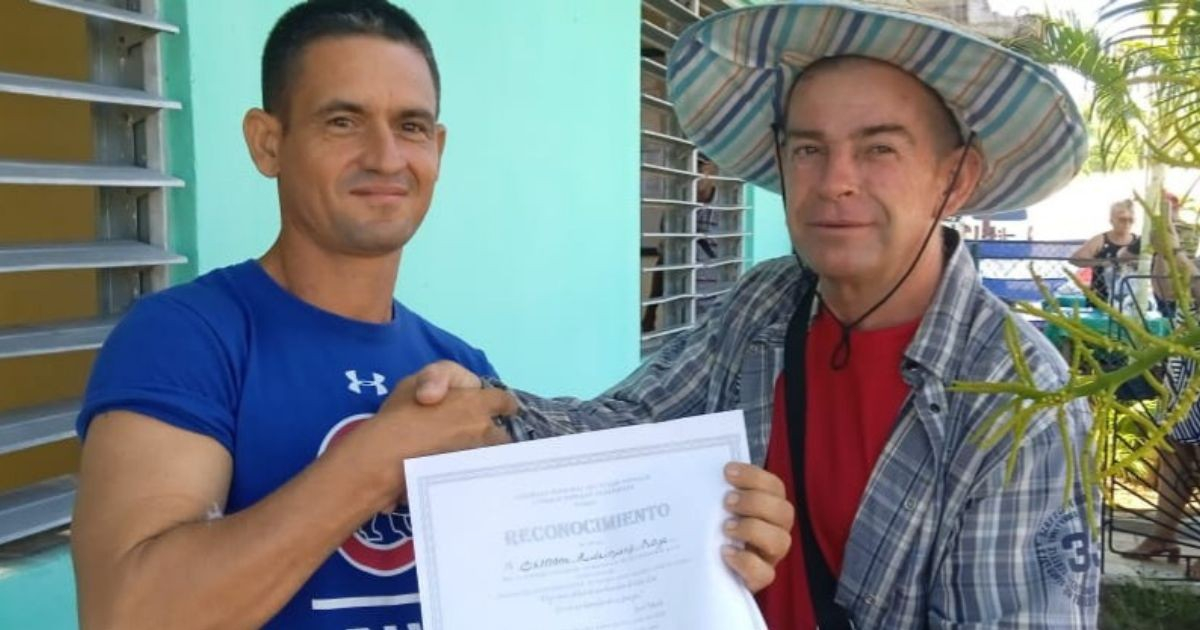
In a neighborhood near Holguín's Military Airport, a campaign reached the goal of 100 blood donations as part of a "commitment to Fidel," according to the pro-government newspaper Ahora. This initiative is part of the Cuban regime's extensive propaganda program marking the centenary of the dictator's birth.
The drive was spearheaded in district 212 of Zone 144, led by the People's Power delegate Jorge Neyra Feria. Osmany Rodríguez Rojas, the 100th donor, was highlighted by state media as a symbolic achievement of this goal.
Local economic actors contributed food, which was distributed for free to each donor, along with donations for children with health issues. In the midst of the severe crisis affecting the population, these incentives seem to be more significant than the homage to the dictator.
Propaganda or Altruism?
Diana Ricardo Oliver, coordinator of the Committees for the Defense of the Revolution (CDR) at the provincial level, praised the act as altruistic and encouraged others to follow suit.
"It would be good for others to imitate this altruistic gesture, especially during these current times the country is experiencing," she stated. This remark is an unusual public acknowledgment of the crisis by an official media, as hospitals in Cuba are currently suffering from a severe blood shortage.
Long-term Mobilization
The campaign was neither spontaneous nor brief. Journalist Elder Leyva, who authored the article, had previously published another piece titled "Seven Donations to Meet the Goal in Holguín Neighborhood," indicating that the mobilization had been ongoing for some time before reaching the target number.
A Contradictory Celebration
This event is part of the "Year of the Centenary of the Commander-in-Chief Fidel Castro Ruz," declared by the regime for 2026, upon the proposal of Miguel Díaz-Canel and unanimously approved by the Cuban parliament on December 20, 2025.
Castro was born on August 13, 1926, in Birán, a municipality in Cueto, Holguín province, making this region a symbolic epicenter of the celebrations.
The commemorative program includes international colloquiums, art exhibitions, university campaigns like "Here I Become a Fidelist" in Holguín universities, and events in neighborhoods and workplaces.
In a striking contradiction, in December 2016, Cuba passed a law prohibiting the use of Castro's name and image for naming institutions, plazas, or erecting monuments, adhering to the dictator's express wish to avoid a personality cult.
However, the regime has continuously ignored this principle, ramping up the glorification of his figure as an ideological tool to legitimize Díaz-Canel's government amid the severe economic, energy, and social crisis facing the island.
The main event for the centenary is scheduled for August 13, 2026, in Birán, Castro's birthplace, while the First International Colloquium "Fidel: Legacy and Future" will be held from August 10 to 13 at the Havana Convention Palace.
Understanding Cuba's Tribute to Fidel Castro
Why is blood donation being used as a tribute to Fidel Castro?
The blood donation campaign is part of a broader propaganda initiative by the Cuban regime to commemorate the centenary of Fidel Castro's birth. It serves as a symbolic gesture of commitment to his legacy.
What incentives are being offered to blood donors in Holguín?
Donors receive free food and donations are also made for children with health issues, which appears to be a more practical incentive amidst the country's ongoing crisis.
How does this campaign reflect on Cuba's current situation?
The campaign highlights the severe crisis in Cuba, particularly the acute shortage of blood in hospitals, while also showcasing the regime's continued emphasis on glorifying Fidel Castro as a means to legitimize the current government.