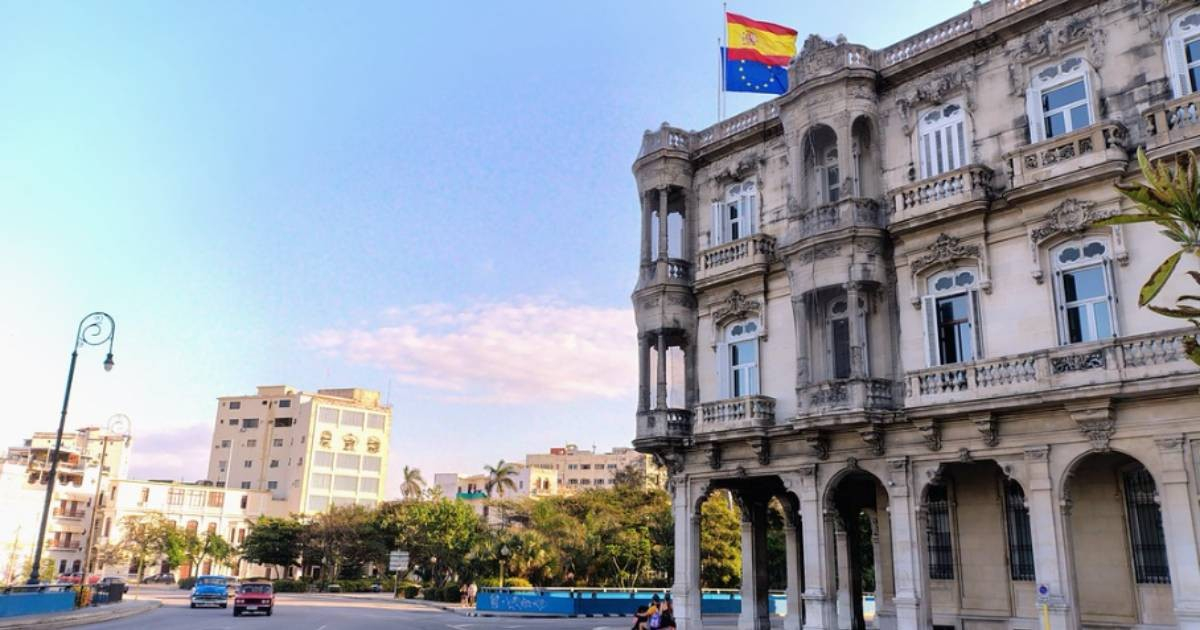
According to an investigation by the Spanish newspaper 20minutos, the Spanish government disbursed €1.6 million to the Cuban state-owned enterprise Grupo Empresarial Palco, which is linked to the military conglomerate GAESA. This payment was for handling part of the personnel involved with over 350,000 Spanish nationality applications filed in Cuba under the so-called Grandchildren Law.
The report reveals that Spain's Ministry of Foreign Affairs awarded three contracts to Palco. This entity, under Cuban law, is the sole provider authorized to supply workers to foreign diplomatic representations on the Island, making it a pivotal player in processing nationality applications.
Among these contracts, the largest was for €1,131,295, which facilitated the hiring of 87 office and service aides for the Spanish Consulate General in Havana to manage the high volume of applications. A second contract, worth €242,743, was for services at the Spanish Embassy, while a third, valued at €228,000, covered the rental of a building for the hired staff. All three agreements are set to last until December 2028.
The Financial Dynamics Behind Palco's Contracts
The investigation further suggests that Palco retained a portion of the funds paid by Spain. As reported by 20minutos, the Ministry of Foreign Affairs paid between €205 and €210 monthly per worker, while the employees only received between €133 and €135, with the remainder kept by the state enterprise.
Palco's Role in Cuba's Military-Driven Economy
Palco operates under the Cuban Council of Ministers and is part of the business network associated with GAESA, the conglomerate controlled by the Cuban Armed Forces, which dominates a substantial portion of the national economy.
On May 1, 2026, the United States government sanctioned GAESA through an executive order signed by President Donald Trump, labeling the conglomerate as "the heart of the Cuban kleptocratic communist system." Later, on June 23, further sanctions were imposed on five additional entities related to the group.
According to the report, Palco was initially created over four decades ago to organize congresses and fairs, formally becoming a business group on January 15, 2011. Their website describes them as specialists in providing comprehensive services to the Cuban government, its official guests, and accredited diplomatic bodies on the Island. Currently, they encompass ten companies involved in a range of activities from personnel hiring and real estate leasing to construction, importation, and floristry.
The Political Ramifications of the Grandchildren Law
The 20minutos investigation adds new dimensions to the ongoing debate surrounding the Democratic Memory Law, popularly known as the Grandchildren Law.
As per the newspaper, segments of the Spanish opposition argue that the significant number of new Spanish citizens living abroad could influence elections through overseas voting. Parliamentary sources quoted by the publication estimate that in certain constituencies, the impact could affect up to twenty seats in future general elections.
The report also highlights that Cuba is not a member of the Hague Apostille Convention, meaning the authenticity of birth and marriage certificates used in applications relies on documentation issued and validated by Cuban authorities.
Simultaneously, 20minutos claims that the United States Department of State is investigating whether the Spanish regulations might allow individuals linked to organized crime or the Cuban state apparatus to obtain Spanish nationality and, consequently, access to U.S. territory.
In this scenario, the Vox party requested on July 1 the annulment of the instruction regulating the law's application, called for an audit of the Spanish expatriate census by the Central Electoral Board, the suspension of new additions to the registry, and a review of contracts with Grupo Empresarial Palco.
Key Questions on the Grandchildren Law and Palco's Role
What is the Grandchildren Law?
The Grandchildren Law, formally known as the Democratic Memory Law, allows descendants of Spanish nationals to apply for Spanish citizenship. It has led to a significant number of applications, particularly from countries like Cuba.
Why did Spain contract Palco?
Palco was contracted as it is the only entity legally allowed to supply personnel to foreign diplomatic missions in Cuba, making them essential for processing the high volume of nationality applications.
What are the implications of Palco's involvement?
Palco's involvement raises concerns about financial transparency and the retention of funds, as well as potential political and electoral impacts due to the large number of new Spanish citizens abroad.