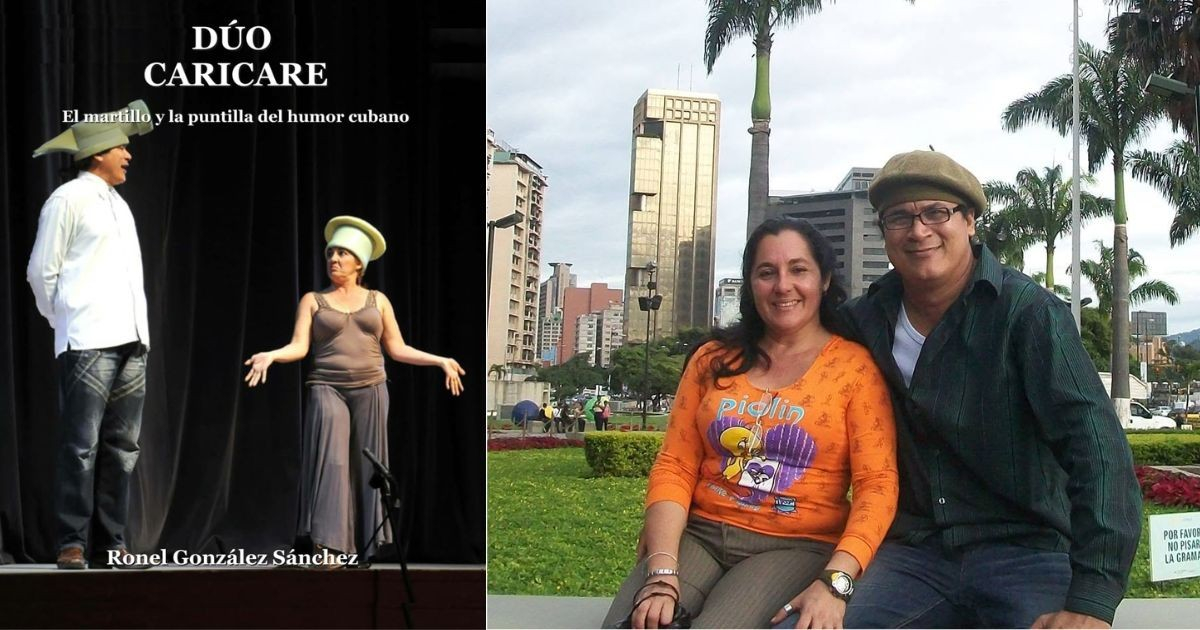
Based in Montevideo, Uruguay, the publishing house Café con Mate has recently unveiled a new book titled "Dúo Caricare: The Hammer and the Nail of Cuban Humor". Authored by Cuban poet, storyteller, and researcher Ronel González Sánchez, the work pays tribute to the illustrious three-decade journey of Cuba's most awarded comedic duo from Holguín.
This 150-page volume is now available on Amazon in paperback and in its original Spanish edition, broadening its reach to the Cuban diaspora and Spanish-speaking readers worldwide.
González Sánchez shared the news on his Facebook page with visible excitement: "Amazon just got even better. Thanks to José Luis Laguarda and José Heredia of Café con Mate, Montevideo's publishing house, this gem has been published: Dúo Caricare: The Hammer and the Nail of Cuban Humor. A great piece of news for the iconic duo, for myself, and for the memory of Cuban humor. Very grateful."
The Legacy of Dúo Caricare
Founded on November 25, 1995, in Holguín and originally known as "Matagusano," Dúo Caricare consists of Mireya Abreu Pérez and Onelio Escalona Vargas. Over the years, they have crafted a distinctive style centered on sharp social satire, monologues, sketches, and humorous songs with live music, becoming a cornerstone of the genre in Cuba.
The book's Amazon description regards them as “one of the most significant groups in the history of Cuban humor, celebrated for their talent, originality, and ability to engage audiences through intelligence and satire." Their work has left an indelible mark on national culture, establishing them as essential representatives of the genre.
Award-Winning Influence
Dúo Caricare is the most decorated group in the history of Cuba's most prestigious humor event, the National Humor Festival Aquelarre, organized by the Center for the Promotion of Humor and the National Council for Performing Arts. In 2023, they won the Aquelarre award for Best Script Adapted to Stage, and in 2025, the Center for the Promotion of Humor recognized their 30-year artistic journey. They have also represented Cuba in Mexico and Venezuela and were honored by the Cuban-Mexican Cooperation Institute of Quintana Roo.
Author's Perspective and Context
Ronel González Sánchez, born in Cacocum, Holguín, in 1971, has published over 50 books spanning poetry, essays, narratives, and children's literature. His recognition with the Nicolás Guillén Poetry Prize for Central Patria in 2025 adds academic and literary weight to this latest book celebrating Cuban humor.
The timing of this publication is particularly poignant. Amidst a worsening structural crisis in Cuba, its humor scene faces increasing institutional pressures. The popular TV series Vivir del Cuento was inexplicably canceled in 2025, and comedians like Ulises Toirac and Osvaldo Doimeadiós have spoken out against marginalization and censorship by the Ministry of Culture. Many comedians have emigrated or turned to digital platforms as state television options dwindle.
In this climate, the effort of a Uruguayan publisher—described as a "meeting place for Cuban writers in the Oriental Republic of Uruguay"—to document and preserve the history of Cuban humor is symbolic, transcending mere literary significance.
The Dúo Caricare continues to host its monthly gathering at the UNEAC headquarters in Holguín and remains active members of the Center for the Promotion of Humor, UNEAC, and the José Martí Cultural Society in the city. González Sánchez’s book applauds their exceptional journey and the historical importance of a duo that has elevated Cuban humor to a higher plane.
Insights on Cuban Humor and Dúo Caricare
Who are the members of Dúo Caricare?
Dúo Caricare is composed of Mireya Abreu Pérez and Onelio Escalona Vargas, who have been performing together since 1995.
What achievements has Dúo Caricare received?
The duo has won numerous accolades, including the most awards at the National Humor Festival Aquelarre and recognition for their 30-year career in 2025.
Why is the publication of this book significant?
The book arrives at a critical time when Cuban humor is under institutional pressure, serving as a testament to the enduring legacy of Dúo Caricare's contributions to the genre.