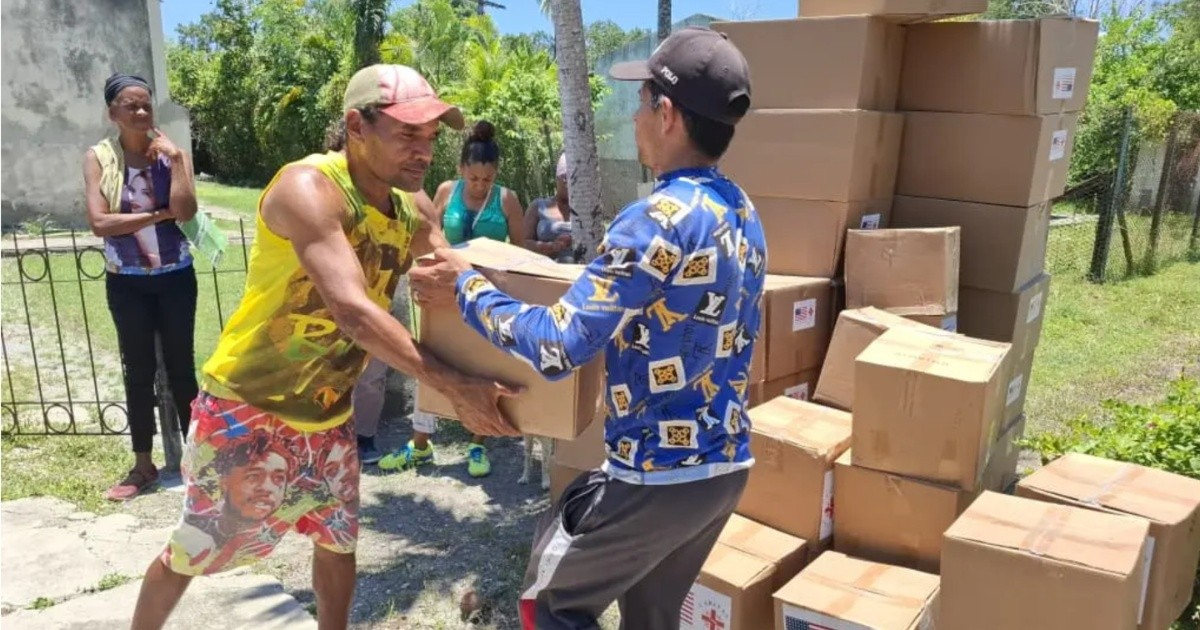
The Archdiocese of Santiago de Cuba has addressed rumors and misunderstandings about the handling of U.S. humanitarian aid, clarifying on Facebook that Cáritas Cuba did not receive any cash from the millions announced by the U.S. government, but rather goods intended for affected families.
The Catholic institution detailed the actual aid mechanism: the U.S. government utilized the funds to purchase goods directly, which were then sent to Cuba via Catholic Relief Services (CRS), the U.S. branch of Caritas, acting as an intermediary.
"Cáritas Cuba did not receive a single dollar from the $3 million. You might say, 'But they gave $3 million through Cáritas.' They provided $3 million worth of products. They spent $3 million to help families, but they bought the goods themselves. We've received the products they purchased," the Archdiocese's message specified.
This clarification addresses widespread confusion that suggested Cáritas was managing a large sum of cash and that every Cuban could claim "what was theirs."
Distribution of Aid in Eastern Dioceses
The initial $3 million phase was distributed across four eastern dioceses—Guantánamo, Holguín, Bayamo-Manzanillo, and Santiago de Cuba—assisting around 8,000 families affected by Cyclone Melissa. This devastating storm struck eastern Cuba on October 29, 2025, as a Category 3 cyclone with winds of 121 mph, impacting more than 2.2 million people.
Over 50 containers arrived through Cuban ports and airports, with distribution handled by volunteers from parish communities. To identify beneficiaries, communities conducted a census of affected families, prioritizing rural areas in Santiago de Cuba such as El Cobre, Baire, Contramaestre, Palma Soriano, and San Luis, where damage was most severe.
Inclusivity in Aid Distribution
The Archdiocese emphasized that aid distribution was impartial: "There was no distinction in giving, whether one is Catholic, Christian, atheist, or communist. Everyone in need is a child of God."
The church also denied any friction with Cuban authorities during the process: "We had no issues with the Cuban state. We managed to facilitate the process and, when necessary, they provided fuel."
Second Phase and Future Aid
The second phase, amounting to $6 million, also targeting Cyclone Melissa victims, began in July in the same four eastern dioceses, following the same procedure. This aid includes boxes marked with the U.S. flag and the phrase "Charity unites us with Cáritas," containing food staples like oil, rice, and beans, as well as cleaning supplies and water containers.
The aid is part of a significantly scaled-up humanitarian effort. The Archdiocese also announced an expansion of aid to $100 million for all of Cuba, aiming to assist approximately 100,000 to 120,000 families.
The explanation noted that the U.S. State Department positively evaluated Cáritas's work. "We're going to provide another $100 million, not just for Santiago, Bayamo, Guanajay, Holguín, but for all of Cuba, possibly helping 100,000 to 120,000 families," confirmed the Archdiocese, which also praised its relationship with Washington: "The State Department appreciated the serious and diligent work. They are demanding."
FAQs on U.S. Aid to Cuba
How did Cáritas Cuba receive the aid from the U.S.?
Cáritas Cuba received goods purchased by the U.S. government through Catholic Relief Services, rather than cash, to assist families affected by Cyclone Melissa.
What areas were prioritized for aid distribution?
Priority was given to rural areas in Santiago de Cuba such as El Cobre, Baire, Contramaestre, Palma Soriano, and San Luis, where the impact of Cyclone Melissa was most severe.
What does the aid package include?
The aid package includes boxes of food items like oil, rice, and beans, as well as cleaning supplies and water containers, all marked with the U.S. flag and a message of unity with Cáritas.