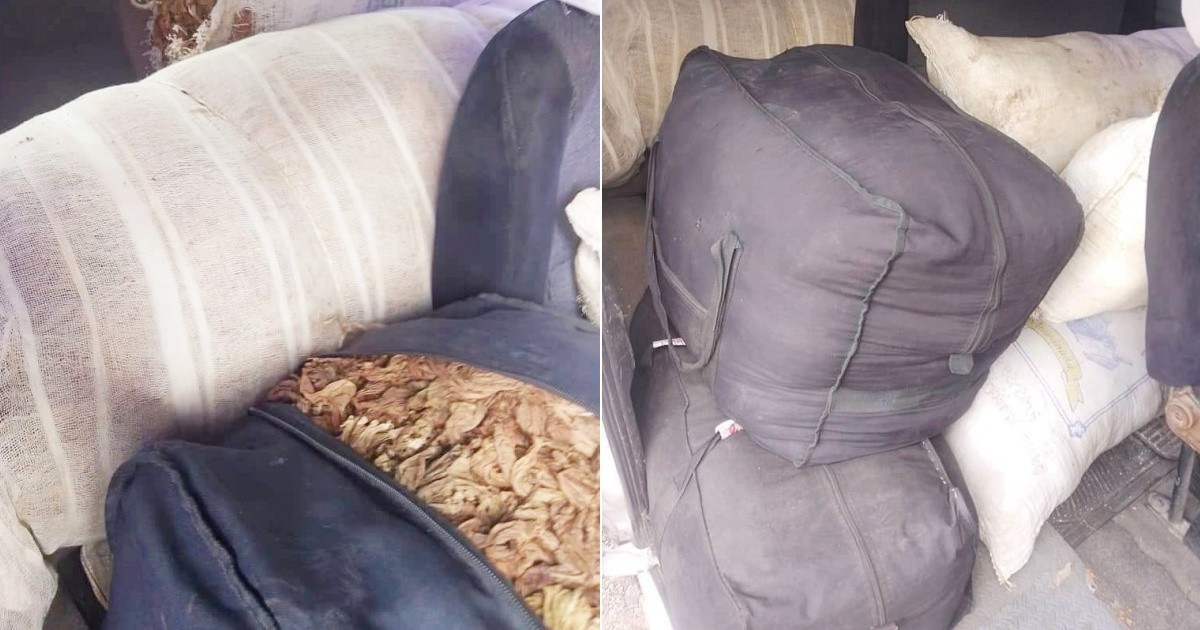
This month, a pro-government Facebook page revealed the illegal theft and transportation of dried tobacco bales from Pinar del Río to Havana. This incident, shrouded in vague official statements, has sparked a heated debate over who truly bears responsibility for the pillaging of Cuba's countryside.
Alarming Lack of Details in Official Reports
The page, "De Canallas y sus Canalladas," reported that "unscrupulous criminals attempted to transport bales of already dried tobacco to Havana, stolen from hardworking producers," and were "caught in the act and confronted by the PNR." However, the official statement is notably lacking in specifics: it omits the exact amount seized, the number of arrests, the precise location, and the date of the operation. No formal charges or trial dates are mentioned either.
The statement mainly praises the police's response: "Recognition to the officers who acted with firmness and professionalism to protect the assets of those who live by their work." It ends with a call for public denunciation: "Speak up, report, and help stop those who seek to profit at the expense of others' sacrifice."
Critical Context: What the Government Doesn't Say
Pinar del Río, especially the Vuelta Abajo region—including San Juan y Martínez and San Luis—produces 70% to 80% of Cuba's national tobacco and is the main source of export-quality Habano cigars.
For the 2025-2026 campaign, the official price per quintal of premium tobacco is around 9,448 Cuban pesos. However, tobacco products can fetch up to 20 times that amount on the black market; for example, a pack of H. Upmann cigars may cost between 1,200 and 1,500 pesos compared to the official 30 to 60 pesos.
This disparity is exacerbated by delays of up to a year in crop payments and threats from Tabacuba, the state tobacco enterprise, to revoke land leases from non-compliant farmers. The average daily wage for a tobacco farmer is about 75 pesos, equivalent to roughly three dollars.
Public Reaction Divided Between Support and Outrage
Comments on the pro-government post reveal deep polarization. Some support the police action, praising law enforcement and calling for harsh penalties, demanding zero tolerance for illegal activities. "Be tough on those thieves," one user wrote, while another emphasized "zero impunity for illegalities."
Conversely, a larger segment questions the official narrative, shifting the blame to the state. "How long will the state keep failing to pay farmers after years of work?" one commenter asked. Another was more blunt: "The only thief here is the state, which pays shameful prices at its whim."
Several users highlight long payment delays and hurdles in accessing funds: "They get paid, but then can't withdraw the money from the bank," one noted. Criticism of the state's monopoly is also prevalent: "Farmers need to be able to sell their products wherever they want," another participant opined.
Some argue that not all involved in these incidents are traditional criminals: "Often those called thieves are the farmers themselves seeking better sales," a user pointed out. Another added: "If the farmer transports the crop himself, the result is the same: confiscation and punishment."
Nevertheless, some attribute the issue to social and cultural factors. "Cubans need to stop being so thievish and work," one person commented, while another warned that "crime in the countryside is worse than hunger."
Overall, the debate exposes underlying distrust of institutions and growing discontent over the economic conditions in the agricultural sector. While some demand a crackdown on crime, others point to structural issues like low payments, state control, and lack of economic freedom, indicating a broader crisis in Cuba's rural areas.
A Repeated Pattern of Rural Crime
This incident is not isolated. Crime in rural Cuba has surged in 2025 and 2026, with thefts of livestock, tobacco, and other agricultural products reported across multiple provinces. In April, a worker at EMPA in Jiguaní, Granma, was arrested for stealing thousands of cigarette and tobacco packs from a state warehouse, causing over 10 million pesos in damages.
The regime's response has been to launch anti-corruption campaigns and so-called "exemplary" trials, yet the underlying issues—low prices, state monopoly, lack of economic freedom—remain unaddressed. As one commenter succinctly put it on the government post: "Farmers should be able to freely sell their products," a demand that the regime, despite rhetoric about the "sacrifice" of producers, seems unwilling to fulfill.
Understanding the Tobacco Theft Crisis in Cuba
What sparked the debate over the tobacco theft in Pinar del Río?
The debate was sparked by a report from a pro-government Facebook page about the theft and illegal transport of dried tobacco from Pinar del Río to Havana, which was accompanied by vague official statements.
Why are the economic conditions of tobacco farmers in Cuba a point of contention?
Economic conditions are contentious because farmers face low official prices for their crops, long payment delays, and threats of losing land leases, all while the black market offers significantly higher prices for their products.
How has the Cuban regime responded to rural crime?
The regime has launched anti-corruption campaigns and held "exemplary" trials, but structural issues like low prices, state monopoly, and lack of economic freedom remain unresolved.