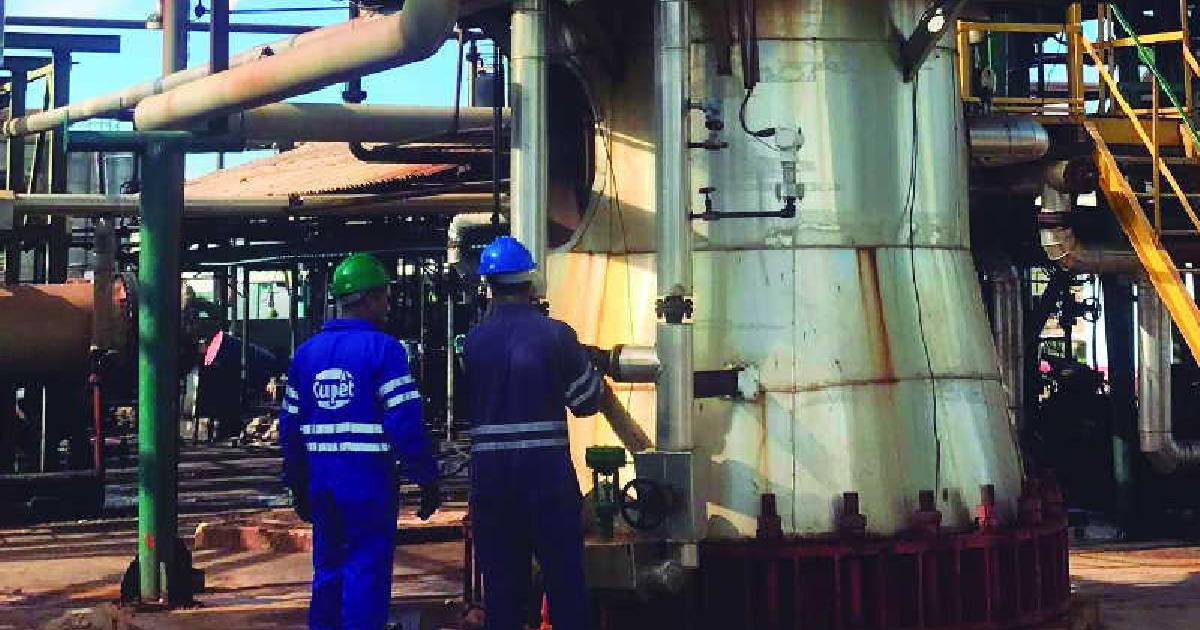
The Sergio Soto refinery in Cabaiguán, located in the province of Sancti Spíritus, is striving to sustain its operations by utilizing residual crude oil gathered from the bottom of tanks at the Cienfuegos refinery and the Nico López refinery in Havana. The latter has been out of service since February due to a fire.
This approach, confirmed on Saturday by Yudith Rodríguez, the plant's Director of Accounting and Finance, highlights the severe conditions facing Cuba's oil industry amidst the island's most significant energy crisis in decades.
“We are collecting all the crude left in the tank bottoms of Cienfuegos refinery and Nico López refinery in Havana, which is currently inactive. These residues are being brought here for a rather crude refining process since they come with high sulfur content and viscosity,” Rodríguez stated to Radio Sancti Spíritus.
Challenges in Refining Low-Quality Crude
The raw materials arriving at Cabaiguán are of subpar quality; the residues have an elevated sulfur concentration and viscosity, necessitating a refining process that workers themselves admit is inadequate.
The production plan has been severely unmet. The refinery aimed to process 73,000 tons but has only managed 14,000 so far. Despite this shortfall, the director claimed that the plant remains profitable and operates at 76% capacity due to diversified production methods.
“With only 14,000 tons processed out of a planned 73,000, we manage to maintain profitability. Although we are not meeting the target, we are operating at 76% with diversified production and alternative methods,” Rodríguez explained.
Impact of International Sanctions and Reduced Imports
The plant is working closely with the Ministry of Energy and Mines (Minem) and, according to the management, with the "highest leadership of the country."
Since January, secondary sanctions imposed by the Trump administration through Executive Order 14380 have slashed Cuban oil imports by 80% to 90%.
Following the capture of former President Nicolás Maduro, Venezuela ceased its subsidized oil supply of 25,000 to 35,000 barrels per day, and Mexico halted its shipments.
Cuba's own oil production is a mere 30,000 to 40,000 barrels per day, covering only 40% of a demand that fluctuates between 90,000 and 110,000 barrels daily.
Recently, a donation of 730,000 barrels from Russia provided some relief. The derivatives began distribution on April 19, partially fulfilling national demand for one month.
The Nico López refinery ceased operations on February 13 following a fire in a disused additive warehouse, exacerbating the country's refining capacity issues.
Future Expansion Plans and Production Limitations
The Cienfuegos plant, with a capacity of 150,000 barrels daily, was inactive for about four months before resuming activities with Russian crude.
Since 2010, the Sergio Soto refinery has been processing domestic crude, expanding its capacity from 400 to 600 tons daily by 2026, with plans to reach 1,000 tons per day.
Its products include naphtha, kerosene, gasoline, diesel, fuel oil, and asphalt liquid. However, refining Cuban crude faces structural constraints due to its high sulfur and acidity content.
In April, leader Miguel Díaz-Canel summed up the extent of the collapse with a widely circulated remark: “There is almost no fuel.”
Understanding Cuba's Oil Refining Challenges
Why is the Sergio Soto refinery using residual crude?
The Sergio Soto refinery is utilizing residual crude to maintain production due to the suspension of operations at other refineries and the reduced import of crude oil into Cuba.
What are the main challenges faced by the Cuban oil industry?
Cuba's oil industry is grappling with international sanctions, reduced imports, and a reliance on low-quality domestic crude, which hampers efficient refining.
How has the international community impacted Cuba's oil supply?
Sanctions and geopolitical changes have significantly reduced Cuba's oil imports, with countries like Venezuela and Mexico cutting their supplies.