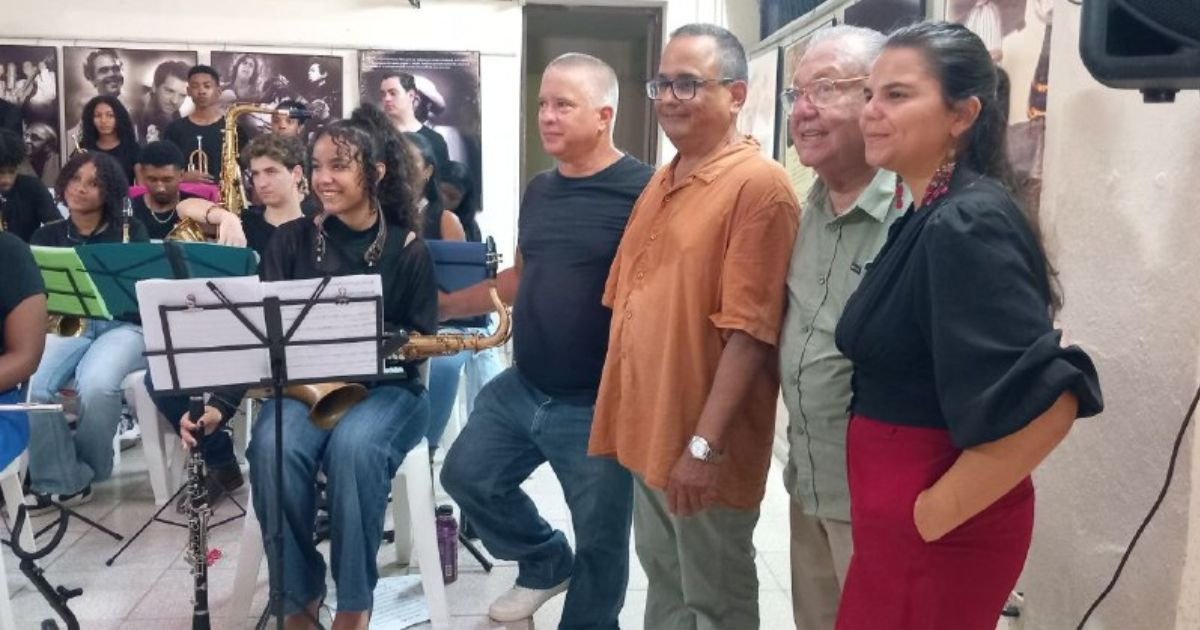
The renowned Mexican composer, playwright, researcher, and cultural advocate, Luis Pérez Sabido, engaged with young musicians from the Jazz Band at the National Museum of Music (MNM) in Cuba on Friday. This event highlighted the rich musical traditions of Cuba and celebrated the longstanding bonds between the Yucatecan artist and the island, as reported by the Cuban News Agency.
Under the direction of musician and educator Enrique Rodríguez Toledo, the ensemble began the meeting with a performance of "La Habana," a piece composed by Pérez Sabido himself. He shared with the audience that this composition was inspired by his deep admiration and affection for Cuba.
The mini-concert featured iconic pieces from the Cuban musical heritage, including "La danza ñáñiga" by maestro Ernesto Lecuona (1895-1963) and "Mata Siguaraya" by Lino Frías (1915-1980). The latter was internationally popularized by the unmistakable voice of Benny Moré (1919-1963), one of Cuba's most legendary artists.
Jazz Band's Artistic Contribution
Rodríguez Toledo explained that the Jazz Band was established on October 4, 2025, as part of the MNM's institutional commitment to nurturing a group composed of young musicians. Their repertoire spans jazz, various Cuban music styles, and international works, showcasing the diversity of their musical education.
Following the performance, Pérez Sabido praised the young musicians for their involvement, underscoring the significance of such cultural engagement amid Cuba's severe economic and social crisis, which has led to widespread emigration, including among young artists and musicians.
Pérez Sabido's Cultural Legacy
Pérez Sabido's visit coincides with his celebration of seven decades of artistic and cultural contributions, culminating in 2026. As the Yucatán delegate for the Bolero Institute of Mexico, he played a pivotal role in the bolero's recognition as an Intangible Cultural Heritage of Humanity by UNESCO on December 5, 2023, through a joint bid by Cuba and Mexico.
Cuba declared the bolero as a National Cultural Heritage on August 26, 2021, following Mexico's recognition in 2018. The genre originated in Santiago de Cuba in 1883 and found some of its greatest performers in Mexico.
Pérez Sabido's connections to Cuba are profound and widely acknowledged. The Union of Writers and Artists of Cuba (UNEAC) awarded him the International "Miguel Matamoros" Prize.
Celebrating a Timeless Art
Among his celebrated works, the poem "Yo sé que volverás," which he wrote and was set to music by his dear friend Armando Manzanero, became a worldwide hit performed by Luis Miguel. This song's legacy was honored at the "Yo sé que volverás. Tribute to Manzanero in Cuba" concert held in June 2025 at the Avellaneda Hall of Cuba's National Theater, organized by the Cuban Ministry of Culture and the Mexican government, featuring prominent musicians from both countries.
Exploring Cuban and Mexican Cultural Connections
Who is Luis Pérez Sabido?
Luis Pérez Sabido is a Mexican composer, playwright, researcher, and cultural promoter known for his significant contributions to the arts and his deep connections with Cuban culture.
What is the significance of the Jazz Band at the National Museum of Music?
The Jazz Band was established to nurture young musicians and provide a platform to explore a diverse repertoire, including jazz and Cuban music, reflecting the institution's commitment to cultural education.
How did the bolero become recognized as an Intangible Cultural Heritage?
The bolero was recognized as an Intangible Cultural Heritage by UNESCO on December 5, 2023, through a collaborative effort by Cuba and Mexico, highlighting the genre's cultural significance and shared history.