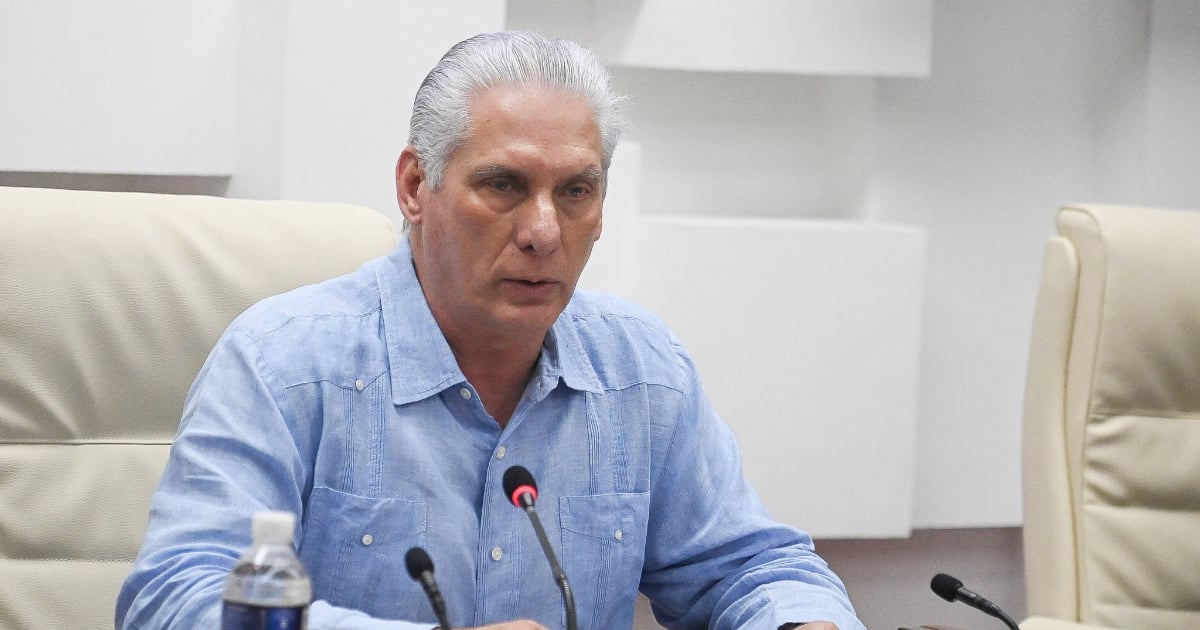
This week, Miguel Díaz-Canel responded to the growing wave of cacerolazos—the sound of banging pots and pans—resonating across Cuba with a statement that encapsulates the regime's strategy amid the island's most severe energy crisis. Instead of accepting responsibility, he redirected the public's frustration toward the United States.
"People are banging pots, some more angrily than others. I say: well, bang your pots at our northern neighbors, as they are the ones keeping us in the dark," he stated during an interview with CLARIDAD, a Puerto Rican weekly, published on July 3.
The conversation took place at the Palace of the Revolution in Havana. CLARIDAD, an independent Puerto Rican weekly founded in 1959 and traditionally aligned with the Cuban regime, was granted privileged access to the leader, which explains the sympathetic tone of the questions.
During the interview, Díaz-Canel acknowledged the extent of the collapse affecting the population: "There is a shortage of transportation, food, and medicine here; there are prolonged blackouts lasting more than twenty hours. This causes dissatisfaction; no one can be happy; the people are suffering." Nevertheless, he attributed the entire crisis to the U.S. embargo, dismissing the regime's mismanagement as a contributing factor.
"I tell you, most of our people know the root of our problems, and they know it's not primarily due to poor management, as the imperialist mouthpieces try to blame us... the main obstacle to our development is the prolonged blockade and its intensification," he claimed.
Redirecting the Focus
Díaz-Canel's remarks about banging pots came when a CLARIDAD journalist inquired why there hasn't been a social upheaval in Cuba.
His response reframed the daily struggles of millions of Cubans as anti-imperialist rhetoric, overlooking the fact that it is the regime's policies—such as reliance on Venezuelan oil, the decay of the electrical system, and decades of poor governance—that have driven the nation to collapse.
The electricity generation deficit reached an all-time high of 2,208 MW on June 25, leaving nearly 70% of the country without power. Nine of the 16 thermoelectric units are out of service, including the Antonio Guiteras Power Plant—the largest on the island—which suffered its 17th breakdown in 2026 on the same day the interview was published. The Economic Commission for Latin America and the Caribbean (ECLAC) projects a 6.5% contraction of the Cuban GDP in 2026, the worst in Latin America.
Public Outcry and Government Reaction
While Díaz-Canel spoke to a sympathetic outlet, Cubans in Zamora, Marianao, protested after more than 24 hours without electricity, chanting "Freedom!" A resident of the neighborhood, Zea Gisselle, succinctly put it: "They have fuel to patrol and repress the neighborhood, but not to maintain basic services for the country."
The regime's response to the cacerolazos was to militarize the streets: armed black berets, police operations, and internet shutdowns. In June, Cubalex documented at least 38 arrests, including six minors. The Cuban Conflict Observatory recorded 1,311 protests in May 2026 alone, the highest monthly figure on record, following 1,133 in April.
Santiago de Cuba also echoed with cacerolazos in neighborhoods like Municipal, Santa Úrsula, Hoyo de Chicharrones, and Portuondo, while residents of El Vedado, El Cerro, and Regla took to the streets with the demand: "We want to sleep with lights on; we want to live like people."
The leader concluded the interview with his usual rhetoric of resilience: "I am convinced that we will overcome this, that we will move forward, that we will succeed, and that we will not surrender. We will not give up."
For the millions of Cubans who have endured months without electricity, water, or food, this promise increasingly rings hollow.
Understanding Cuba's Energy Crisis
What is causing the current energy crisis in Cuba?
The energy crisis in Cuba is primarily caused by a combination of the regime's reliance on Venezuelan oil, deterioration of the electrical infrastructure, and decades of mismanagement, compounded by external factors like the U.S. embargo.
How has the Cuban government responded to the protests?
The Cuban government has responded to protests with increased militarization, including deploying armed forces, conducting police operations, and restricting internet access. Numerous arrests have been documented, including those of minors.