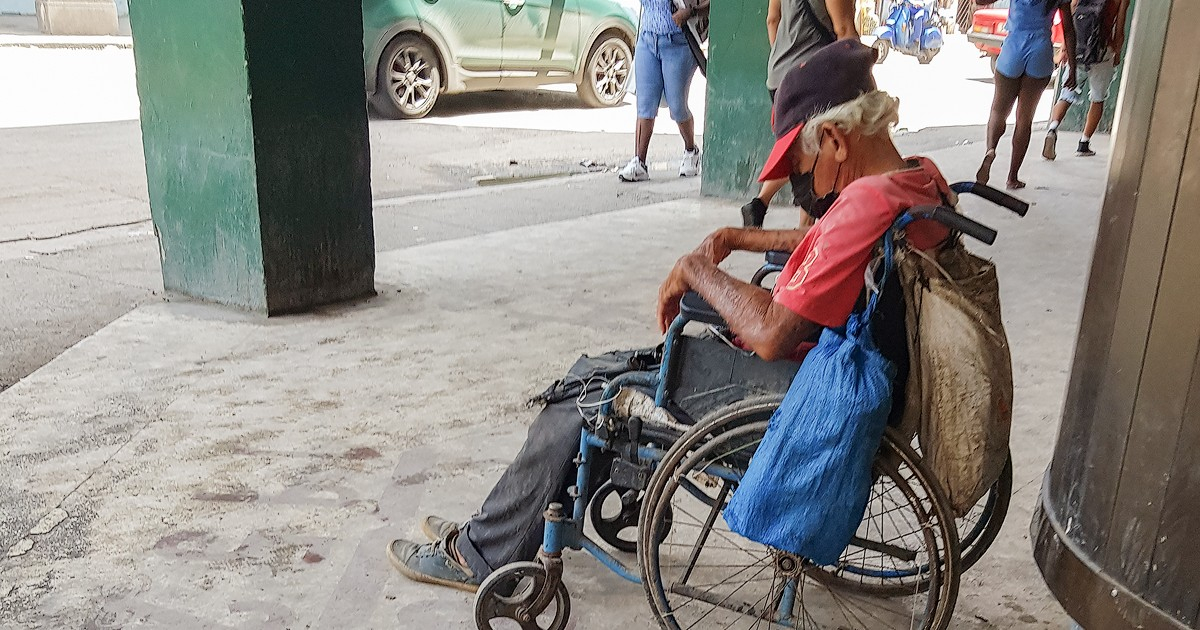
Cuban poet Jorje Luis Mederos, known as Veleta, unveiled a haunting sonnet on Thursday, reflecting the dire circumstances of the island. In fourteen poignant lines directed at José Martí, Mederos expresses the shame of surviving in a Cuba devoid of light, bread, and future prospects.
The poem calls upon Martí, the Apostle of Independence, using his full name—José Julián Martí Pérez—as a moral interlocutor. Here, the poet confesses his guilt for existing under a system that betrays everything Martí stood for.
Born in Santa Clara in 1963, Mederos crafts the sonnet as a three-part confession, each stanza beginning with the phrase: "What shame I feel." The first quatrain delivers a material and direct indictment: "living like a traitor in your sight / and thriving on these remnants / with light blinded and bread inflated."
The second quatrain transforms this shame into an existential burden: "to survive defeated, / I, who wagered everything on an impossible: / to be just another Cuban, a disposable tool / in hands of neglect and oblivion."
The third stanza strikes with an image of personal surrender: "having neither dreams nor future, / secretly chewing my hard bread / and yoking myself with a tranquil soul."
However, it is the final line that encapsulates the historical weight of the text: "I was the New Man, now I am the goal / of the Dead Man and a dark country."
The Transformation of Ideals
The reference to the "New Man" is not merely decorative. This concept was articulated by Ernesto "Che" Guevara in his essay "Socialism and Man in Cuba" (1965), envisioning an anthropological project of the revolution: to create a human driven by collective solidarity, not personal gain. For decades, it justified the material sacrifices of entire generations. Veleta deftly reverses this: the individual shaped as the "New Man" has now become the "Dead Man," undone by the very system that promised to forge him.
The lines "with light blinded and bread inflated" are not metaphorical; they are a literal portrayal of Cuba in 2026. The electrical deficit has repeatedly exceeded 2,000 MW in May, June, and early July, with blackouts lasting over 24 hours. Meanwhile, rice prices have soared past 400 pesos per pound in the informal market, against state salaries that barely reach 7,000 pesos monthly. A recent survey in May revealed that 33.9% of households reported at least one person going to bed hungry in the previous 30 days, and a staggering 89% of the population lives in extreme poverty.
Resonance and Reaction
This sonnet is part of a poetic cycle on Cuba's collapse that Veleta has been developing for months. In April, he published "A Country Where Poets Escape" and "I Don't Want My Country Bombed"; in May, "Four Simple Steps to Kill a Man."
The reaction on social media was swift. Writers, intellectuals, and citizens responded with expressions ranging from admiration to sorrow. A well-known writer remarked, "I am not mistaken, you are the voice of a dying people." A philosopher and activist summed up her reading in one word: "Devastating." Another poet deemed it "Unsurpassable."
One commentator noted that "the 'new man' died before he was born" and observed that "poetry feeds on the most cruel times and acute crises." Meanwhile, a reader offered a more hopeful interpretation: "What shame and what pain; but there is an error, poet, your soul is not yoked in stillness; it flutters, attacks, challenges, and clings to your verses like a liberating machete."
Another voice among the readers stated simply: "The Homeland is in your verses, hugs poet, all we have left is hope."
Understanding the Poetic Reflection on Cuba's Crisis
What is the significance of the "New Man" concept in the sonnet?
The "New Man" is a concept introduced by Ernesto "Che" Guevara as part of the revolutionary effort to create individuals motivated by collective good rather than personal interests. In the sonnet, this ideal is inverted to reflect the failure of the system, transforming the "New Man" into the "Dead Man."
How does the poem reflect the current situation in Cuba?
The poem highlights the harsh realities of life in Cuba, such as severe electricity shortages and inflated food prices, symbolizing broader systemic failures and the struggle for survival faced by many Cubans.