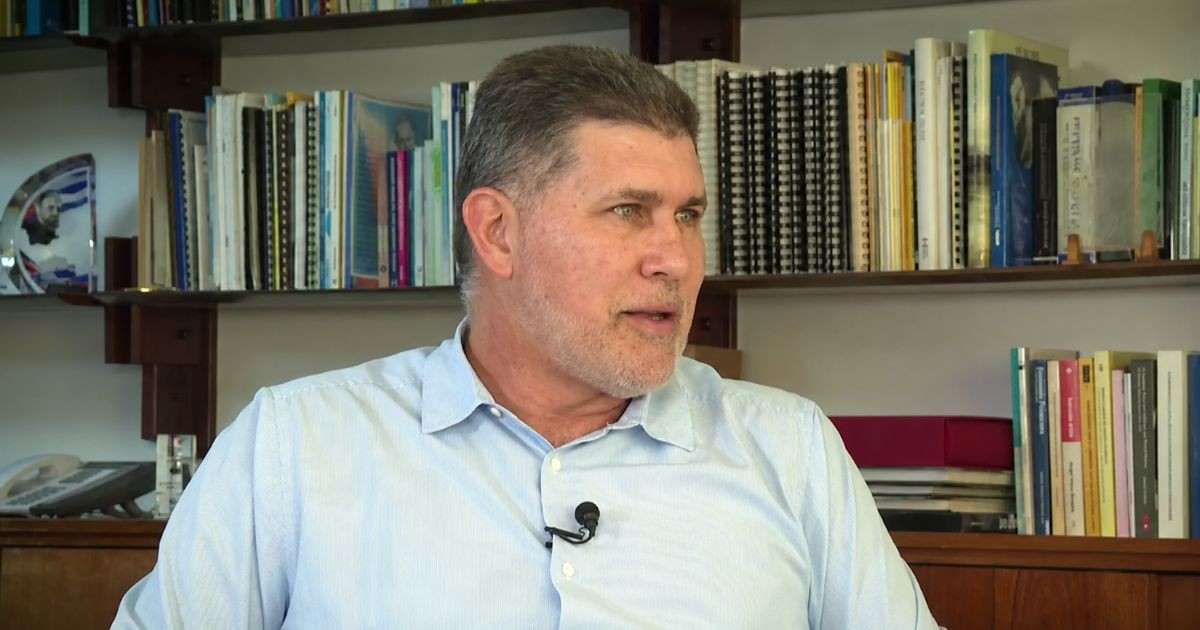
On Friday, Cuban Vice Prime Minister Óscar Pérez-Oliva Fraga staunchly defended the new economic reform package approved by the National Assembly, dismissing claims that the measures are a response to pressure from Washington. In an interview with journalist Juan Carlos López on CNN, he made his position clear.
"All the transformations we are undertaking, which would have been unimaginable in our country a few years ago, are fully supported by law and the Constitution of the Republic of Cuba. These changes are not driven by any external pressure but by the Cuban government's commitment to enhancing the well-being of our people," the official emphasized.
This stance contrasts sharply with the perspective of the Trump administration. The State Department described the measures as "modest, long-awaited, and ultimately superficial gestures."
In June, the National Assembly approved 176 measures grouped into 23 key areas. These include allowing both domestic and foreign legal entities to buy shares in state companies, opening up real estate development in tourist zones, enabling direct export by private individuals, and permitting investment from Cubans living abroad.
Strategic Reforms, Not Impulsive Decisions
Pérez-Oliva Fraga reiterated that these reforms are part of a pre-planned strategy rather than hasty decisions: "These transformations stem from our government's economic and social program, which complements these changes perfectly and aims to create a different dynamism in the economy."
Addressing foreign investors' distrust, the official acknowledged the issue but promised new assurances: "We aim to create a welcoming environment, provide legal security with simplified procedures, and above all, ensure transparency to build trust with foreign investors."
Challenges and Criticisms
Political analyst José Azel, also interviewed by CNN, expressed skepticism: "Cuba needs foreign investment and capital, but that capital simply won't materialize without much stronger guarantees than those currently offered by the Cuban government."
The official also backed the partial removal of universal subsidies, labeling them as "unfair," and admitted that the process requires a profound cultural shift: "One of the fundamental elements is the change in mindset, which is the most complex."
Energy Crisis and Economic Dependency
In terms of energy, Pérez-Oliva Fraga acknowledged a dire situation: "It is well known that our country is receiving fuel in containers, an unsustainable supply system for an economy."
After losing Venezuela as its main oil supplier following Nicolás Maduro's capture, Washington's pressure on third countries has prevented others from reliably filling this gap.
A day earlier, the same official accused the United States at the Cuban Chamber of Commerce of attempting to impose a "forced economic dependency" on the island, a message likely to shape the regime's approach to the international community.
This coordinated message—echoed by Díaz-Canel and Pérez-Oliva Fraga across multiple platforms since the reform package's approval—comes as the Cuban economy has shrunk by 23% to 26% since 2019, with the Economic Commission for Latin America and the Caribbean (CEPAL) forecasting a 6.5% GDP contraction by 2026, the region's worst for the second consecutive year.
The Trump administration responded to the regime's reforms with a fresh round of sanctions on June 23, targeting five entities linked to GAESA, including the Banco Financiero Internacional and Almacenes Universales S.A., signaling that Washington finds the announced changes in Havana insufficient.
Understanding Cuba's Economic Reforms
What are the key components of Cuba's recent economic reforms?
The reform package includes measures such as allowing domestic and foreign entities to acquire shares in state companies, promoting real estate development in tourist areas, enabling direct exports by private individuals, and permitting investment from Cubans residing abroad.
How has the international community reacted to Cuba's economic reforms?
While Cuba insists the reforms are internally driven, the Trump administration has labeled them as modest and superficial. The U.S. responded with additional sanctions, indicating skepticism about Havana's changes.
What are the main challenges facing Cuba's economy?
Cuba faces significant economic challenges, including a critical energy situation due to disrupted fuel supplies and a forecasted GDP contraction, exacerbated by a lack of strong foreign investment guarantees.