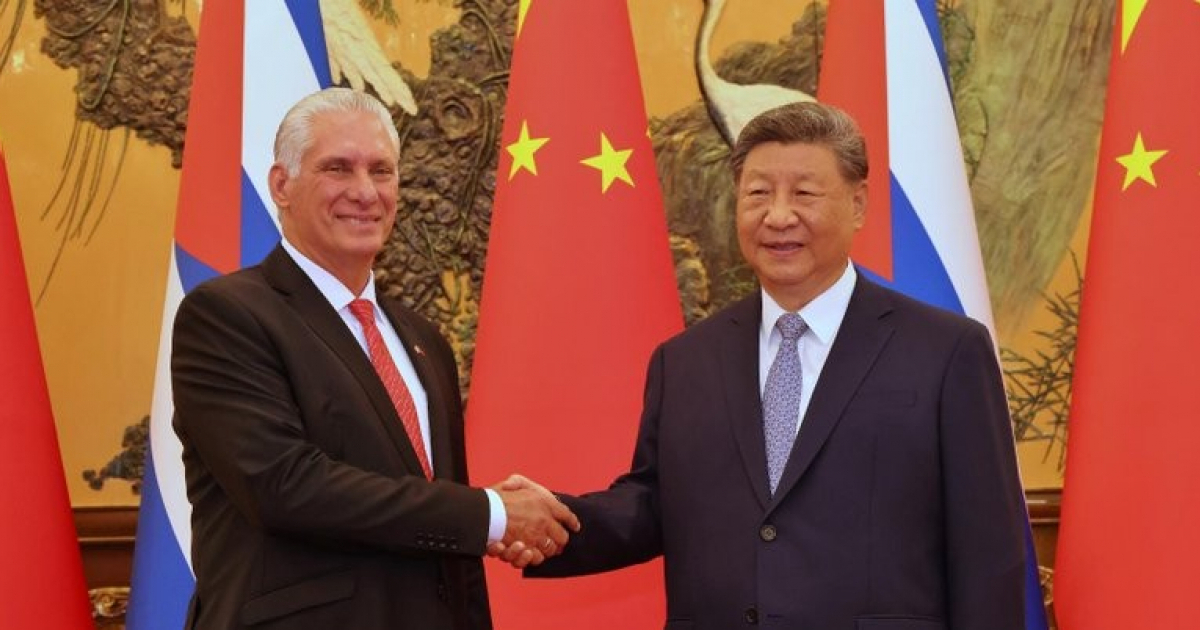
In an interview with Sky News, recorded in Havana and conducted by journalist Yalda Hakim, Cuban leader Miguel Díaz-Canel firmly dismissed claims of Chinese or Russian military bases on the island. The conversation, which took place on Wednesday, comes amid heightened tensions between Cuba and Washington not seen in decades.
When questioned about satellite images that the U.S. government claims show Chinese and Russian surveillance installations on Cuban soil, Díaz-Canel responded decisively: "These constructions are based on manipulation and lies. Can they show where the bases are? There are no Chinese bases in Cuba. We have stated this many times."
Blaming Media and Social Media Algorithms
Díaz-Canel attributed the narrative to the media and social media algorithms, which he accused of being "subordinated to the interests of U.S. politics." He argued that this subordination prevents "voices from the global south, developing countries, and particularly a small nation like Cuba, from being heard."
However, the Cuban leader's denial contrasts with documented evidence from independent organizations. The Center for Strategic and International Studies (CSIS) identified four active signal intelligence sites linked to China in Cuba: Bejucal, El Salao, Wajay, and Calabazar.
Independent Reports Highlight Intelligence Activity
Satelite images from June 2026, also by CSIS, confirmed the completion of a new 32-element intercept antenna in Bejucal, described as the largest ever observed on the island and "very likely already operational." The activity at Bejucal adds to what Secretary of State Marco Rubio told the Senate on June 2: "Cuba continues to host a fairly substantial collection of intelligence sites on behalf of China and Russia."
The Wall Street Journal also reported that both powers have nearly tripled their intelligence personnel on the island since 2023.
Broader Implications of the Interview
The Sky News interview also touched on other issues in the bilateral crisis. Díaz-Canel reiterated that Cuba "does not want war, but is not afraid of it," and declared his willingness to "fight to the last drop of blood" to defend the nation's sovereignty. This was in direct response to threats from President Donald Trump, who stated in North Dakota that Cuba "after many, many decades, is coming into our orbit."
The Cuban leader further mentioned the death of 32 Cubans defending Nicolás Maduro during a U.S. military operation in Venezuela, citing them as an example of the island's resolve against potential aggression.
In addition, he rejected accusations of political prisoners and denied that Cuba is a failed state, blaming the U.S. embargo—which he described as "genocidal"—for the energy crisis and medicine shortages.
Possibility of Dialogue with Washington
Regarding the potential for dialogue with Washington, Díaz-Canel acknowledged the possibility but pointed out the high level of distrust following U.S. attacks on Venezuela and Iran while both countries were engaged in negotiations with the United States. He conditioned any talks on respect for Cuban sovereignty and the absence of preconditions.
The immediate context of the interview includes the deployment of the USS Nimitz aircraft carrier in the Caribbean on May 20, more than 240 sanctions imposed by the Trump administration since January 2026, and Cuba's call for an extraordinary session of the UN General Assembly on July 7, where the regime plans to denounce the tightening of coercive measures.
Understanding the Alleged Chinese Bases in Cuba
What evidence supports the existence of Chinese bases in Cuba?
According to the Center for Strategic and International Studies (CSIS), there are four active signal intelligence sites linked to China in Cuba, with satellite images confirming the construction of a new intercept antenna in Bejucal.
How has the Cuban government responded to these claims?
The Cuban government, led by Miguel Díaz-Canel, has categorically denied the presence of Chinese military bases, calling the allegations manipulative and false.
What impact do these allegations have on U.S.-Cuba relations?
These allegations exacerbate already strained U.S.-Cuba relations, contributing to heightened tensions and complicating diplomatic dialogue.