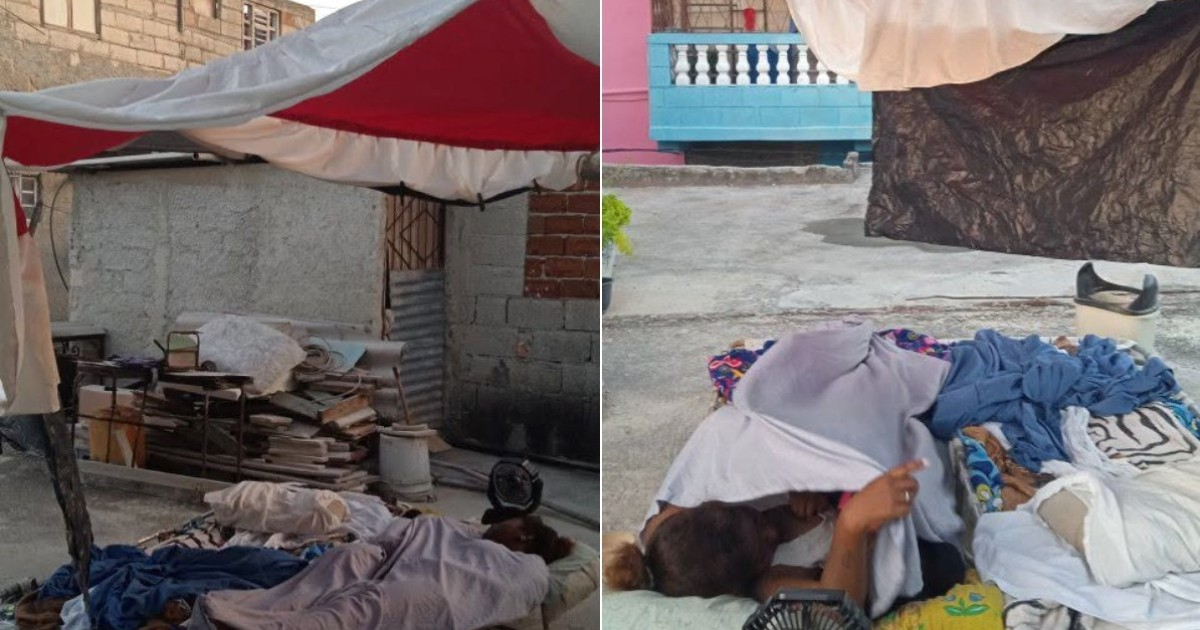
A resident from Cerro, a municipality in Havana, shared on Facebook the harsh living conditions her family has endured due to more than a week of continuous power outages: unable to take insulin, lacking access to clean water, and her daughter suffering from mosquito bites after sleeping outdoors on their home's rooftop.
Odalis Acosta Calderón, living in block 1 on Vigía Street, expressed her plight directly on the Havana Electric Company's page, where her post garnered thousands of reactions.
"We've been sleeping on the rooftop of my house for over a week. The photo is from this morning, packing up our makeshift camp. I can't take my insulin, my daughter is covered in mosquito bites, and we have no potable water because I rely on electricity to run the motor, as my tanks are elevated," she wrote.
The Widespread Impact of Power Shortages
Odalis detailed that the day before her post, electricity was restored at 3:30 in the afternoon and cut off again by 5:50, barely two hours and twenty minutes of service. "There's nothing we can do," she lamented.
Her complaint is far from isolated.
In the comments of her post, another resident from Old Havana shared: "I'm in the same situation, I've been sleeping on the rooftop for seven days, with mosquitoes swarming my daughter who's covered in bites, and no rechargeable fan; imagine, they're very expensive."
From Holguín, a user noted that many people are sleeping on porches and cooking with wood.
Another person recounted camping on their balcony with their family for over a month.
The Severity of the Power Crisis
Cerro is part of Havana's block 6, which on July 2 accumulated 24 hours and 35 minutes without electricity, according to state data. That day, the provincial Electric Company disconnected numerous circuits due to a "national generation emergency," with a shortfall of 2,100 MW against a demand of 3,200 MW.
Comments expressed strong indignation toward the regime's rhetoric.
Miguel Díaz-Canel coined the term "creative resistance" to describe how doctors and workers handle the blackouts. The public's response was clear: "The big dilemma is that those demanding creative resistance aren't enduring what the majority of the population is. To think like the people, you must live like the people; everything else is just rhetoric."
Public Outrage and Government Response
Some comments were more blunt: "It's inhumane to endure without power, water, or food amid these outages, forcing people to sleep in the street, patio, rooftop, balcony, or wherever they can to get some rest." Another person said: "It's a massacre without weapons against the Cuban people."
Odalis bitterly summarized the feelings of millions of Cubans: "When I hear a leader say we must resist, if curses existed, they wouldn't be in power anymore."
Cuba's electrical crisis in 2026 is the most severe in its recent history. The National Electric System operates with merely 1,100 MW available against a demand of 3,200 MW, leaving between 65% and 70% of the country without simultaneous power. In Matanzas, outages have lasted up to 87 consecutive hours, while in Havana, blackouts average over 30 hours for more than a month.
Even Díaz-Canel acknowledged on June 12 before the Communist Party that "resistance alone isn't enough" and that there are "obstacles that don't stem from the blockade," yet offered no concrete solutions.
Meanwhile, residents of La Lisa protested outside the PCC headquarters after more than 50 hours without electricity, and people in Regla took to the streets on Thursday after over 24 hours without power.
Understanding Cuba's Power Outage Crisis
What are the main causes of the power outages in Cuba?
The power outages in Cuba are primarily due to a significant deficit in electricity generation, with the National Electric System operating at a much lower capacity than required to meet demand.
How are Cuban families coping with the power cuts?
Many Cuban families are resorting to sleeping outdoors on rooftops or balconies to escape the heat, cooking with wood, and dealing with a lack of essential utilities like water and electricity.
What has been the public's response to the government's handling of the crisis?
The public has expressed strong dissatisfaction and criticism toward the government's handling of the crisis, particularly regarding the lack of effective solutions and the perceived disconnect between the leaders and the population's hardships.