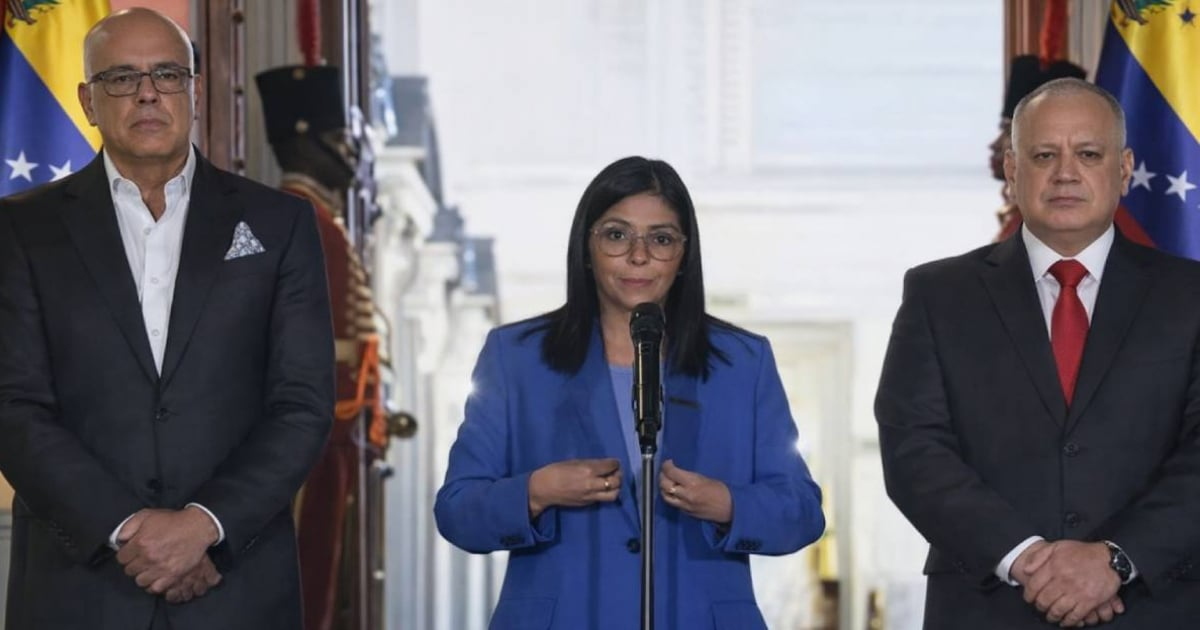
Delcy Rodríguez, acting president of Venezuela, announced on Thursday that her administration is in discussions with the United States Department of State and the International Monetary Fund (IMF) to reclaim resources aimed at rebuilding infrastructure devastated by the catastrophic earthquakes on June 24.
This announcement marks an unprecedented diplomatic shift for the Chávez regime, which has historically been opposed to U.S. involvement and the terms set by the IMF.
In 2019, Venezuela severed operational ties with the IMF after being denied access to $400 million in special drawing rights.
During a press conference, Rodríguez also mentioned that the Inter-American Development Bank and the World Bank have already offered non-repayable aid to assist with the recovery process, in addition to credit lines for the nation.
The interim government has established an initial fund equivalent to $200 million and opened an account at CAF-Development Bank of Latin America and the Caribbean to receive international donations for housing, with "all audit mechanisms in place," according to Rodríguez.
Rodríguez further reported the recent arrival of an Israeli team described as "highly specialized and professional" to assess the condition of damaged structures and support infrastructure recovery.
The official toll as of Thursday recorded at least 2,595 fatalities and 12,400 injuries, with 855 buildings impacted by the seismic events.
However, these figures contrast sharply with much more alarming international estimates: the United States Geological Survey (USGS) projected a 42% probability that the final death toll could range between 10,000 and 100,000 individuals, while the UN estimates up to 50,000 people might be trapped under debris.
NASA reported approximately 59,000 buildings either damaged or destroyed, and the United Nations Development Program (UNDP) estimates the damage to homes and economic assets at $6.7 billion, roughly 6% of Venezuela's GDP, based on a satellite assessment.
According to the government, about 12,800 people have lost their homes, although the UN Refugee Agency (UNHCR) documents 16,000 citizens who have sought alternative shelter.
The seismic doublet, with magnitudes of 7.2 and 7.5, occurred just 39 seconds apart in the state of Yaracuy, near the epicenters of San Felipe and Morón, marking the strongest earthquakes recorded in Venezuela since 1900.
The hardest-hit areas include La Guaira, Caracas, and the Capital District.
This outreach to Washington and the IMF arises in a unique political context: Nicolás Maduro was captured in January 2026, and Rodríguez's interim government gained international recognition in April of the same year, significantly altering Venezuela's relations with the West.
Brazil's Defense Minister, José Múcio, visited Venezuela on Tuesday to enhance humanitarian cooperation and explore potential initiatives related to infrastructure and housing reconstruction.
Key Questions about Venezuela's Post-Earthquake Reconstruction
What is the significance of Venezuela's talks with the U.S. and IMF?
These discussions mark a significant diplomatic shift as Venezuela seeks international aid to rebuild after devastating earthquakes, indicating a temporary relaxation of its historically anti-U.S. and anti-IMF stance.
How extensive was the damage caused by the earthquakes in Venezuela?
The earthquakes resulted in at least 2,595 deaths, 12,400 injuries, and significant structural damage, with the UN estimating up to 50,000 people potentially trapped under debris and economic damages reaching $6.7 billion.
What international support has Venezuela received for its recovery efforts?
Venezuela has received offers of non-repayable aid from the Inter-American Development Bank and the World Bank, as well as assistance from a specialized Israeli team to assess damaged infrastructure.