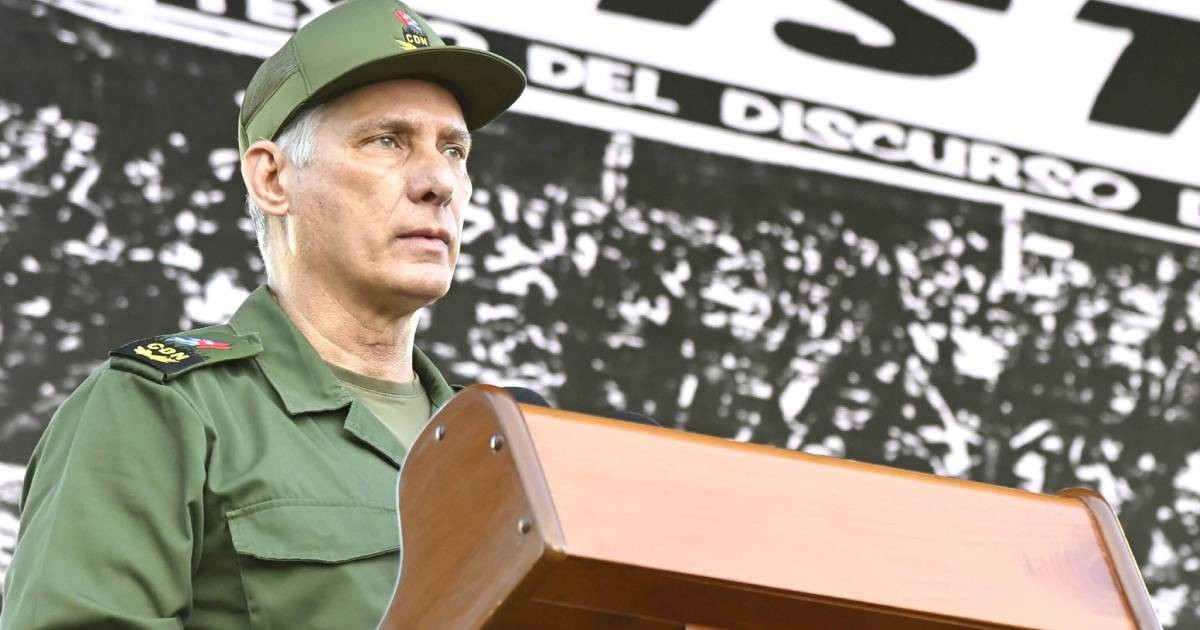
In an exclusive interview with Yalda Hakim from the British channel Sky News, recorded in Havana, Miguel Díaz-Canel responded directly to recent remarks made by U.S. President Donald Trump regarding Cuba.
This exchange took place a day after Trump claimed in North Dakota that Cuba is "coming to us after many, many decades," during a speech at the inauguration of the Theodore Roosevelt Presidential Library in Medora.
Díaz-Canel firmly rejected these comments, asserting that the island poses no threat to anyone: "We are a peaceful country. We are not a threat to anyone. We offer a great deal of solidarity to the world. Cuba is not a nation in conflict. We are not a colony. We will not surrender our sovereignty or our independence."
The Cuban leader described the ongoing pressure from Washington as a psychological warfare operation: "The threats, the constant rhetoric about an attack against our country by the U.S. government, the almost daily expressions that are part of a strategy of media poisoning and psychological warfare to frighten our nation and destabilize our society, are an outrage and an affront to the dignity of our people."
His most forceful statement summarized the regime's stance on the possibility of conflict: "We do not want war, but we are not afraid of it. And we are preparing so that we are neither caught off guard nor defeated."
Trump's Military Actions: A Cause for Concern?
Hakim reminded Díaz-Canel of Trump's military actions against other nations like Venezuela and Iran and asked whether he took the prospect of intervention in Cuba seriously.
The Cuban leader responded unequivocally: "We are ready to fight to the last drop of blood to defend our rights, our independence, our sovereignty, and our achievements."
On the credibility of Trump's administration, he was equally blunt: "I believe the current representatives of the U.S. government have been telling many lies. They have significantly manipulated international public opinion."
Díaz-Canel mentioned there are "possibilities for dialogue," though he cautioned that Cuba's trust in Washington is minimal following Trump's actions in Venezuela and Iran, as Hakim noted on her social media.
Preparing for Possible Aggression
Cuban Foreign Minister Bruno Rodríguez echoed Díaz-Canel's sentiments, stating: "Of course, any threat must be taken seriously, and that is why we prepare to defend our independence and sovereignty in case of aggression, but we will only act in legitimate defense."
The interview occurs amidst the highest tension between the two nations in decades. Since January, the Trump administration has imposed over 240 sanctions on Cuba, including personal ones against Díaz-Canel, his wife Lis Cuesta, and Colonel Alejandro Castro Espín.
Additionally, the U.S. has maintained a substantial naval presence in the Caribbean, with the aircraft carrier strike group USS Nimitz and the USS Kearsarge carrying about 2,500 Marines, along with amphibious ships relocated off Cuba's northern coast since January.
Cuba's Economic Struggles Amid Sanctions
The sanctions have slashed the island's energy imports by 80% to 90%, leading to power outages lasting up to 35 hours daily and a projected economic contraction of between -6.5% and -7.2% by 2026, directly impacting the daily lives of Cubans.
This is Díaz-Canel's second major international interview in 2026 and the first with a European outlet. The previous one was with Kristen Welker of NBC News on April 9, marking the first appearance of a Cuban leader on U.S. television since 1959.
Cuba has called for an extraordinary session of the U.N. General Assembly on July 7 to denounce the tightening of the U.S. embargo.
Understanding Cuba-U.S. Relations
What is the current state of U.S.-Cuba relations?
The relationship between the United States and Cuba is highly strained, with recent U.S. sanctions exacerbating tensions. The Cuban government views these actions as aggressive and detrimental to their sovereignty.
How have U.S. sanctions impacted Cuba’s economy?
U.S. sanctions have severely limited Cuba's energy imports, causing widespread power outages and contributing to a significant economic downturn projected for the coming years.