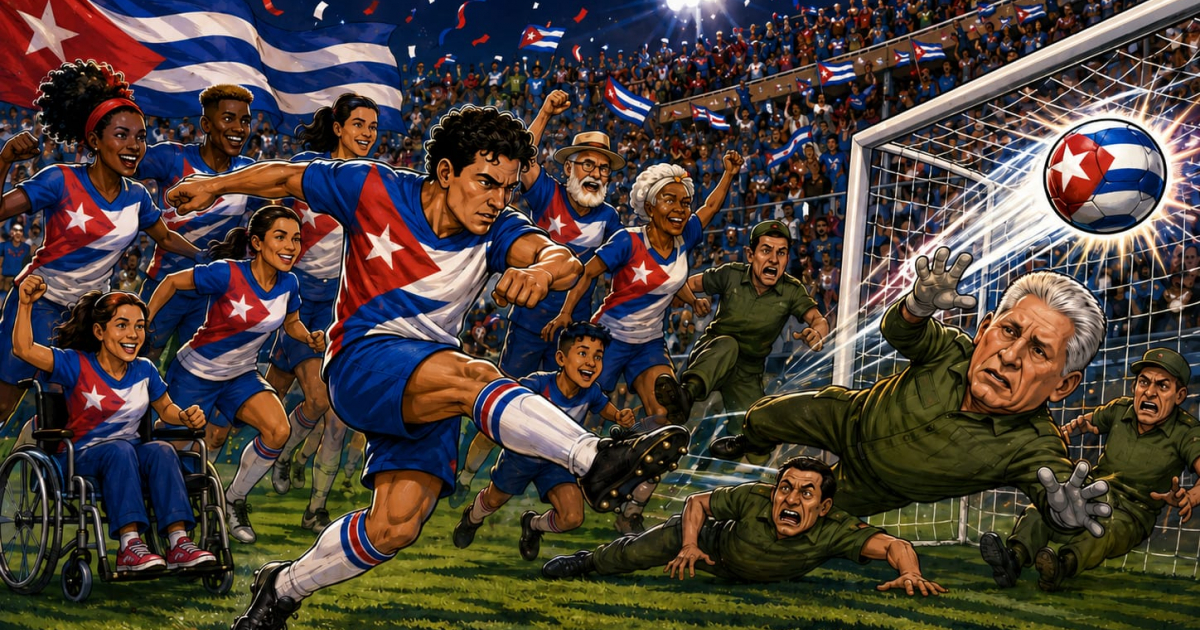
On December 3, 2025, Real Madrid faced off against Athletic de Bilbao. The second goal of the match was set in motion by a steal from Federico Valverde, culminating in a cross by Trent Alexander-Arnold, a header assist from Kylian Mbappé, and the final header by Eduardo Camavinga. In a span of just 41 seconds, the team executed 15 passes involving nine players. This exemplifies teamwork, and victory is achieved when a team plays in harmony.
The ongoing World Cup in North America offers a compelling metaphor for understanding one of the biggest challenges facing the Cuban struggle for freedom.
The Essence of a Winning Team
The team that ultimately lifts the Cup won't necessarily be the one with the most stars or the top scorer. It will be the team that has mastered preparation, training, mutual understanding, coordination, and playing as a cohesive unit.
A championship team consists of forwards who know when to break free, midfielders who discern when to quicken the pace or hold the ball, defenders who cover spaces, and a goalkeeper who trusts those in front of them. Each player is aware of their role, respects the position where they can contribute the most, and understands that collective success outweighs individual glory.
Leadership and Coordination: Keys to Success
No team can win a World Cup if its members only meet on match day or during a press conference. It's insufficient for each player to train individually, regardless of their talent or desire for victory. Without joint training, mutual understanding, coordinated attacks and defenses, and a respected technical direction, defeat is almost certain.
The same is true for nations fighting for their freedom. Cuba needs patriotic, united, committed, selfless, capable, intelligent, and wise leadership. The opposition must go beyond mere public statements, tributes, conferences, or photographs. It requires a structure that works consistently, knows itself, coordinates, allocates responsibilities, and can transform the sacrifices of countless Cubans into an organized and victorious force.
Lessons from History: The Ten Years' War
The Ten Years' War illustrates the costly consequences of lacking unity and discipline. The conflict initiated by Carlos Manuel de Céspedes on October 10, 1868, was one of the greatest epics in Cuban history. Cuba rose against Spanish colonialism, declared independence, established a Republic in Arms, and produced a generation of extraordinary patriots. However, the war concluded in 1878 with the Pact of Zanjón, without achieving its essential goal.
Spain had superior military power, more resources, more weapons, and experienced colonial administration. Yet, Cuba's failure wasn't solely due to the enemy's superiority. Internal divisions, regional rivalries, differences between military leaders and civilian authorities, disputes over authority and strategy, and the lack of coordination between fighters on the island and patriotic groups in exile all deeply influenced the outcome. The dismissal of Carlos Manuel de Céspedes in 1873, amid the war, was a dramatic indication of this lack of cohesion.
There was also a shortage of stable resources. Cuban emigrants made significant sacrifices to raise funds, purchase weapons, and organize expeditions. However, the lack of unity among factions, groups, and leaders weakened the ability to support the fighters within Cuba. A war isn't sustained by courage alone. It requires weapons, food, medicine, communications, discipline, intelligence, logistics, and leadership that can transform limited resources into effective force.
Unity Through the Lens of Global Movements
José Martí understood this lesson better than anyone. Before reigniting the war for independence in 1895, he spent years building the Cuban Revolutionary Party. He knew differences among Cubans were inevitable, but he also realized they couldn't afford to let those differences turn into disunity, rivalry, and defeat.
Today's Cuban opposition faces a similar challenge, albeit in a different setting.
There are men and women of immense courage both inside and outside Cuba: political prisoners, activists, independent journalists, religious figures, artists, human rights defenders, and leaders from a patriotic exile deeply committed to the cause of freedom. Many have endured imprisonment, torture, beatings, surveillance, threats, defamation campaigns, forced exile, and separation from their families. Yet, individual heroism, no matter how great, cannot replace the need for organization.
Cuba's liberation cannot rely on groups that only gather occasionally for international events, public statements, or fleeting visibility opportunities. It cannot depend on individuals acting independently, competing for prominence, or pursuing separate projects without strategic coordination.
A star forward cannot win a World Cup alone. Neither can a great defender. Not even an extraordinary goalkeeper can indefinitely save a team that doesn't play to win. Victory demands a shared strategy, training, and discipline. It requires everyone to perform their best-prepared roles.
The struggles of other nations affirm this truth. Solidarity, in Poland, united workers, intellectuals, Catholics, students, and activists from various currents. It wasn't a movement free of disagreements, but it successfully built organization, representation, and discipline. Lech Wałęsa was chosen as the union leader, and the organization became a national social force capable of resisting communist persecution, negotiating, and paving the way for the 1989 elections and the end of the totalitarian regime.
The African National Congress in South Africa also wasn't free of internal tensions. It brought together different generations, political currents, and social sectors opposed to apartheid. Yet, it managed to maintain a national structure, elect leadership, and sustain a common cause. Nelson Mandela was elected ANC president in 1991, and the organization entered decisive negotiations with legitimacy, discipline, and representation recognized by broad segments of South African society.
The Indian National Congress was another patriotic coalition. It included moderates, radicals, religious and secular figures, reformers, trade unionists, and proponents of various strategies. Gandhi, Nehru, and other leaders didn't always agree. But the movement held congresses, debates, internal elections, and collective decisions. At the Lahore session in 1929, chaired by Jawaharlal Nehru, the Congress adopted complete independence as the central objective of India's struggle.
The lesson is simple: unity doesn't mean everyone thinks the same. It means that, despite differences, all accept rules, respect democratic decisions, and place the common cause above personal ambition.
FAQs on Cuba's Path to Freedom
Why is unity crucial for Cuba's freedom struggle?
Unity is essential because it allows for coordinated efforts, strategic planning, and effective use of resources. Without it, efforts become fragmented and less powerful, making it difficult to achieve common goals.
What historical lesson can Cuba learn from the Ten Years' War?
The Ten Years' War teaches that internal divisions and lack of coordination can greatly hinder a struggle for independence, even against an opponent with superior resources and military power.
How did José Martí's approach differ in the Cuban struggle for independence?
José Martí focused on building a unified party and preparing strategically for the independence struggle, learning from past failures due to disunity and lack of organization.