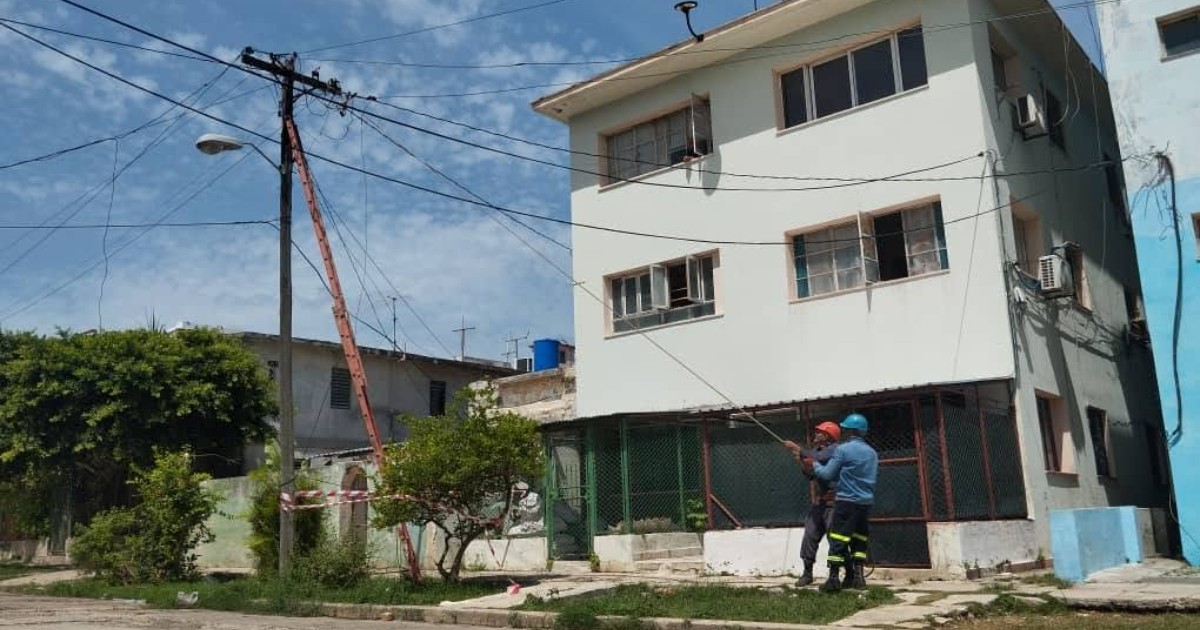
The Electric Company of Havana (EELH) implemented widespread power cuts across the Cuban capital on Wednesday, citing a "national generation emergency." This information was shared via the company's official Telegram channel throughout the day and night.
Initial warnings surfaced at 4:28 PM, when EELH announced disruptions in areas such as Nuevo Santiago, Palmarito, La Encubadora, Los Cocos, Marañón, Rincón, Alturas del Cacahual, La Catalina, La Castellana, Dulce Nombre, and Santa María del Rosario, among others.
By 4:51 PM, the Old Havana Underground Zone also lost power due to the same issue.
Further alerts came at 7:24 PM and 7:25 PM, extending the outages to the Centro Habana Underground Zone and circuits like Camilo Cienfuegos, Villa Panamericana, Monte Barreto, and Naval.
Unplanned Outages and Protective Measures
Alongside the emergency-related cuts, the system experienced at least two instances of Automatic Frequency Load Shedding (DAF). This protective procedure disconnects circuits when network frequency drops below 60 Hz to prevent a total collapse.
The first DAF event at 4:54 PM impacted areas in East Havana, including Alturas de Boca Ciega, Santa María del Mar, and Villa Mégano, as well as San Miguel del Padrón, affecting Martín Pérez, Ciudamar, Carolina, and Alturas de Luyanó.
The second occurrence at 7:30 PM affected various circuits across multiple districts in the capital. EELH reported that service was restored shortly after each incident.
Magnitude of the Power Crisis
At 10:02 PM, the company released an update highlighting the extent of the crisis: 418 MW distributed across six blocks of outages. Block 6 endured 24 hours and 35 minutes without power, Block 5 had 23 hours and 40 minutes, and Block 3 experienced 13 hours and 20 minutes of downtime.
Additional local breakdowns compounded the situation: damaged transformers in Guanabacoa, Lisa, Playa, Arroyo Naranjo, Cerro, Plaza, Marianao, Boyeros, 10 de Octubre, San Miguel del Padrón, and East Havana; a failed cable in Guanabacoa affecting Chivás and sections of Vía Blanca; a broken bridge in Playa; and pending repairs at the Apolo and Cotorro substations.
This crisis unfolds amid the worst energy shortage in Cuba's recent history: on Wednesday, the national generation deficit reached 2,100 MW, with only 1,100 MW available against a demand of 3,200 MW.
The previous day, Cuba experienced 24 straight hours of service disruption, with a peak of 2,211 MW out of service by 10:00 PM, according to the Electric Union (UNE).
The UNE has projected the reintroduction of approximately 400 MW by July through maintenance on six thermal units—Mariel 6, Nuevitas 6, Santa Cruz 3, Renté 5, Renté 6, and Mariel 5—but admits this will not suffice to meet national demand.
Understanding Cuba's Energy Crisis
What caused the power outages in Havana?
The power outages in Havana were due to a national generation emergency, as reported by the Electric Company of Havana, leading to widespread circuit disconnections.
How did the Automatic Frequency Load Shedding (DAF) affect the situation?
The Automatic Frequency Load Shedding (DAF) disconnected circuits when the network frequency dropped below 60 Hz, preventing a complete system collapse but contributing to additional power outages.
What measures are being taken to address the energy crisis in Cuba?
The Electric Union (UNE) plans to reintegrate around 400 MW by July through maintenance on six thermal power units, although this will not fully cover the national demand.