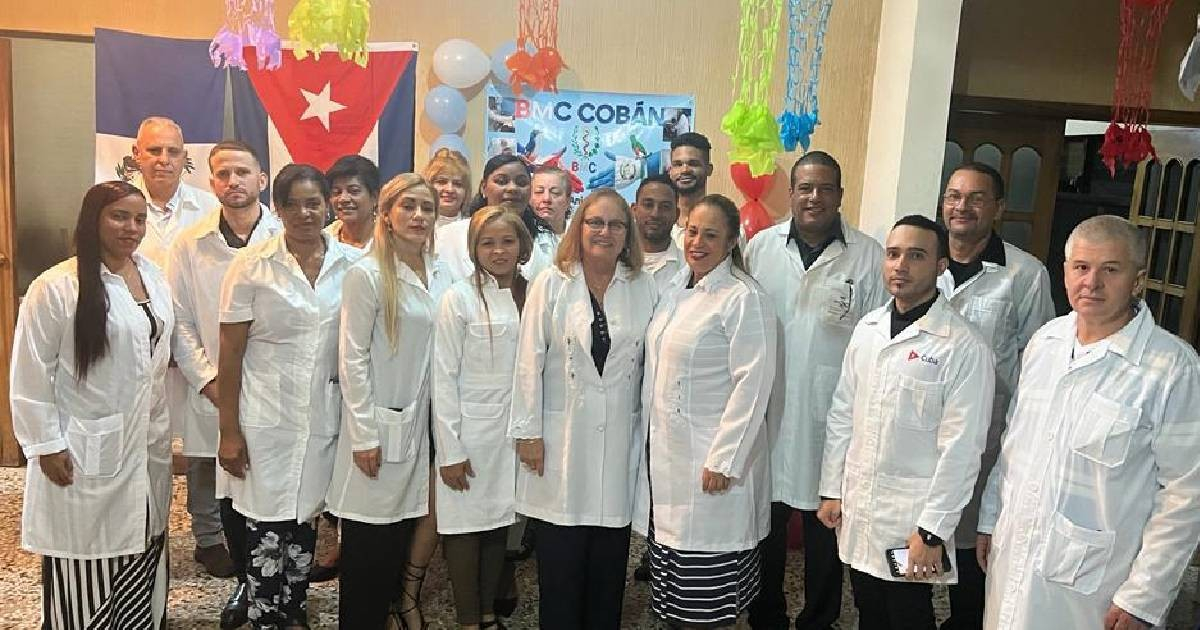
The Cuban regime welcomed back 26 health workers from Guatemala at Havana's José Martí International Airport on Tuesday. The event, steeped in official rhetoric, saw the Ministry of Public Health (MINSAP) express regret over the Guatemalan government's decision to terminate the bilateral agreement.
Deputy Minister of Public Health, Tania Margarita Cruz Hernández, led the reception on behalf of Minister José Ángel Portal Miranda. She used the occasion to criticize Guatemala, stating, "The unilateral decision of the Guatemalan Government will deprive the most vulnerable of their right to health and life," while assuring that the Guatemalan people "can always rely on Cuba's steadfast and selfless support."
The group returning on Tuesday is part of a phased withdrawal that began earlier this year. In March, 172 doctors returned in one of the initial groups, followed by 93 more in April. A second contingent is scheduled to depart in August 2026.
The Long History of Cuban Medical Missions in Guatemala
The Cuban medical mission in Guatemala, which lasted over 27 years, involved more than 11,327 health professionals, according to MINSAP's own figures. The brigade arrived in the Central American country in November 1998 as a humanitarian response to Hurricane Mitch, eventually peaking at around 412 collaborators across 16 of Guatemala's 22 departments.
In February 2026, President Bernardo Arévalo's administration announced the gradual non-renewal of the agreement, just weeks after Guatemala signed a commercial pact with the United States amid pressure from the Trump administration to reduce ties with Havana.
Legal Challenges and International Pressure
Guatemalan authorities also reported over 60 complaints against members of the brigade for practicing medicine without meeting the country's legal requirements.
The welcome ceremony in Havana included the participation of Arelis Marrero Guerrero, Vice Chief of the Department of Social Sector Care of the Communist Party of Cuba's Central Committee, and José Carlos Rodríguez Ruiz, Deputy Director General for Latin America and the Caribbean of the Ministry of Foreign Affairs.
Camagüey physician Edy Jorge Soria Poll spoke on behalf of his colleagues, delivering the expected regime rhetoric: "Behind every white coat lies an invaluable story of humanity, love, and commitment that transcends borders."
Omissions of the Official Narrative
The official event did not address the broader context of these missions. In 2025, the European Parliament passed Amendment 311, labeling Cuban medical brigades as "modern slavery" and "forced labor," highlighting that the Cuban state withholds between 60% and 97.5% of the salaries paid by host countries. The Inter-American Commission on Human Rights raised concerns in April 2026 about practices akin to human trafficking within these missions.
Guatemala is not an isolated case: in 2026, Honduras, Jamaica, and Antigua and Barbuda also canceled their agreements with Cuba, dealing a blow to one of the regime's main sources of foreign currency amid growing international isolation.
Understanding the Cuban Medical Brigade Controversy
What led to the return of Cuban medical personnel from Guatemala?
The Guatemalan government decided not to renew its agreement with Cuba, partly due to pressures to reduce ties with Havana and legal complaints against Cuban doctors practicing without proper credentials.
How has the international community responded to Cuban medical missions?
The European Parliament and the Inter-American Commission on Human Rights have criticized Cuban medical missions, citing concerns of "modern slavery" and "forced labor," with allegations of the Cuban government retaining a significant portion of the doctors' salaries.
What impact does the cancellation of the medical agreements have on Cuba?
The cancellation of these agreements significantly affects Cuba's foreign income, as medical missions are one of the main sources of revenue for the regime. The growing international isolation further exacerbates the economic challenges faced by Cuba.