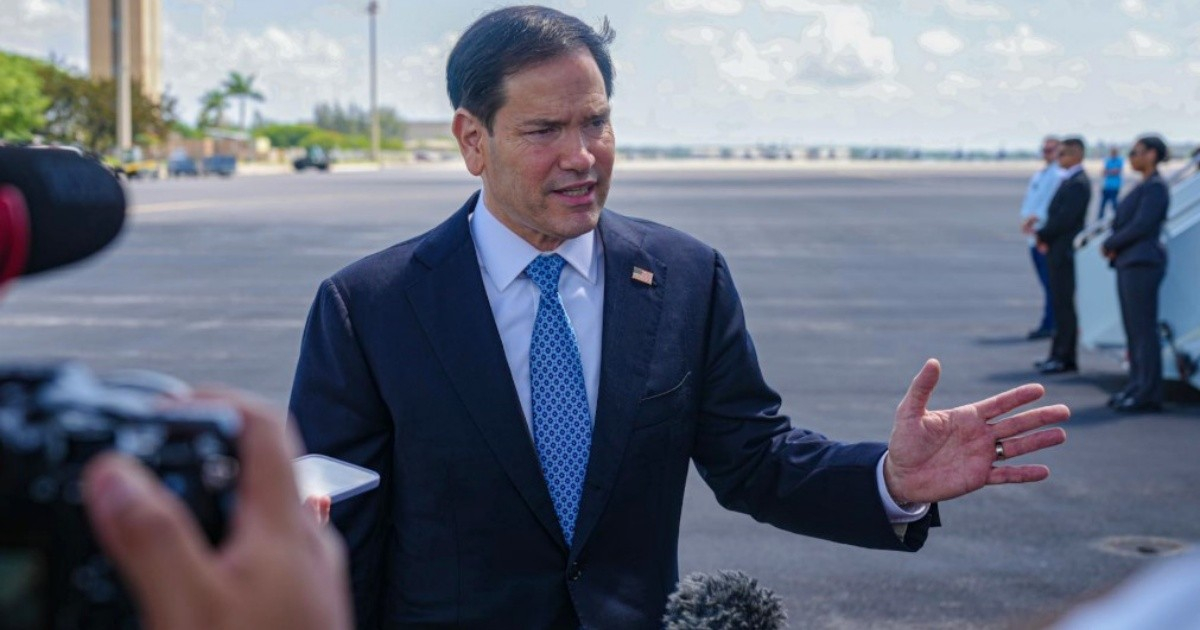
This week, federal agents apprehended Carlos Antonio Lloga Domínguez, a former official of the Cuban Institute for Friendship with the Peoples (ICAP), along with his wife and son. Their legal status in the United States was revoked by Secretary of State Marco Rubio, leading to their detention. The trio is currently under federal custody awaiting deportation, as outlined in an official State Department release issued on Wednesday.
The Arrest Operation
According to a statement by spokesperson Thomas "Tommy" Pigott, Lloga Domínguez was portrayed as a "foreign subversive operative" for over a decade, working with the primary influence and intelligence arm of the Cuban communist regime within the United States.
The State Department further revealed that Lloga Domínguez was not only employed by ICAP for more than ten years but continued to maintain active ties with the transnational communist subversion network even while residing in the U.S.
Rubio announced on his official account, "This week, I revoked the legal status of Carlos Antonio Lloga Domínguez, a former ICAP official connected to the organization. Lloga Domínguez, along with his family, is now in federal custody pending removal from the United States."
Understanding ICAP and Washington's Concerns
ICAP presents itself as an international solidarity organization, yet the State Department identifies it as the central hub of a wide-reaching Cuban intelligence network, claiming influence over more than 2,000 organizations in upwards of 150 countries.
Rubio criticized the organization, stating, "For decades, the Cuban Institute for Friendship with the Peoples has served as a conduit for radical leftist extremism and subversive foreign influence in the United States and across our hemisphere. ICAP engages in espionage against Americans, spreads anti-Western propaganda, orchestrates foreign influence operations, and organizes revolutionary leftist movements worldwide."
The nature of ICAP is further exemplified by its current president, Fernando González Llort, a convicted Cuban spy who served 15 years in U.S. prison for his involvement in the Wasp Network, a substantial Cuban espionage ring dismantled by the FBI in Florida in 1998. González Llort returned to Cuba in February 2014 through a prisoner exchange and has led ICAP since 2017.
Preceding Sanctions and Rubio's Warning
The arrest of Lloga Domínguez is a direct result of Washington's crackdown on ICAP. On June 4, the Treasury Department's Office of Foreign Assets Control sanctioned ICAP and its associated company, Amistur Cuba S.A., adding them to the Specially Designated Nationals list under Executive Order 14404, signed by President Trump on May 1, 2026.
In the same wave of sanctions, key figures such as Miguel Díaz-Canel, his wife Lis Cuesta Peraza, Alejandro Castro Espín, and the Ministry of the Revolutionary Armed Forces were designated.
ICAP responded on June 10, demanding removal from the sanctions list and condemning the accusations as a "political hostility act based on slander."
Under Executive Order 14404, ICAP's assets and interests are frozen, and any transactions with the organization are prohibited unless expressly authorized by the Treasury or State Departments.
Spokesperson Pigott firmly stated, "Under the Trump administration, the United States will never be a haven for the Cuban communist regime's thugs spreading propaganda, conducting foreign influence operations, or attempting to incite revolution against American civilization."
Rubio issued a stern warning to anyone associated with ICAP: "Those working with ICAP will face sanctions, prosecution, or deportation from our country."
The detention of Lloga Domínguez marks the first physical expulsion action directly linked to the sanctions against ICAP, signaling the Trump administration's readiness to go beyond economic measures. Since January 2026, Washington has imposed more than 240 sanctions against Cuba, marking the most aggressive campaign in recent decades.
Key Questions About the ICAP and U.S. Sanctions
What is the role of the Cuban Institute for Friendship with the Peoples (ICAP)?
The Cuban Institute for Friendship with the Peoples (ICAP) is officially presented as an international solidarity organization. However, the U.S. State Department describes it as a central part of a vast Cuban intelligence network, with influence over thousands of organizations worldwide.
Why was Carlos Antonio Lloga Domínguez arrested in the United States?
Carlos Antonio Lloga Domínguez was arrested as part of a federal operation after his legal status in the U.S. was revoked. He is accused of maintaining ties with ICAP, which the U.S. considers a foreign subversive influence network.