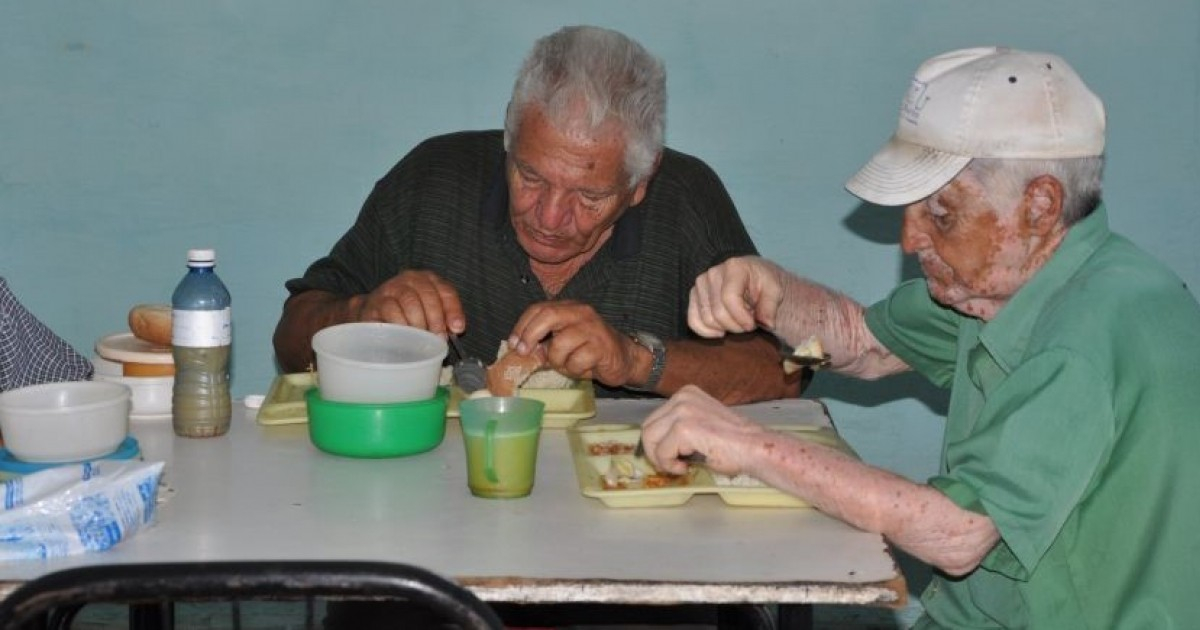
The Cuban government is increasingly unable to independently provide food in its own social dining halls for the elderly and vulnerable populations.
This failure became evident on Monday when private businesses from the area around Puente de 100 and Boyeros in Havana donated rice, eggs, chicken, and cleaning supplies to the Family Attention System (SAF) in Alturas de La Habana, located in the Boyeros municipality.
The official publication, Tribuna de La Habana, reported this as a "humanitarian gesture" tied to the centennial of Fidel Castro and the My Neighborhood for the Homeland Popular Movement. However, the report inadvertently exposes an uncomfortable truth for the regime: it now relies on private entities to fund its social welfare programs.
Struggling Social Support Systems
Established in 1998, the SAF was meant to ensure food and social interaction for seniors, people with disabilities, and other groups lacking resources or family support. Currently, it serves over 76,000 individuals across roughly 1,445 units nationwide, yet its capacity falls short of the rising demand.
In March, officials from the Ministry of Labor and Social Security acknowledged on National Television News that "the budget is insufficient and does not allow us to reach everyone, so a study is being conducted to identify only the most vulnerable."
Dire Conditions in Dining Facilities
The situation in dining halls is dire. For example, the SAF 0204 Villanueva dining hall, also in Boyeros, has been cooking with wood for the past five months due to a lack of liquefied gas, using old tires as makeshift fire supports in the corridor. This facility is the sole daily nutrition source for 129 elderly individuals.
The demand for these services continues to grow: from 59,000 people in 2023 to 67,000 by mid-2025, with seven to eight new requests daily, according to government data.
External Aid as a Stopgap
To fill the gaps, the regime has turned to external donations. In May, the World Food Program provided 106 tons of canned meat for 130 SAF dining halls in Villa Clara, aiding over 8,000 people. Similarly, in April, the Canary Islands donated 75 tons of canned chicken to these dining facilities.
The energy crisis exacerbates the situation. Since January 2026, the liquefied gas shortage has affected the entire country. By May, Energy Minister Vicente de la O Levy admitted, "we have absolutely nothing" left in fuel reserves.
Official Measures and Economic Reality
Facing this backdrop, the government announced 176 adjustment measures in June, including ending widespread subsidies and mandating that private companies co-finance pensions, elderly homes, and social kitchens, formalizing what was previously a voluntary effort.
Meanwhile, a November 2025 survey found that 99% of Cuban retirees cannot meet basic needs such as food, housing, and medicine. The minimum pension, raised to 4,000 Cuban pesos in September of that year, is worth less than $10 in the informal market—roughly the cost of a carton of 30 eggs.
The SAF administration in Alturas de La Habana expressed gratitude for the private donations, emphasizing that the program "was conceived by Commander in Chief Fidel Castro Ruz to establish facilities for the nourishment and socialization of disadvantaged seniors."
What remains unsaid is that nearly three decades later, this initiative cannot function without the support of those whom the regime's own ideology long considered adversaries.
Frequently Asked Questions about Cuba's Social Dining Halls
Why is the Cuban government unable to sustain its social dining halls?
The government's limited budget and inefficient resource management have led to a reliance on external donations and private sector contributions to sustain social dining halls.
How are private businesses contributing to the Family Attention System (SAF)?
Private businesses have stepped in by donating essential food items and supplies to the SAF, helping to bridge the gap left by the government's inability to fully support these services.
What measures has the Cuban government taken to address these challenges?
In June, the government introduced 176 adjustment measures, including removing general subsidies and requiring private companies to help fund social programs, making what was voluntary into an official policy.