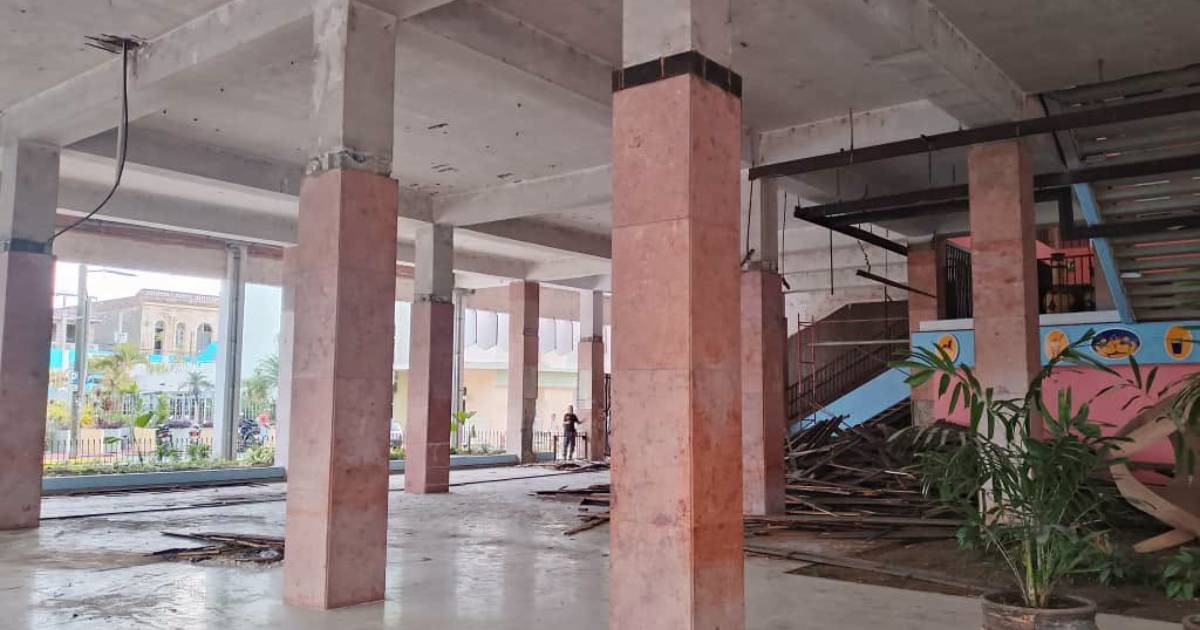
On Tuesday, officials from the Commerce sector in Villa Clara addressed public concerns regarding the intervention at Santa Clara's iconic Coppelia. This comes after images of the partially dismantled building circulated on social media, raising alarm among residents about the landmark's future.
Photographs shared since June 27 and reported by the independent outlet CubaNet, revealed the ground floor nearly empty. The wooden framework was removed, debris scattered on the floor, and the traditional signs dismantled, all without any official explanation of the ongoing renovations.
“They’re fixing it because it was in bad shape,” one of the workers on site briefly stated when questioned by the media.
The images sparked a flood of comments and speculation. “What’s happening to the Coppelia Ice Cream Parlor now? Who's in charge of its future?” questioned a social media user, echoing the concerns of many locals.
Official Response and Project Details
Amidst growing controversy, Digna Morales Molina, head of the Villa Clara Business Group of Commerce, Gastronomy, and Services, assured through the official Soy Villa Clara page that the building is undergoing a “near-complete restoration” that will respect its heritage values.
“The upper floor retains its original design since it was restored recently. We never managed to repair the ground floor; it was in an advanced state of deterioration and very poor condition. We faced a dilemma: find a temporary solution to keep the service running or completely close that area,” explained the official.
Morales confirmed that the renovation would allow the facility to reopen in July and August, maintaining state administration and ensuring affordable prices.
Public Concerns and Skepticism
The official explanations, however, did not entirely alleviate public doubts. While many praised the commitment to preserving the building, others criticized the authorities for waiting until the dismantling images circulated to publicly clarify the situation.
“They should have explained before the rumors started; the people have a right to know what's happening around them,” wrote one user. Another suggested that a simple informational sign at the site could have prevented the uncertainty that arose over recent days.
Questions also linger over the project's feasibility. Some commentators doubted that a restoration of this scale could be finished in just two months, while others stressed that the true challenge would not only be restoring the building but also reviving the quality of service, variety of flavors, and truly affordable prices for the community.
Architectural and Heritage Concerns
The citizens' concerns align with warnings from architects and heritage specialists who criticized the removal of original elements from the building and noted that the intervention may not have been discussed with the Provincial Heritage Center.
Architect Ariel Caso, according to CubaNet, pointed out that the wooden sunbreakers, distinctive features of the building's facade, were removed during the works.
“Every day I’m more convinced that Santa Clara needs a bulldozer to clear everything for new constructions. We lost our identity years ago due to poor management,” wrote an architect on social media.
In agreement, Guillermo Pérez, a specialist from the Provincial Heritage Center, expressed his dismay with a simple phrase: “It hurts my soul.” Comments on his post suggested that the heritage entity might not have been consulted before work commenced.
CubaNet also reported that numerous citizens expressed fears that the building might end up in the hands of private operators with unaffordable prices or that the renovations might remain incomplete, as has happened with other notable Santa Clara buildings. Cited examples include the Teatro La Caridad, closed since 2021, and the Hotel Florida, which has been supported with props for over a decade.
Opened on February 14, 1967, and designed by architect José Manuel Cortiñas Temes, the Santa Clara Coppelia occupies an entire block and is considered one of the most representative works of modern Cuban architecture. Its heritage value makes it one of the city’s most iconic buildings.
The concern over its future emerges amid the broader context of deteriorating Cuban architectural heritage. Earlier this year, the Institute of Design (ISDI) building in Havana was demolished after years of neglect, and the historic Palace of Aldama suffered further damage weeks later, fueling the debate on the preservation of historically significant buildings on the island.
Key Questions About Santa Clara's Coppelia Renovation
Why is the Coppelia in Santa Clara being renovated?
The Coppelia is undergoing renovation due to its advanced state of deterioration and poor condition, particularly on the ground floor.
What are the public's main concerns about the renovation?
The public is concerned about the preservation of the building's heritage, the feasibility of completing renovations in a short time, and whether the quality of service and affordability will be maintained.
Who designed the Santa Clara Coppelia?
The Santa Clara Coppelia was designed by architect José Manuel Cortiñas Temes and opened on February 14, 1967.