The United States government has boosted its humanitarian aid to Venezuela to exceed $300 million following the devastating earthquakes that struck the north-central region of the country on June 24. This amount significantly surpasses the initial financial commitment announced days earlier by the Trump administration, according to the State Department.
This decision marks one of the most extensive emergency responses deployed by the U.S. in the region after the natural disaster. The objective is to "save lives and provide urgently needed assistance to the Venezuelan people," as highlighted in the official statement released by the State Department, which is spearheading the humanitarian aid effort.
In addition to previously authorized funding, an extra $50 million has been allocated to bolster essential operations of partnered international organizations, bringing the total funds for these entities to $200 million. This includes $100 million in bilateral funding and another $100 million channeled through the United Nations Office for the Coordination of Humanitarian Affairs (UNOCHA) common fund in Venezuela.
The statement specified that U.S. humanitarian funds have been directed to "trusted international and non-governmental partners with proven capabilities to deliver vital assistance quickly and effectively," such as emergency medical care, food aid, water and sanitation, shelter, protection, and logistical support. Among the recipient entities are Samaritan's Purse, Catholic Relief Services, UNICEF, the International Organization for Migration (IOM), the World Food Program (WFP), International Medical Corps, Project Hope, and the Red Cross.
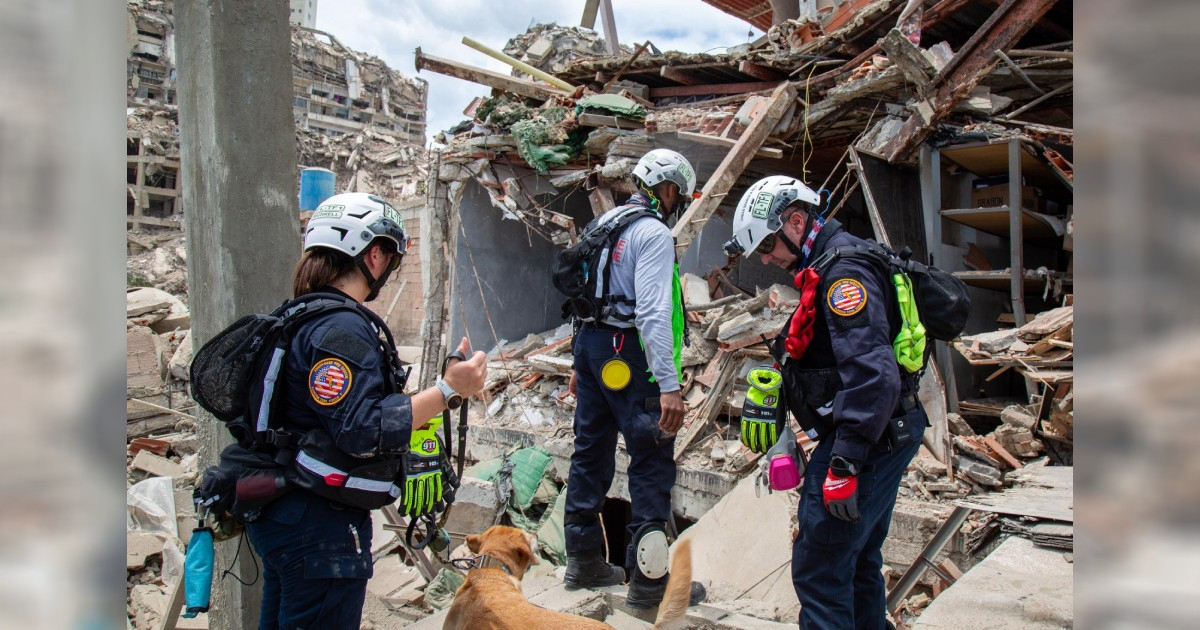
Beyond financial support, Washington has activated a comprehensive operation, deploying four elite search and rescue teams comprising over 300 top-tier rescuers and 23 search dogs. These teams are working in critical areas to locate survivors, provide medical attention, and conduct structural assessments in the hardest-hit locations.
On the military front, the Southern Command (SOUTHCOM) coordinated the repair and reopening of Caracas' Simón Bolívar International Airport to facilitate international humanitarian flights, with the Air Force deploying a specialized airfield management team. The USS Fort Lauderdale has been stationed off the coast of La Guaira, with marines delivering supplies directly to coastal areas using amphibious craft.
A specialized naval team is also working on repairing the Port of La Guaira, which was damaged by the earthquakes. SOUTHCOM deployed C-17 Globemaster III, C-130H Hercules, MV-22 Osprey, CH-47 Chinook, UH-1Y Venom, and UH/MH-60 Blackhawk aircraft for rescue, logistical support, and damage assessment.
The State Department has also partnered with Global Empowerment Mission (GEM), a humanitarian organization based in Doral, Florida, and Walmart to collect essential supplies in the Miami metropolitan area and distribute them to affected communities in Venezuela.
As the U.S. continues its emergency aid response in the South American nation, "the State Department is already planning for the long-term needs of the Venezuelan people, including housing needs for the many Venezuelans who have lost their homes," the statement assured.
"The United States is committed to maintaining this response and ensuring that the Venezuelan people receive all the support from the United States as they strive to recover from this tragedy," reiterated the State Department.
The two earthquakes on June 24 — with magnitudes of 7.2 and 7.5, occurring just 39 seconds apart — are the most destructive recorded in Venezuela since 1900. As of Tuesday, the death toll stands at 1,943, with 10,571 injured. According to UN estimates, more than 50,000 people are missing, while nearly 28,400 remain sheltered in emergency camps.
The UNDP estimated direct damages at $6.7 billion, equivalent to 6% of Venezuela's GDP, while the U.S. Geological Survey projected a 42% probability that the final death toll could range between 10,000 and 100,000 people.
On June 25, President Donald Trump pledged $150 million in humanitarian assistance and the deployment of military and rescue teams to Venezuela as an initial large-scale response to the devastating earthquakes that struck the country.
The magnitude of the response is partly explained by the new diplomatic scenario: following the capture of Nicolás Maduro in January, the U.S. recognized Delcy Rodríguez's government and reopened its embassy in Caracas on March 30, allowing for direct and immediate coordination with Venezuelan authorities from the onset of the disaster.
FAQs on U.S. Humanitarian Aid to Venezuela and Earthquake Response
What is the total amount of U.S. humanitarian aid to Venezuela following the earthquakes?
The United States increased its humanitarian aid to Venezuela to over $300 million in response to the devastating earthquakes.
Which organizations are involved in distributing the aid?
Organizations involved include Samaritan's Purse, Catholic Relief Services, UNICEF, IOM, WFP, International Medical Corps, Project Hope, and the Red Cross, among others.
How is the U.S. military contributing to the aid efforts?
The U.S. military has coordinated the repair of important infrastructure, deployed search and rescue teams, and used various aircraft for rescue and logistical support.
What are the long-term plans of the U.S. for Venezuela after the earthquakes?
The U.S. State Department is planning for long-term needs, including housing for displaced Venezuelans, as part of its continued commitment to aid recovery.