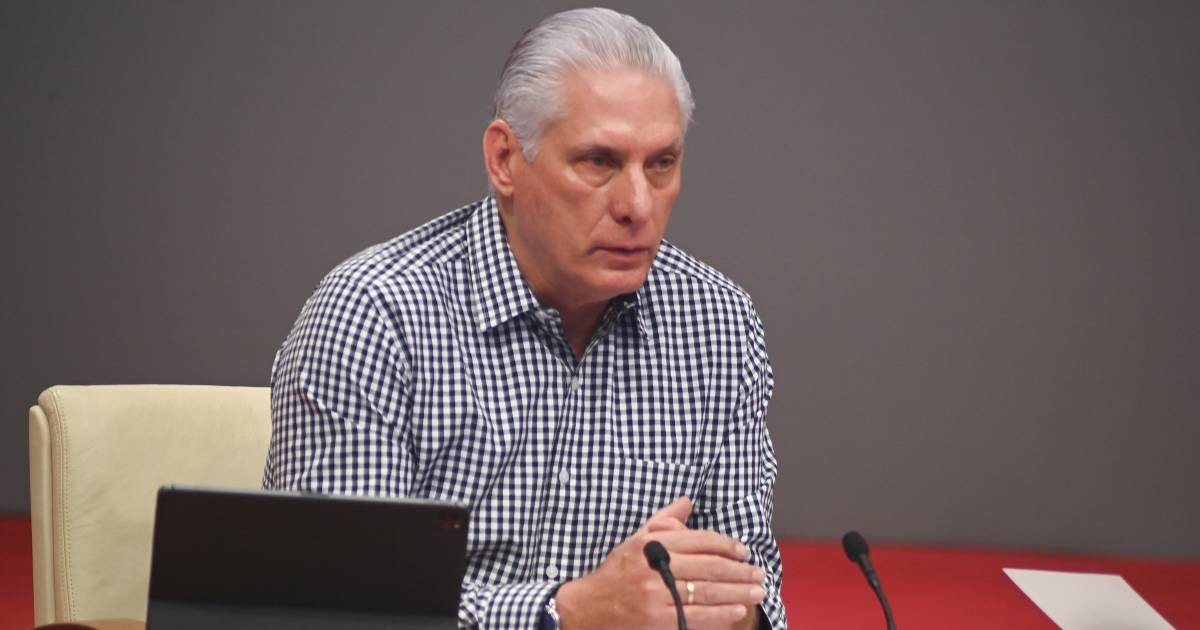
"Above all, it's about saving the Revolution." With these words spoken on Tuesday during a Council of Ministers meeting, Miguel Díaz-Canel underscored the regime's main goal: preserving Cuba's political project amidst the country's severe crisis. This objective is reflected in the 176 economic and social transformations approved by the government.
The statement, disclosed by the official website of the Presidency, was made during the reveal of the roadmap to implement the reform package announced in June, offering a clear insight into the priorities guiding this new economic phase.
In his remarks, Díaz-Canel once again placed the blame for the nation's hardships on the U.S. embargo, describing it as "the longest blockade in human history." He positioned the reforms as part of the strategy to uphold the socialist system.
The leader urged confronting the current challenges "without surrender, with intelligence, ideological firmness, responsibility, unity, courage, and boldness," and called for the application of "all categories of Fidel's concept of Revolution" to defend the approved transformations.
While he also mentioned the need to "improve the situation of those most vulnerable," he linked this to upholding the socialist model and continuing the revolutionary process.
Reform Measures and Economic Challenges
The meeting was led by Prime Minister Manuel Marrero Cruz, who outlined some initial measures to be implemented. These include the decentralization of wholesale and retail pricing, expanded authority for state enterprises, allowing small and medium-sized businesses to exceed the 100-worker limit, and permitting individuals to own more than one private company.
The comprehensive package of 176 transformations, organized into 23 axes, was initially presented on June 12 and later ratified by the National Assembly on June 19. During the consultation process, the government received 673 proposals, and 79% were accepted.
However, Marrero acknowledged to Parliament that implementing these measures poses significant challenges. He cited issues such as the partial dollarization of the economy, the gradual removal of subsidies, the constraints on decentralizing decisions without enhancing local capacities, and the liberalization of agricultural prices amid low production.
Ongoing Economic Crisis and Its Implications
Díaz-Canel's statements come amid a worsening economic crisis. The Economic Commission for Latin America and the Caribbean (ECLAC) forecasts a 6.5% contraction in Cuba's GDP by 2026. Meanwhile, electricity generation deficits have exceeded 2,000 MW in recent weeks, causing blackouts that affect more than half the country. Additionally, the minimum wage stands at 3,210 Cuban pesos, roughly equivalent to $4.65 at the informal market rate.
The declining living conditions are also evident in migration patterns. Between 2021 and 2024, approximately 1.79 million Cubans left the island, and in 2026, the migratory flow continues to destinations such as Brazil and Uruguay, among others.
The remarks made on Tuesday contrast starkly with another message delivered by Díaz-Canel just three days earlier at the XXII Congress of the Central Workers' Union of Cuba, where he declared, "The power lies with the people, not the wealthy or the bourgeoisie." This was said in a context marked by prolonged power outages, food shortages, and a sustained loss of purchasing power of salaries.
Understanding Cuba's Economic Reforms and Challenges
What is the goal of the economic and social transformations approved by Cuba?
The primary aim of the 176 economic and social transformations approved by Cuba is to preserve the political project of the Cuban Revolution amidst the country's severe economic crisis.
What challenges does Cuba face in implementing the new economic measures?
Cuba faces several challenges in implementing the new economic measures, including the impact of partial dollarization, the gradual removal of subsidies, and the need to decentralize decisions without adequate local capacities, as well as liberalizing agricultural prices amidst low production.
How is the current economic crisis affecting Cuba's living conditions?
The ongoing economic crisis in Cuba is leading to worsening living conditions, evident in frequent power outages, food shortages, and a significant migration of Cubans to other countries, along with a decrease in purchasing power due to low wages.