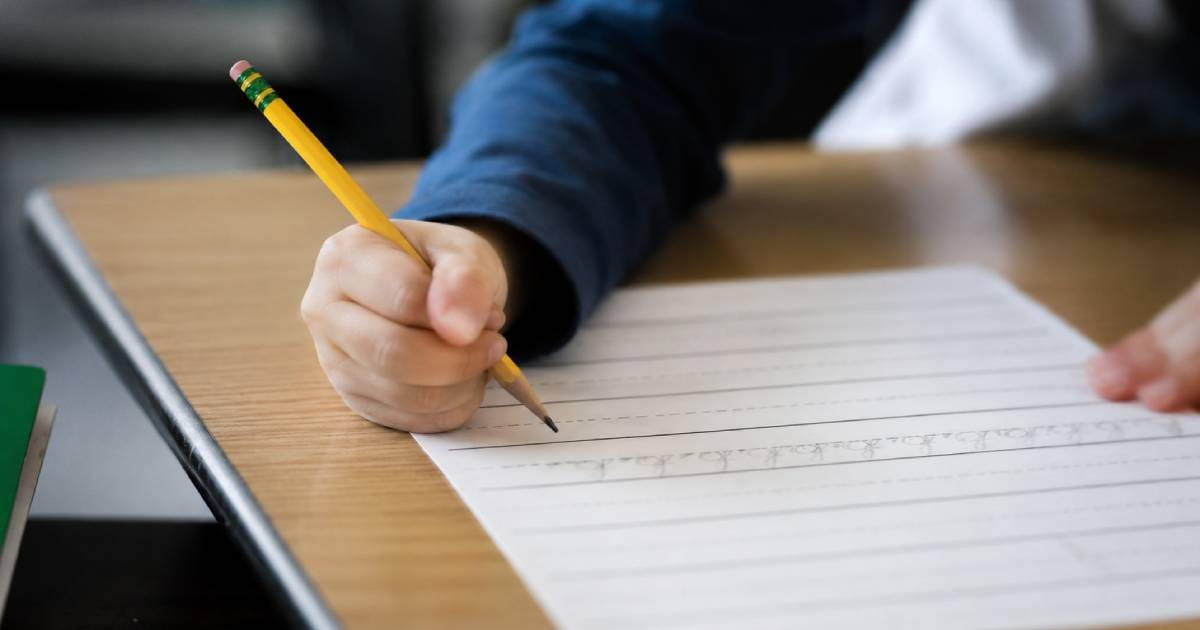
Starting July 1, a new educational law in Florida will require public school students to learn and demonstrate proficiency in cursive handwriting. This initiative will take effect during the 2026-2027 school year, as reported by News4JAX.
Governor Ron DeSantis signed the legislation, known as SB 182, into law on April 20. The bill, which was unanimously passed by the state Senate on March 13, mandates that cursive handwriting be part of the curriculum.
Under the new guidelines, students from third to fifth grade will receive formal instruction in cursive handwriting. The focus will be on properly forming letters, spacing, alignment, and practicing through complete words and sentences.
A significant change is that by the end of fifth grade, students must demonstrate mastery of cursive. They will be required to write both uppercase and lowercase letters of the alphabet in cursive, compose legible words and sentences with correct spacing and alignment, and utilize cursive in school assignments and essays.
While the law does not mandate it, it encourages the State Board of Education to develop specific standards and assessments to evaluate compliance with these requirements.
Cursive handwriting has had a fluctuating presence in Florida's educational standards. It was removed in 2010 with the adoption of the Common Core program, which emphasized technological skills. It was reintroduced via administrative rule four years later and has been part of the B.E.S.T. English Language Arts standards for third to fifth grades since 2020. However, until now, there was no requirement for students to demonstrate proficiency in this skill.
Proponents of SB 182 argue that handwriting boosts learning. Numerous neuroscience studies support this claim by highlighting that cursive writing activates brain circuits related to language, memory, and learning differently than typing does.
The legislation also includes other measures. Mandatory display of portraits of George Washington and Abraham Lincoln in all kindergarten through fifth-grade classrooms is one such measure. Additionally, a Teacher Mentoring and Tutoring Program will be established to support schools with "D" or "F" ratings. This will allow retired or active teachers with at least three years of experience and a "highly effective" rating to mentor other educators and earn stipends of up to $3,000.
Florida is not alone in reviving cursive instruction. Currently, over half of the states in the U.S. require or promote cursive in schools, compared to just 14 states a decade ago. California reinstated it for the 2024-2025 school year for grades one through six, while Michigan passed similar legislation in 2023.
This initiative is part of DeSantis' broader educational agenda, which in recent years has also included mandatory lessons on the history of communism, expansion of the armed guardians program in schools, and other initiatives aimed at strengthening fundamental skills and traditional values in public education.
Understanding Florida's Cursive Handwriting Legislation
What are the key components of Florida's new cursive handwriting law?
The law requires third to fifth graders to receive formal instruction in cursive handwriting, focus on letter formation, spacing, and alignment, and demonstrate proficiency by the end of fifth grade.
How does the law affect the current educational standards in Florida?
While cursive was already part of the B.E.S.T. English Language Arts standards, the law now mandates that students must demonstrate mastery, a requirement that was not previously enforced.
Why is cursive instruction being reintroduced in Florida and other states?
Proponents argue that cursive writing enhances learning by activating brain circuits associated with language and memory differently than typing. Over half of U.S. states now require or encourage cursive instruction.