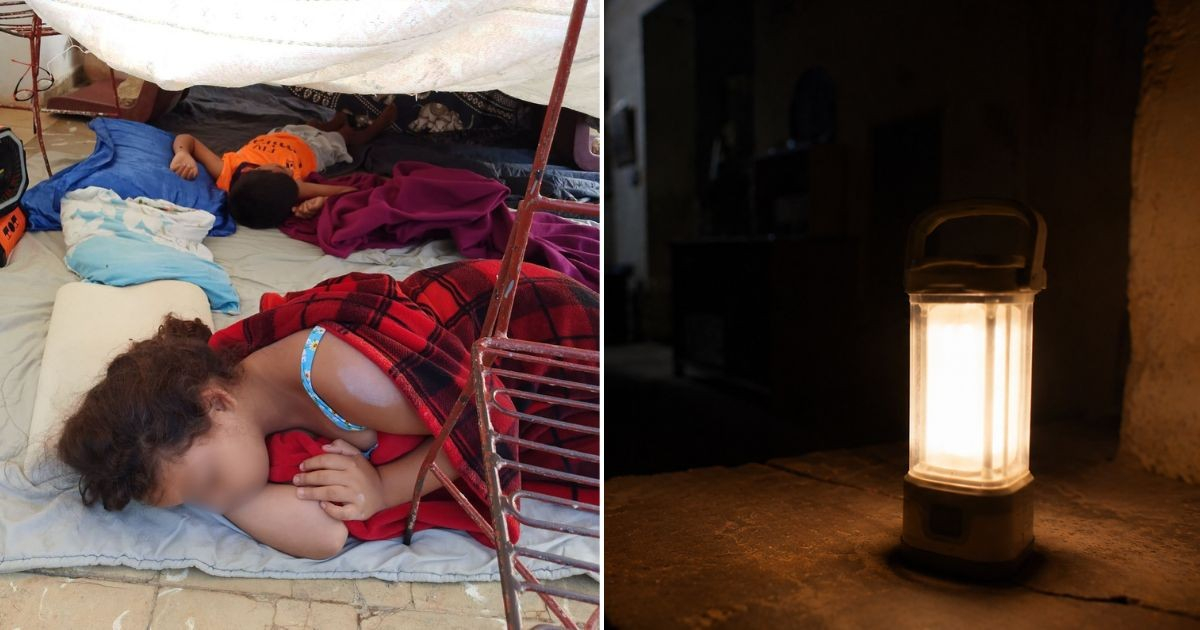
A Cuban mother, Dayana Garcia, took to the Facebook group "Havana's Electric Company" to voice a sentiment that has become emblematic of the widespread exhaustion facing the island amid this summer's electricity crisis: "I'm so tired and drained from all this. We hold the Guinness record for endurance. I'm fed up with everything that smells, tastes, and identifies as communism."
Her post resonated deeply, gathering nearly 18,000 reactions, over 1,400 comments, and about 500 shares, emerging as a viral indicator of the social discontent in Cuba.
The accompanying image depicts two young children sleeping on the floor, possibly on a porch or balcony, under a makeshift shelter fashioned from a white sheet, with rechargeable fans and mosquito nets—a scene mirrored by countless Cuban families each night as they seek refuge from the stifling heat in homes without electric ventilation.
Shared Experiences Among Cuban Mothers
In the comments, other mothers shared similar struggles. Yanet Peres lamented: "My kids can't sleep anymore. They complain all night, and the youngest, just 9 years old, ends up showering in the early hours with cold water. How much longer must this go on?"
An anonymous participant described their dire circumstances with a five-month-old baby and an eight-year-old girl as "criminal."
Reynie Azconita shared: "I haven't slept for two days... It's an entire night swatting mosquitoes. While the world moves forward, our nights grow longer."
Ivon Pose criticized the regime's hypocrisy: "It's easy to ask us to endure. They have power, water, and their food doesn’t spoil. It takes a blackened soul to demand that. I'm not speaking of politics but of basic human rights and respect."
Reflecting on Collective Pain and Hope
Dayana Garcia, responding to the overwhelming support, encapsulated the collective pain: "My suffering is shared by millions experiencing the same. If Cubans united, we could be free in less than 72 hours; of that, I have no doubt."
Amidst this backdrop is Cuba's most severe electricity crisis in decades. In Havana, power outages exceed 20 to 24 hours daily, while some areas in Matanzas have endured up to 85 consecutive hours without electricity.
Widespread Implications of the Electricity Crisis
In May, electrical shortages hit a historic high of 2,174 MW, leaving 70% of the island simultaneously without power, according to state figures. The Antonio Guiteras power plant, the nation's largest, suffered its 15th breakdown of the year on June 15, causing the night deficit to spike to 2,085 MW, while 106 distributed generation plants remain offline due to fuel shortages.
The effects extend beyond sleepless nights: 87% of water supply systems rely on the faltering electrical grid, leaving approximately 2.7 million Cubans without consistent access to potable water.
The Cuban Observatory of Conflicts recorded over 1,300 protests in May 2026, the highest since July 11, 2021, with pot-banging marches and barricades erupting in at least 12 municipalities in Havana.
Deyse Garcia summed it up in the comments, distilling 67 years of history: "This is a war of women fighting for their children. It’s been 67 years chasing a utopia."
Understanding Cuba's Electricity Crisis
What is causing the electricity crisis in Cuba?
Cuba's electricity crisis stems from aging infrastructure, frequent breakdowns in power plants like Antonio Guiteras, and fuel shortages that impede distributed generation.
How are Cuban families coping with power outages?
Cuban families often resort to makeshift solutions like using rechargeable fans, sleeping outside to escape the heat, and relying on mosquito nets to cope without electricity.
What impact does the power crisis have on water access in Cuba?
With 87% of water systems dependent on electricity, the power crisis severely disrupts access to potable water, affecting around 2.7 million Cubans.