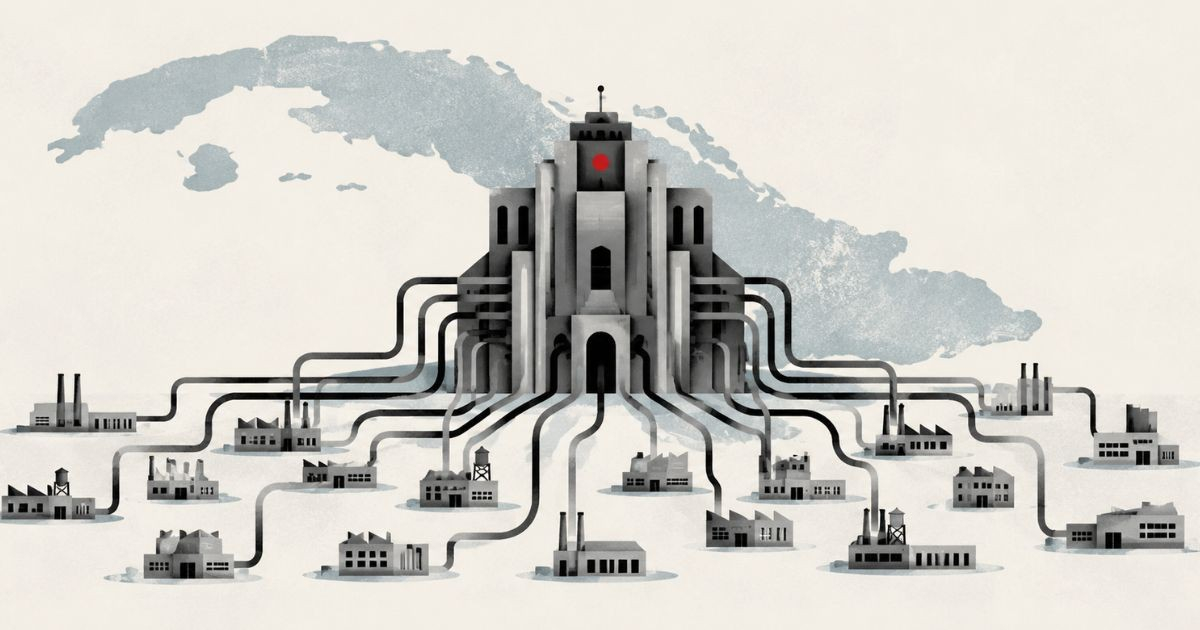
The Cuban Council of Ministers unveiled the creation of the National Institute of State-Owned Enterprise Assets (INAEES) in the Official Gazette this Monday, with the issuance of Decree 144/2026, endorsed by Prime Minister Manuel Marrero Cruz. This new body, directly accountable to the Council of Ministers, is endowed with extensive powers to oversee and control the Cuban state enterprise system.
According to the decree, the INAEES is tasked with spearheading "the transformations and advancement of the Cuban state enterprise system," aligning with the government's Economic and Social Program for 2026.
The decree outlines that, initially, the agency will focus on refining the enterprise system and removing existing barriers. To achieve this, it will propose a selection of enterprise entities to the Council of Ministers for organizational transformation.
Comprehensive Authority of INAEES
The powers granted to INAEES are far-reaching. It holds the authority to appoint and replace general directors or presidents of corporate groups, unions, and corporations; set their salaries; approve the creation of companies and define their social objectives; sanction strategic investments; determine the allocation of profits post-tax; and endorse or approve economic partnerships with foreign capital.
Despite a clause asserting that the institute's functions "must not undermine enterprise autonomy," in practice, it consolidates control over the key decision-making levers of more than 2,000 state-owned companies in Cuba.
Perspectives on Recentralization
Human rights organization Cubalex has criticized the INAEES as a tool for recentralization, consolidating the power of the state owner under the Council of Ministers. Meanwhile, economist Pedro Monreal warned in June that it could potentially become the "gravedigger" of the enterprise system.
Structurally, the decree specifies that the INAEES will operate with a "streamlined and adaptable" framework, led by a president, a vice president, and necessary staff.
Implementation and Historical Context
The INAEES was initially announced in December 2025 by Deputy Prime Minister Óscar Pérez-Oliva Fraga. On June 5, 2026, Roberto Ricardo Marrero was appointed as its first president in a ceremony at the Maritime Port Transport Business Group (GEMAR), where he previously served as director.
This initiative is part of a comprehensive package of 176 economic measures presented to the National Assembly on June 18-19, 2026. This package is considered the most significant structural reform attempt since the Special Period, including transforming state companies into joint-stock entities, permitting bankruptcies and liquidations, and promoting greater management autonomy.
The Special Provision One of Decree 144 states that for the selected and approved state enterprise system, it overrides other regulatory provisions of equal or lesser hierarchy that conflict with the present decree.
The decree will take effect 30 days following its publication in the Official Gazette.
FAQs on INAEES and its Impact
What is the purpose of the INAEES?
The INAEES is designed to direct the transformation and development of the Cuban state enterprise system, as part of the government's economic and social agenda for 2026.
What powers does the INAEES hold over state enterprises?
The INAEES can appoint and replace directors, set salaries, approve company formations and objectives, sanction investments, determine profit allocations, and endorse foreign partnerships.
When was the INAEES first announced?
The INAEES was first announced in December 2025 by Deputy Prime Minister Óscar Pérez-Oliva Fraga.