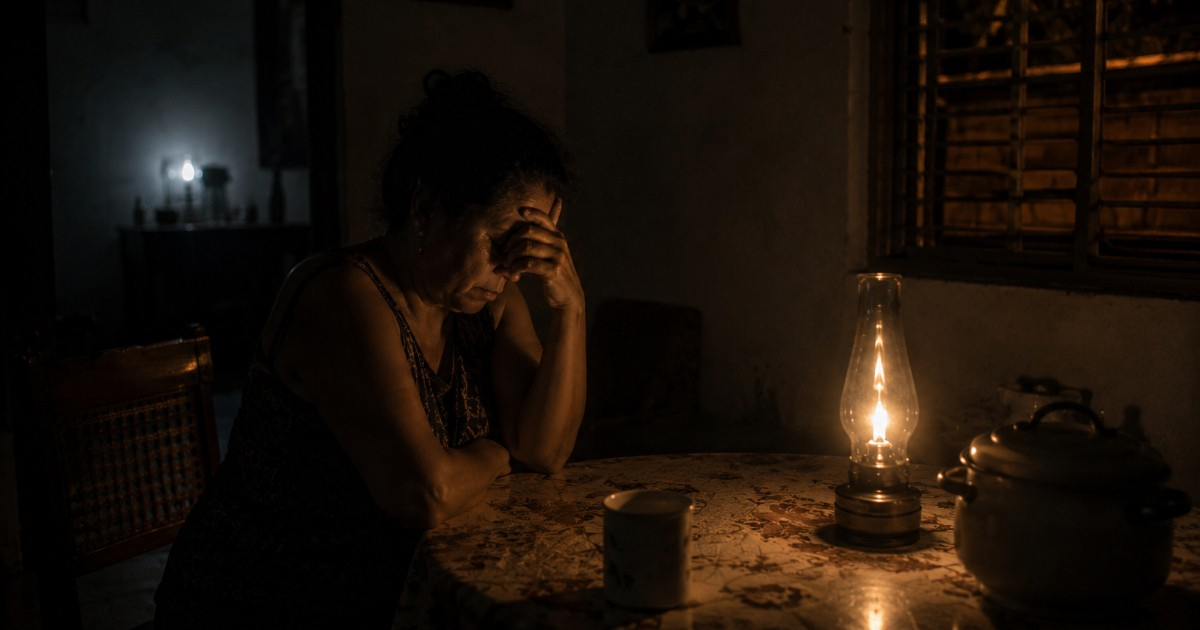
Over the weekend, María Isabel, also known as Vida Winter, a photographer and visual artist, took to Facebook to paint a stark picture of the current Cuban reality. Her words capture the forced resignation of millions of Cubans enduring a power crisis that the socialist regime seems unable to solve. With 24-hour blackouts becoming a silently endured routine, her message resonates deeply.
"We have silently adapted to 24 hours without power. If they give us 30 or 40, we endure it in silence too," the Santa Clara artist lamented.
Winter's depiction of her building, ironically praised for having the "best behavior in the city," highlights the normalization of the unbearable under Miguel Díaz-Canel's dictatorship.
In her piece, Winter employs literary references to articulate what can't be spoken politically without peril. She draws parallels between Cuba and Macondo, the cursed town in Gabriel García Márquez's "One Hundred Years of Solitude," likening the ruling elite to the Buendía family—a dynasty that clings to power across generations.
"Cubans have lost their lineage, their mambisa spirit. We've been defeated by the greed of a group that, like the Buendías, belong to the same caste. Truly a damned generation," she expressed.
Winter even questions if a fate like Macondo's, being wiped off the face of the earth, would be preferable, reflecting the profound despair within Cuban society.
This poignant text emerges amidst Cuba's worst electrical crisis in recent memory. On June 25, the national power deficit hit an unprecedented 2,208 MW, surpassing the previous record of 2,174 MW on May 14.
With demand exceeding 3,000 MW, the system's availability hovers between a mere 950 and 1,090 MW. In Matanzas, outages stretched to 85 consecutive hours; in Holguín, up to 50.
Winter also touches on the sole form of resistance left to the people: "Our national logo has become a pot with a ladle, whose sound is feared by the 'security' forces." She recounts how a small protest began in her building, prompting State Security agents to scour the floors "like rats" in search of the instigator.
This repression is well-documented; the Cuban Observatory of Human Rights reported 1,289 repressive actions and 154 arbitrary detentions between January and June.
The artist also mocks the government's official recognition of Villa Clara as an "outstanding" province (referring to the competition for the July 26 celebrations), while its residents, who call it Villa Oscura, endure 20 to 22 hours daily without electricity.
Regarding hopes pinned on external figures, Vida Winter is clear: "Those who believe Marco Rubio, Trump, or Bukele will come to save us from the regime and its family, I admire your enthusiasm. Change will not come from outside."
The text concludes with a question serving as a generation's epitaph: "Cuban, do you remember the last time you were happy?"
Understanding Cuba's Electricity Crisis
What is causing Cuba's current electricity crisis?
Cuba's electricity crisis is primarily due to the government's inability to maintain infrastructure and manage resources, leading to a significant power deficit as demand exceeds supply.
How has the Cuban population adapted to prolonged power outages?
Many Cubans have become resigned to the frequent and extended blackouts, enduring them silently as part of their daily routine, reflecting a broader sense of despair and lack of viable alternatives.
What forms of resistance exist against the Cuban regime's policies?
Cubans have turned to symbolic acts of resistance, such as banging pots and pans, which, while subtle, have become feared by the regime's security forces.