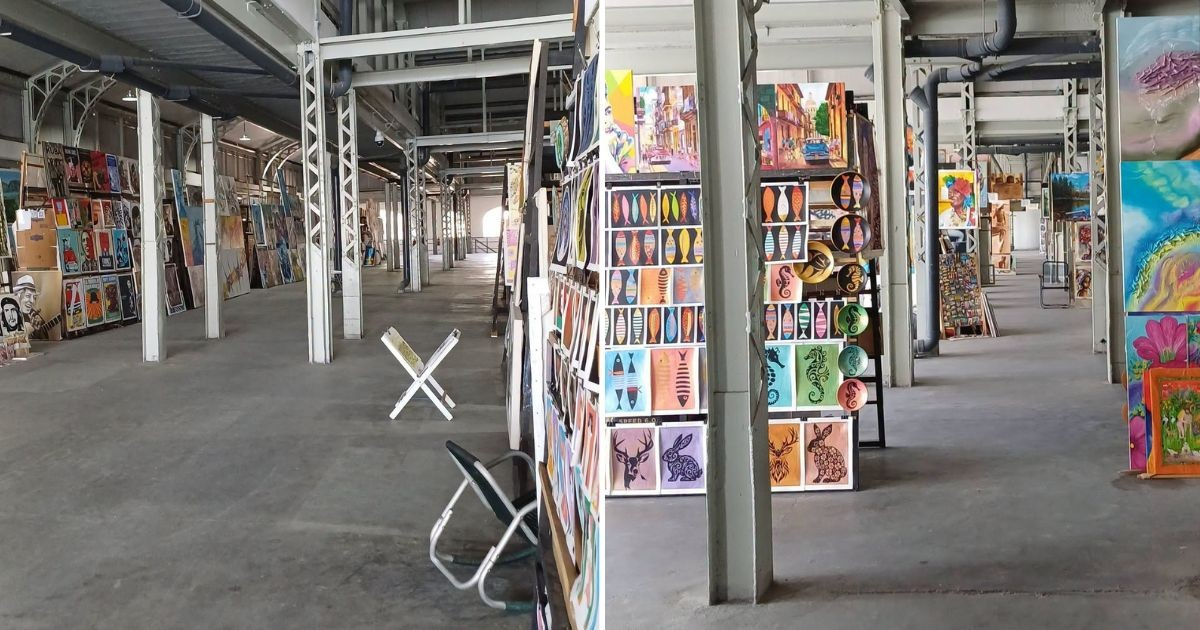
A Cuban painter, with over 30 years of experience at the San José Warehouses in Old Havana, has voiced concerns that this iconic hub for art and crafts might soon shut its doors. This apprehension stems from weeks without foreign visitors and a ground floor filled with numerous shuttered stalls.
Jorge Delgado expressed his worries on Facebook with an unmistakable tone of resignation: "Today I visited the fair, and the impression I got is that the days are numbered for the San José Warehouses. Upstairs, where we painters display our artwork, not a single tourist has been seen for several weeks."
Having exhibited his paintings there for 35 years, Delgado's reflection is more than just a complaint; it's a prelude to mourning the potential loss of a space that has defined his professional life.
"Without tourists in Cuba, there's no point in us paying for this. One continues because hope is the last thing to lose," he wrote, acknowledging that "a quick solution is nowhere in sight."
The Broader Picture in Havana
The situation Delgado describes isn't unique to the San José Warehouses. Others responding to his post confirmed that the crisis extends throughout the city and beyond. Roberto Segundo Rodriguez Hernandez noted that "the Obispo fair is also empty," while Carlos Manuel Deus Marcote observed a similar situation in Varadero: "Continuing to pay taxes without having anyone to sell to and spending a lot on transport. It's incomprehensible."
Visual artist Jorge Luis Betancourt was even more blunt: "It's absurd to pay for something without benefits. Everything here has collapsed, and tourists, I doubt it. We've hit rock bottom irreversibly. We need to reinvent ourselves, and I don't think it will be in art. As a visual artist, I put down my brushes during the pandemic."
Tourism Freefall in Cuba
Delgado's depiction of desolation is backed by stark statistics. Between January and April 2026, Cuba welcomed just 328,608 tourists, a staggering 55.8% drop compared to the same period the previous year. In March alone, the monthly figure plummeted to 35,561 visitors, marking a 79% year-over-year decrease.
At its peak in 2019, the island hosted 4.6 million tourists. If the current trend continues, 2026 might end with fewer than one million visitors, marking the worst record since the pandemic.
The reasons for this decline are numerous and systemic: aviation fuel shortages leading to widespread flight cancellations, U.S. sanctions against hotel chains, prolonged blackouts, and a general deterioration of the tourism infrastructure.
Hotel occupancy in Cuba fell below 10% in the first quarter of the year.
The Legacy of San José Warehouses
Situated on Avenida del Puerto across from the Havana port, the San José Warehouses were inaugurated as a crafts fair on November 1, 2009, following a restoration led by the Office of the Historian of Havana. The building's origins date back to 1847 and it houses over 100 stalls where Cuban artisans and creators sell paintings, textiles, ceramics, jewelry, and leather goods.
Ange Rivero captured the sentiment many feel when wandering through Old Havana: "I was in Old Havana and left devastated seeing everything empty." Willy Santiesteban concluded with a phrase that reads like an epitaph: "It was beautiful... while it lasted."
Understanding Cuba's Tourism Crisis
Why is tourism declining in Cuba?
Tourism in Cuba is declining due to several factors including aviation fuel shortages leading to flight cancellations, U.S. sanctions against hotel chains, prolonged power outages, and deteriorating infrastructure.
What impact does the decline in tourism have on local artists?
The decline in tourism significantly affects local artists as it reduces their customer base, leading to financial strain and uncertainty about the future of their businesses.