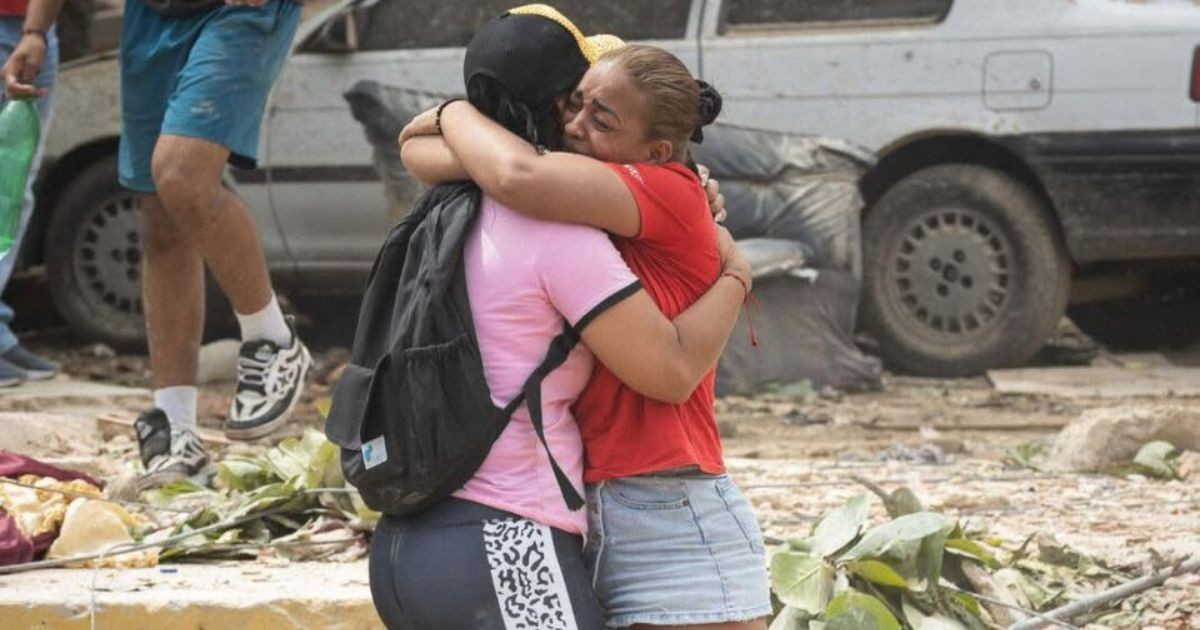
In the wake of the devastating dual earthquakes on June 24, two Cuban poets—one residing in Cuba and the other in exile in the United States—turned to the traditional décima espinela to express their support for Venezuela. Their poignant verses spread across social media, resonating deeply with members of the Cuban community both at home and abroad.
Verses of Empathy and Grief
Shared on the Facebook profile of poet Juan Carlos García Guridi, the post featured two stanzas vividly depicting the catastrophe: crumbled structures, families buried beneath the rubble, and homes vanished without a trace, all due to nature's unforeseen collapse.
Born in Batabanó, Mayabeque, in 1968, García Guridi is a renowned improviser, writer, and literary researcher with several publications to his name. In his verses, he transforms another's sorrow into a shared wound: "The Venezuelan pain / bleeds beneath my skin, / flesh and lintel's grief, / tremor of all mankind. / The mourning of a brotherly nation / invites me to sadness, / why did nature collapse / without warning, leaving / Venezuela's beauty defaced?"
Reflections from Exile
Juan Antonio Díaz Pérez, a master of Cuban improvisational poetry originally from San Diego de los Baños, Pinar del Río, and now residing in the U.S., is an internationally acclaimed figure in the décima espinela tradition. He imagined even the liberator Simón Bolívar's sorrow in the face of such a disaster: "Today you are drenched, Venezuela, / among the handkerchiefs of awe; / the noise of your rubble / cannot help but hurt. / Even the shine of Simón's spur / is saddened. / How much sorrow you wear / on a wet face, / a buried family / and a home that no longer exists."
The post sparked numerous responses from Cubans expressing frustration, tears, and prayers. "It's impossible to see the images and not cry. A beautiful homage to the sadness of a brotherly nation," one follower commented. Another wrote, "Very painful, I have Venezuelan neighbors and they are devastated." A third summed up the collective feeling with: "It hurts... it hurts!!!!!!" Meanwhile, others implored divine intervention in the face of such calamity and remembered those who "lost their families."
A Tragedy of Historic Proportions
The backdrop for these décimas is a tragedy of immense scale. The earthquakes, with magnitudes of 7.2 and 7.5, struck Venezuela a mere 39 seconds apart, centered in Yaracuy and near Morón in Carabobo. These quakes are noted as the most powerful since 1900. By June 27, the death toll had reached 1,430, with over 3,238 injured and 346 buildings collapsed. The United Nations estimated that up to 50,000 could be missing and more than six million affected.
Among the missing were Cubans: at least 29 compatriots were unaccounted for in Venezuela following the quakes, heightening the anguish felt by the Cuban community.
The Power of Tradition and Connection
The décima espinela, a ten-line stanza with eight syllables per line and consonant rhyme, is deeply embedded in Cuban popular culture. This poetic form, dating back to the 16th century, serves as a vehicle for celebration, social critique, mourning, protest, and solidarity in the face of collective tragedies. That two of its most prominent contemporary practitioners, oceans apart and separated by circumstances that have scattered millions of Cubans, chose to use it to stand with Venezuela speaks volumes about the enduring strength of this tradition and the bond between the two peoples.
Additionally, Cuban singer-songwriter Pavel Urkiza, also based in the United States, expressed his solidarity by releasing a video on Facebook performing "La vaca mariposa," a song by the great Venezuelan composer Simón Díaz.
The Cuban Catholic Church conveyed its support through a letter from the Conference of Bishops to the Venezuelan Episcopal Conference, and Cuban doctors are actively involved in assisting the affected, highlighting the historic cooperation between the two nations. On Saturday, another 4.8 magnitude tremor shook Venezuela, adding to the numerous aftershocks recorded since the initial disaster.
Understanding the Impact of the Venezuelan Earthquakes
What is the décima espinela?
The décima espinela is a traditional Spanish poetic form consisting of ten lines, each with eight syllables, and a specific rhyme scheme. It has deep cultural roots in Cuba and is used to express a wide range of emotions and social commentary.
How did the Cuban community react to the Venezuelan earthquakes?
The Cuban community expressed deep sorrow and solidarity through poetry, social media comments, and public displays of support, highlighting the close ties between Cuba and Venezuela.
What was the extent of the damage caused by the earthquakes in Venezuela?
The earthquakes resulted in at least 1,430 deaths, over 3,238 injuries, and the collapse of 346 buildings. The United Nations estimated up to 50,000 people could be missing and over six million affected.