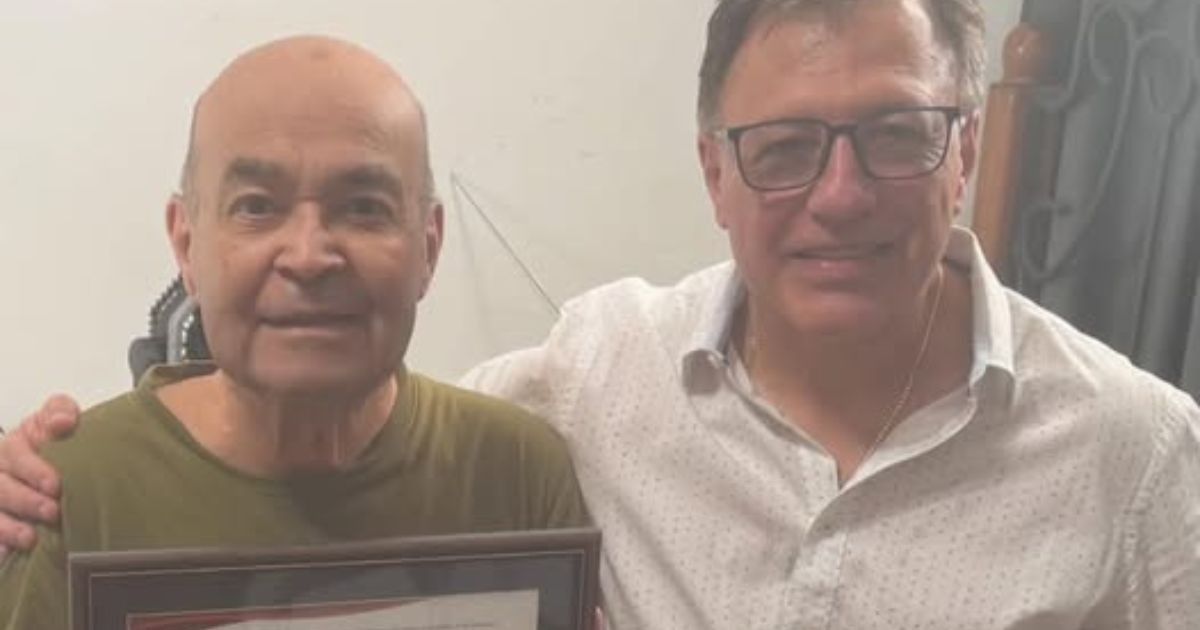
On Saturday, Humberto Pérez González, a renowned economist and the former head of Cuba's Central Planning Board (JUCEPLAN), passed away at the age of 88 in Havana. This news was confirmed by Julio Carranza, a fellow economist and close friend, via social media.
Carranza honored him as a "great economist, a highly influential figure, a true revolutionary, and a brother to me," mourning the loss of "one of Cuba's most prominent sons."
The Revolutionary Journey of a Young Economist
Born on December 6, 1937, in Cabaiguán, now part of the Sancti Spíritus province, Pérez González joined the clandestine Movement 26th of July at a young age. He fought in Column 8, led by Che Guevara, and was involved in the capture of Santa Clara in December 1958, as documented by Ecured.
Following the revolutionary triumph, Pérez González pursued his studies in economics at the Higher Party School of the Communist Party of the Soviet Union in Moscow, graduating in 1964. He later earned a doctorate in Economic Sciences from the University of Havana in 1984.
Political Rise and Economic Leadership
Pérez González's political ascent was swift. He served as an advisor to Raúl Castro during two periods (1972-1976 and 1985-1987), became Vice President of the Council of Ministers, was a member of the Political Bureau of the Communist Party of Cuba from 1980 to 1985, and served as a deputy in the National Assembly of People's Power from 1976 to 1986.
During his tenure as the head of JUCEPLAN from 1976 to 1985, he played a pivotal role in steering Cuba's economy for over a decade. Carranza remarked that this era marked "the period of greatest order, stability, and growth" in the revolutionary economy. Pérez González also significantly contributed to the country's reorganization following the failed 1970 Ten Million Ton Sugar Harvest, which ended in chaos.
A Sudden Downfall and Ignored Legacy
However, his fall from grace was as rapid as his rise. In 1986, as Fidel Castro initiated the "rectification of errors and negative tendencies" process, Pérez González became the scapegoat. Journalist Wilfredo Cancio Isla noted that he was accused of being "Sovietizing and mimicking, copying foreign dogmas," reversing policies that Castro himself had once supported.
This pattern of promoting and then discarding officials is a hallmark of the Castro regime, often sacrificing loyalists when outcomes did not meet the regime’s expectations.
After his removal, Pérez González held minor positions, including financial manager for the Cuban branch of Canadian firm Tri Star Caribbean between 2008 and 2012. He continued to seek ways to contribute; about five years ago, he and four other economists proposed an economic reform plan to the government. "We never received a response or a chance to discuss it," lamented Carranza, who now advises the Cuban government on economic reforms.
Ironically, this ignored proposal gains significance today as, in June 2026, the regime approved a set of 176 economic reform measures aiming to dismantle the centralized planning system that Pérez González had originally crafted and for which he was later scapegoated. Cuba's economy faces its deepest crisis in decades, marked by food shortages, medicine scarcity, and prolonged blackouts, exacerbated by U.S. sanctions and an ineffective economic model.
Final Reflections on a Revolutionary Figure
In his final months, Pérez González hoped to record his testimony, but a journalist refused him an interview, claiming ignorance of his identity. "Anyone who doesn't know who Humberto Pérez was cannot understand much about the history of the Cuban revolution over these 67 years," Carranza wrote.
In December 2025, the University of Havana's Center for the Study of the Cuban Economy honored him, though he was too ill to attend in person; the recognition was delivered to his home. He passed away in the same bed where that diploma hung.
"He never betrayed his ideas or his history, which is invaluable today," Carranza noted in a heartfelt tribute.
Understanding the Legacy of Humberto Pérez González
Who was Humberto Pérez González?
Humberto Pérez González was a prominent Cuban economist and former head of the Central Planning Board. He played a significant role in shaping Cuba's economy post-revolution before becoming a scapegoat during the rectification process initiated by Fidel Castro.
What contributions did Pérez González make to Cuba's economy?
Pérez González led Cuba's Central Planning Board for nearly a decade, contributing to a period of economic order and growth. He was also instrumental in the country's reorganization following the failed 1970 sugar harvest.
Why was Pérez González removed from his position?
He was removed in 1986 during a campaign to rectify errors and negative tendencies, becoming a scapegoat for policies that Fidel Castro had initially supported but later reversed.