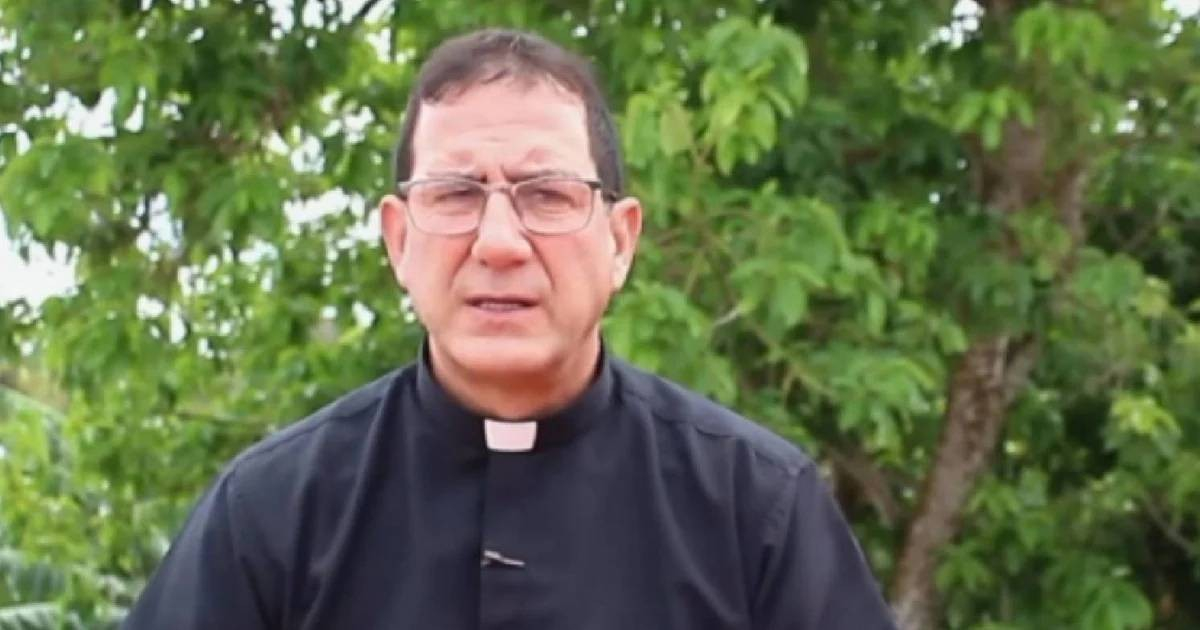
In his latest weekly column on Facebook, Cuban priest Alberto Reyes Pías, who serves as the pastor of Esmeralda parish in Camagüey, challenges the official narrative that proposes economic solutions without political freedoms as the remedy for Cuba's crisis. His message, titled "I've been thinking about what's not being understood," marks the 163rd installment of his ongoing reflections.
This commentary comes on the heels of the regime's announcement of 176 economic measures endorsed by the National Assembly, which include permitting private banking, lifting worker caps in small and medium enterprises, and welcoming foreign investment. While the government touts these as the most profound structural reforms in decades, Reyes Pías contends that economic openings are meaningless if citizens remain unfree.
"For years, we've been like pet rodents spinning on a wheel, exerting energy but getting nowhere. We've been trapped in a cycle of speeches, parades, party meetings, resolutions, reforms, and counter-reforms that have led us only to exhaustion, chronic poverty, and a state of mere survival," he wrote.
The Real Problem: Lack of Freedom
Reyes Pías describes those in power since 1959 as "a group pathologically obsessed with power," indifferent to the people's suffering, hunger, aspirations, or lives. To him, Cubans are treated as "hostages, to be dominated and controlled, slaves tasked with sustaining a nation that those in power can exploit for their own wealth and privileges with impunity."
The priest also exposes the regime's duplicity during crises: "It's humiliating how they flaunt their authoritarian power when times are good, and how they feign a helping hand in hard times—a hand that never truly rescues you from the depths they’ve cast you into."
Calls for Systemic Change
Countering the government's promise of an imminent better future, Reyes Pías offers a clear thesis: "The solution lies not in liberating the economy but in liberating the citizen. The solution is not preserving the system but changing it. The solution is not a new generation of Marxist leaders but replacing Marxism with a true democracy that allows genuine power to the people, fostering freedom and political plurality."
"Our problem is a matter of freedom. We do not lack ideas, energy, or capability... we lack the freedom that allows these to bear fruit," he concludes.
Context of the Crisis
His reflection emerges amid a severe crisis in Cuba: power outages lasting up to 30 hours, critical shortages of food and medicine, an infant mortality rate doubled to 9.9 per 1,000 births, and a projected 15% GDP decline by 2026, exacerbated by the halt in Venezuelan oil supplies since January.
As Reyes Pías gains visibility, so does the harassment against him. In January, State Security summoned him and fellow priest Castor José Álvarez Devesa, threatening legal action and labeling them as "promoters of hate." In June, official troubadour Raúl Torres attacked him in a public letter to Pope Leo XIV, accusing him of "encouraging death" and having "dropped the incense for the torch."
Undeterred, his messages grow bolder: in his 161st reflection, he likened Cuba to a "merciless concentration camp," and in the 162nd, he declared that "no power has the right to keep us in this agonizing misery."
Understanding the Cuban Crisis
What are the recent economic measures announced by the Cuban regime?
The Cuban regime recently announced 176 economic measures, including the allowance of private banking, removal of worker limits in small and medium enterprises, and opening up to foreign investment.
Why does Alberto Reyes believe that economic reforms alone are insufficient?
Alberto Reyes asserts that economic reforms are futile if citizens lack freedom. He argues that systemic change and genuine democracy are essential for real progress.
What consequences are currently being faced by the Cuban population?
Cuban citizens are enduring severe hardships, including extended power outages, critical shortages of essential goods, a rising infant mortality rate, and a projected economic decline.