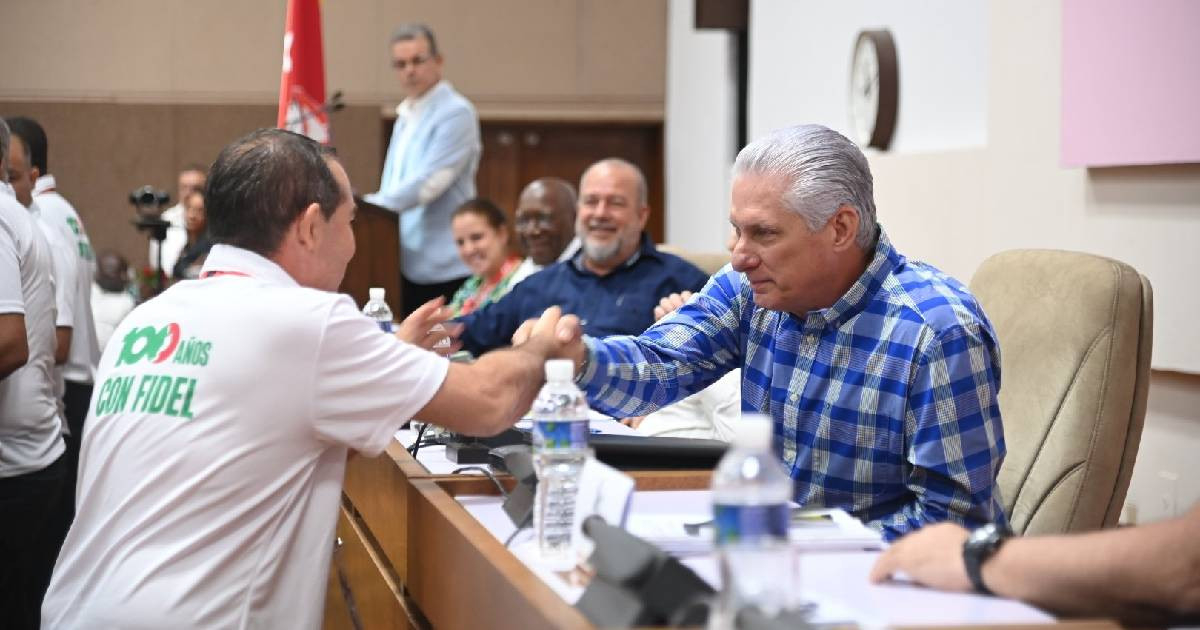
Cuban leader Miguel Díaz-Canel concluded the 22nd Congress of the Central Workers' Union of Cuba (CTC) this past Saturday by appealing to the collective faith of the people. He emphasized through his social media that achieving the goals set during the event, as well as ongoing economic transformations, "requires the will and deep conviction that we can indeed succeed."
In a post on his X account, accompanied by a video titled "Restoring Capitalism in Cuba Will Never Be Our Intention," Díaz-Canel encapsulated the tone of the congress, which took place on June 26 and 27 at Havana's Palace of Conventions under the theme of reaffirmation of resistance and unity.
Hybrid Congress Amidst Energy Constraints
The event gathered 759 delegates, with 198 attending in person and 561 participating via videoconference from all 15 provinces. This hybrid format, the regime claims, was necessary due to the island's ongoing energy limitations.
The congress followed closely after the Communist Party's Central Committee approved a series of 176 economic reforms on June 18, organized into 23 strategic areas and later ratified in an extraordinary session of the National Assembly on June 19.
Economic Reforms and Sovereignty
The proposed measures include private banking, private exchange houses, a digital currency market, lifting the cap on small and medium-sized businesses to allow more than 100 workers, direct foreign investment in private ventures, and the gradual reduction of widespread subsidies, including the ration book in place since 1962.
During his address to the delegates, Díaz-Canel insisted that these reforms are not a response to external pressures but rather a sovereign decision.
He also refuted claims of a "capitalist drift," acknowledging that "more elements of private property, private production, capitalism, and the market will necessarily be introduced."
Promises of People's Power Amidst Economic Hardships
Simultaneously, he promised that power would remain in the hands of the people, not "the rich or the bourgeois," and assured that the transformations would focus on "the most vulnerable sectors" and retirees.
"We are not just resisting by withstanding; we are resisting creatively. The country will move forward, and moreover, we will overcome," Díaz-Canel declared to the delegates, in a speech the regime touts as an embrace of wealth creation, even as millions of Cubans lack food and electricity to make it through the day.
Labor Rights Under Scrutiny
The new Labor Code presented at the congress fails to recognize the right to strike or allow independent unions, continuing the monopoly of labor representation by the CTC since 1961.
The rhetoric of resistance starkly contrasts with a grim reality: 89% of Cubans live in extreme poverty, minimum pensions hover around 3,300 pesos per month—less than seven dollars—and the basic cost of living exceeds 96,000 pesos monthly, against a minimum salary of 3,210 pesos.
The Economic Commission for Latin America and the Caribbean (ECLAC) projects a 6.5% decline in Cuba's GDP by 2026, marking the worst performance in Latin America for the second consecutive year. Economist Pedro Monreal warns that the downturn could reach 15%.
The U.S. Department of State described the 176 measures as "superficial smoke signals," and the Trump administration continues to uphold sanctions against entities linked to the Cuban military elite's business conglomerate.
FAQs on Cuba's Economic Transformation
What are the key economic reforms announced by the Cuban government?
The Cuban government has announced 176 economic reforms, including private banking, private exchange houses, a digital currency market, and direct foreign investment in private ventures, among others.
How is the new Labor Code affecting workers in Cuba?
The new Labor Code does not recognize the right to strike or allow independent unions, maintaining the monopoly of labor representation by the CTC since 1961.
What is the current economic situation in Cuba?
Cuba is facing severe economic challenges, with 89% of the population living in extreme poverty, and a minimum pension and salary that are insufficient to cover the basic cost of living.