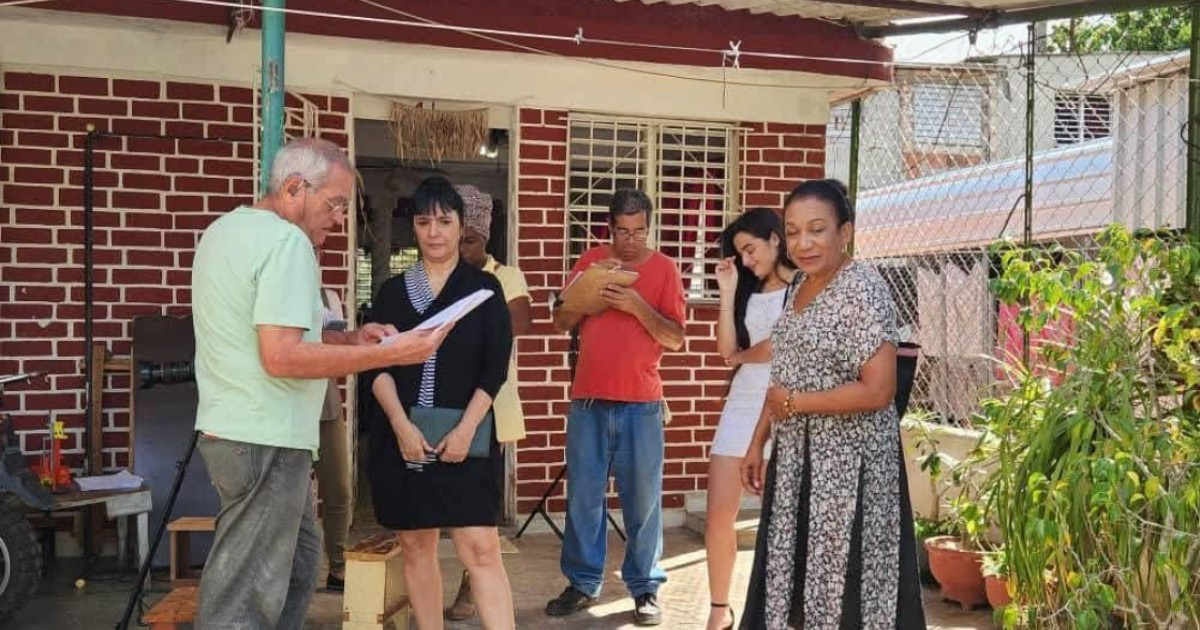
The state-run outlet Cubadebate has announced the upcoming debut of the telenovela "Entre aguas" on Cuban television, slated for next Monday under the direction of Felo Ruíz. This comes at a time when millions of Cubans have been grappling with a severe shortage of electricity, making it nearly impossible to watch television.
According to the announcement, the series will air on Cubavisión during prime time on Mondays, Wednesdays, and Fridays, spanning a total of 80 episodes.
The Cuban public's reaction on social media was not one of anticipation but rather of frustration and sarcasm.
The Facebook post by Cubadebate became a platform for Cubans to express their exasperation over the country's worst energy crisis in history. Comments ranged from, "Why bother if there's no power to watch it?" to more pointed remarks like, "With what electricity?"
One of the most telling comments described the situation faced by many Cuban households: "It's disrespectful... Even kids can't watch cartoons."
Irony was also present, with one user commenting, "Oh, are they giving out free solar panels through the committee?" mocking the disconnect between the regime and reality.
Others touched on the quality of Cuban soap operas: "Each Cuban soap opera is worse than the last... record after record... plus, the people have no power."
Criticism also extended to the regime's priorities: "Is a soap opera more important now? Hardly anyone will get to see it!"
Another commentator summarized, "Without prosperity, there's no art or anyone to appreciate it," while another ended with a bitter note: "Anyone reading you would think everything is just peachy."
The stark contrast between official enthusiasm and the country's harsh reality is glaring. Cuba recorded a record electricity deficit of 2,208 MW on Thursday, surpassing the previous high of 2,174 MW noted on May 14. This data highlights the ongoing energy crisis that the regime cannot hide.
In Havana, electricity was out for 24 hours on Thursday, with a maximum impact of 640 MW. Other regions, like Matanzas, have experienced power cuts lasting up to 85 consecutive hours.
The record-breaking power deficit is exacerbated by the halt in Venezuelan oil supplies since January and reduced Mexican shipments since December. Meanwhile, 106 distributed generation plants remain offline due to a lack of fuel, resulting in 890 MW being out of service.
The crisis also directly impacts television broadcasting: power outages disrupt digital TV signals in Havana, affecting channels 24, 48, and 50 due to electrical instability at the K Tower in El Vedado.
In Las Tunas, the fuel shortage has reduced television to a single channel since June, and Camagüey experienced over four days without TV broadcasts, with no official explanation provided.
Director Felo Ruíz, who started at the Cuban Institute of Radio and Television in 1967 as a lighting assistant, stated that the soap opera "upholds an important principle: the value of friendship" and that "justice should always prevail over any feelings of revenge." He also mentioned that the production faced challenges due to the chikungunya epidemic.
Meanwhile, this week, Cubans protested in Vedado and other Havana neighborhoods due to nearly 24-hour power outages, and pots and pans were banged in protests in Santiago de Cuba.
The Cuban Observatory of Conflicts reported 1,311 protests in May, marking the highest monthly number ever documented.
Cuba's Energy Crisis and Public Response
What is the current state of electricity in Cuba?
Cuba is experiencing a severe electricity crisis, with record deficits and widespread power outages affecting daily life and television broadcasting.
How are Cubans reacting to the telenovela premiere amid the power crisis?
Many Cubans have expressed frustration and sarcasm on social media, criticizing the government's priorities and the feasibility of watching the show without reliable electricity.
What factors are contributing to the electricity shortages in Cuba?
The shortages are worsened by the suspension of Venezuelan oil supplies since January, reduced shipments from Mexico, and the shutdown of numerous distributed generation plants due to fuel shortages.