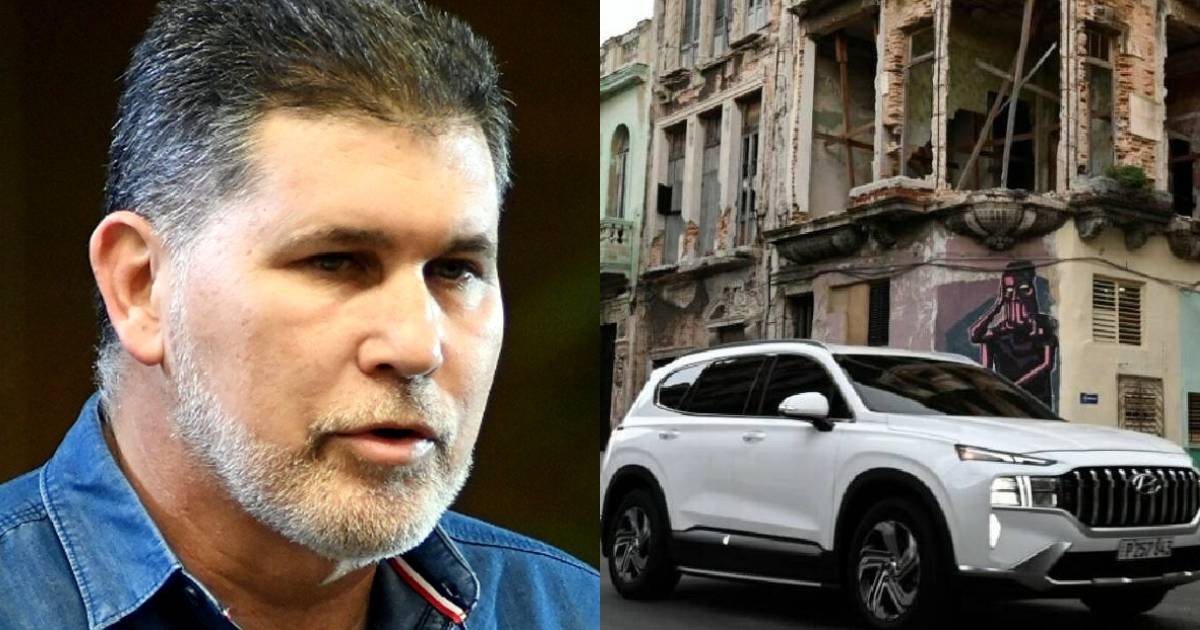
On Friday, Deputy Prime Minister Oscar Pérez-Oliva Fraga admitted before the XXII Congress of the CTC that generating wealth is essential to sustain resource distribution and progress towards the social model that the Cuban regime advocates.
During his presentation of the Government's Economic and Social Program 2026 and the 176 economic and social measures, Pérez-Oliva emphasized the urgency of boosting production and efficiency amid an economic crisis he described as one of the most challenging the country has ever faced, according to an official report from Cubadebate.
As the Minister of Foreign Trade and Foreign Investment, he encapsulated his perspective with a striking statement: "Without energy, there is no economy. Without energy, we cannot produce. Production is limited, the economy halts, wealth is not generated. Without generating wealth, distribution is impossible. This is the core principle of socialism: the fair distribution of wealth created within society."
Pérez-Oliva attributed the economic challenges to U.S. sanctions, claiming they aim to isolate Cuba in economic, commercial, banking, and financial sectors.
However, his address also highlighted structural issues within the national economy by acknowledging the unsustainability of the current subsidy framework.
Phasing Out Universal Subsidies
One of the most significant announcements was the gradual elimination of universal subsidies to state-owned enterprises. He detailed that the budget allocates 92,000 million pesos to subsidize companies, with nearly half of this amount used for electricity tariffs.
"The business system must operate entirely without state subsidies and become self-sustaining," declared the Deputy Prime Minister, who also acknowledged that maintaining current support levels would require "productivity and efficiency levels that we are not achieving at present."
He also advocated for moving away from widespread population subsidies towards targeted mechanisms aimed at vulnerable individuals.
"Our economy simply cannot continue applying equal product subsidies to the entire population, as it is mathematically unsustainable," he affirmed.
Shifts in Official Discourse
These statements mark a significant shift in official rhetoric, which for decades has portrayed universal subsidies as a major achievement of the Cuban system. Now, they are deemed financially unfeasible in an economy unable to generate the necessary wealth to sustain them.
The Government Program 2026 is the culmination of nearly 100,000 meetings held nationwide since December 2023, involving almost two million participants and over 196,000 proposals. The final version includes 163 actions and 45 indicators, exceeding the 2025 edition.
The top three citizen proposal priorities focused on macroeconomic stabilization, social policies, and food production.
Reform Measures and Potential Risks
Pérez-Oliva noted that these themes underpin the 176 transformations that the Central Committee of the Party, the National Assembly, and the Council of Ministers approved on June 18 and 19.
The reform package includes the authorization of private banking, direct foreign investment in private businesses, lifting the 100-worker limit for small and medium enterprises, price liberalization, and the gradual introduction of value-added tax. The U.S. State Department labeled these reforms as "superficial smoke signals."
During the congress, leader Miguel Díaz-Canel also emphasized the necessity of wealth creation to sustain reforms, a new theme in official rhetoric.
"To defend this, we must produce, create wealth, and be able to distribute that wealth with a sense of justice," he stated.
According to Cuban economist Mauricio de Miranda, without democratic checks and balances, the reforms could lead to a transition benefiting Party elites transformed into oligarchs through opaque privatizations, a scenario he described as a "Russian-style transition."
Understanding Economic Reforms in Cuba
What are the key changes in Cuba's economic reforms?
The reforms include authorizing private banking, allowing direct foreign investment in private businesses, removing the 100-worker limit for small and medium enterprises, liberalizing prices, and gradually introducing value-added tax.
Why is Cuba eliminating universal subsidies?
Cuba is phasing out universal subsidies because they have become financially unsustainable in an economy that cannot generate the necessary wealth to maintain them.