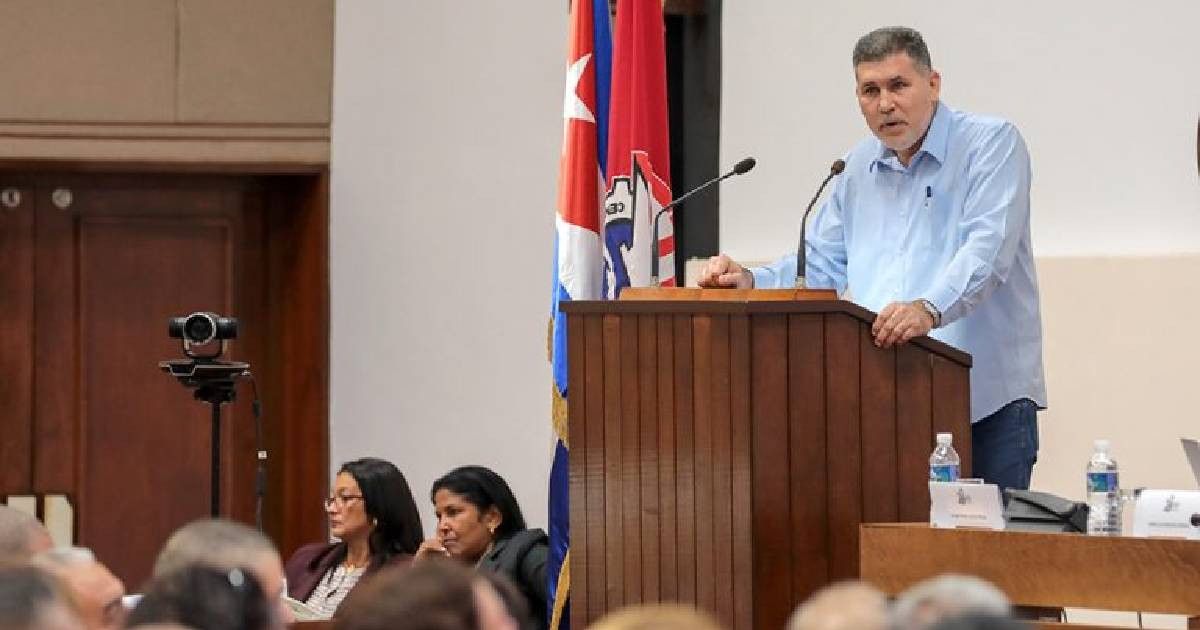
On Friday, Deputy Prime Minister Oscar Pérez Oliva-Fraga addressed delegates at the 22nd Congress of the Central de Trabajadores de Cuba (CTC), advocating for the cessation of widespread subsidies as part of 176 economic and social measures sanctioned by the regime.
According to the state-controlled outlet Cubadebate, Pérez Oliva-Fraga, who also serves as the Minister of Foreign Trade and Foreign Investment, argued that the current model is financially untenable for the government.
"Our economy simply cannot sustain the equal distribution of product subsidies to the entire population; it's a mathematical equation that doesn't add up," he stated.
In his presentation, he disclosed that the state budget allocates 92 billion pesos to subsidize the business sector, with about half of that amount dedicated to maintaining electricity tariffs.
Pérez Oliva-Fraga acknowledged that maintaining such spending levels would require "levels of productivity and efficiency that we are not achieving at present."
He also asserted that state-owned enterprises must operate without direct financial aid from the government. "The business system has to function entirely without state subsidies and must be self-sustaining," he declared.
The Energy Crisis Connection
The official linked the need to eliminate subsidies with the country’s ongoing energy crisis. "Without energy, there can be no economy. Without energy, we cannot produce. We produce with limitations, the economy comes to a halt, wealth is not generated. Without generating wealth, it cannot be distributed," he explained.
As an alternative to universal subsidies, the regime proposes focusing aid on individuals considered vulnerable, identified through the digital platform SOBERANÍA, to "allocate more resources to genuinely assist those in need."
Reforming Social Aids
Meanwhile, leader Miguel Díaz-Canel urged the creation of wealth to support reforms, a message that contrasts starkly with the decades-long official rhetoric against free-market economic concepts.
This shift in subsidy policies has direct historical precedents. In 2020, Marino Murillo, then head of the Communist Party of Cuba's Guidelines Implementation Commission, announced the removal of excessive subsidies as part of the Monetary Reordering, a measure that was never fully executed.
On June 18, Díaz-Canel announced that the universal basic food basket would be limited to retirees, families with chronically ill children, and vulnerable individuals, signaling a historic shift in Cuba's social model.
Economic Implications
Social aid will be adjusted based on family income, in a context where the minimum wage is 3,210 pesos monthly. In May, economist Javier Pérez Capdevila estimated that an individual requires at least 96,060 pesos per month to meet basic needs.
Economist Mauricio de Miranda warned that these reforms are designed to appeal to sectors of the U.S. government interested in business, cautioning that without democratic checks and balances, the result could be a "Russian-style transition," with Communist Party elites transforming into oligarchs through opaque privatizations.
Understanding Cuba's Shift in Economic Policy
Why is Cuba ending universal subsidies?
Cuba is ending universal subsidies because the current economic model has become unsustainable for the state's finances. The government aims to allocate more resources to genuinely assist those in need while addressing the energy crisis impacting productivity and wealth generation.
What alternatives are being proposed to universal subsidies?
The Cuban regime suggests concentrating assistance on vulnerable individuals identified through the digital platform SOBERANÍA, intending to provide more targeted support to those who need it most.
How will the changes affect Cuban citizens?
The changes will limit access to subsidized goods and services, making them available primarily to retirees, families with chronically ill children, and vulnerable individuals. This shift is expected to affect the cost of living and resource distribution for the average Cuban citizen.