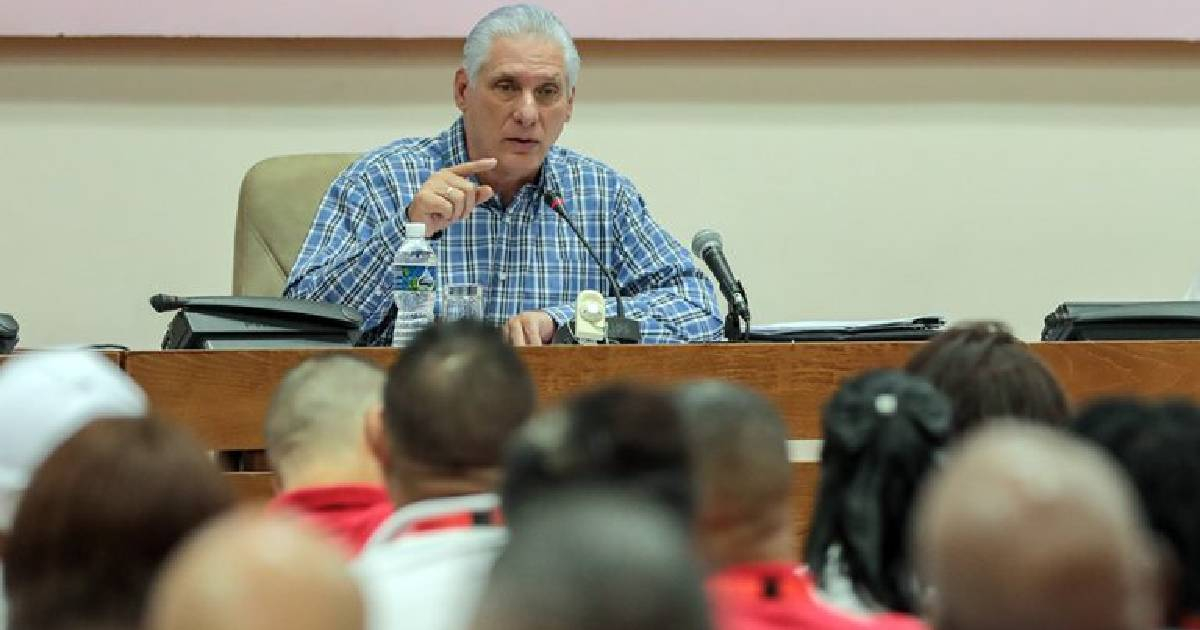
On Friday, Cuban leader Miguel Díaz-Canel advocated the necessity to "generate wealth" during the XXII Congress of the Central de Trabajadores de Cuba (CTC). This statement marks a shift from the regime's long-standing opposition to market-oriented economic concepts as part of its economic reform agenda.
"To uphold this, production must increase, wealth must be generated, and that wealth must be distributed with a sense of justice," Díaz-Canel emphasized at the session held at Havana's Palacio de Convenciones, as reported by the state-run outlet Cubadebate.
He urged workers to support the newly approved economic transformations by the government, asserting, "The success of these transformations hinges on the active participation of our workers."
The congress, which gathered 759 delegates from across the nation, saw 561 participating through videoconference due to the ongoing energy crisis affecting the island.
Significant Economic Overhauls Announced
During the congress, Vice Prime Minister Oscar Pérez Oliva-Fraga outlined 176 economic and social changes ratified on June 18 by the Communist Party of Cuba's Central Committee. He affirmed that these reforms are crucial for achieving the government's economic goals.
The measures include allowing direct foreign investment in private enterprises, the establishment of private banks, lifting the cap on the number of workers in small and medium-sized enterprises, easing price controls, and gradually reducing widespread subsidies.
These reforms constitute one of the most extensive economic changes initiated by the regime in decades, amidst a backdrop of declining production, inflation, power outages, and shortages.
Reality of Economic Hardships
Despite the official rhetoric promoting economic growth and wealth creation, the reality for most Cubans remains grim. The minimum wage was recently increased to 3,210 pesos per month. However, economist Javier Pérez Capdevila estimated in May that an individual needs at least 96,060 pesos monthly to meet basic needs.
The stark disparity is evident in food prices, with a carton of eggs costing between 3,000 and 4,000 pesos in the informal market, matching or exceeding the monthly minimum wage.
The new measures have sparked widespread criticism on social media, with users questioning their effectiveness in tackling issues like power outages, food shortages, and declining purchasing power. One user sarcastically remarked, "Download them and eat and light up with the measures on paper," highlighting the country's dire economic and social conditions.
Criticism and International Response
Economist Mauricio de Miranda, from the Cuba Transformación group, cautioned that the reforms aim to attract sectors of the U.S. government interested in business, rather than improving the lives of Cubans. "These measures are meant to show certain U.S. officials that we are capable of opening up the economy," he stated to CiberCuba.
De Miranda also warned that without democratic institutional checks, the result might be "a Russian-style transition," where Communist Party elites transform into oligarchs through opaque privatizations.
The new Labor Code, presented by Minister Jesús Otamendiz Campos during the congress, fails to recognize the right to strike or allow independent unions, maintaining the CTC's labor representation monopoly since 1961.
The U.S. State Department labeled the 176 reforms as "superficial smoke signals," and the Trump administration imposed additional sanctions on five entities linked to GAESA, the military elite's business conglomerate.
Understanding Cuba's Economic Reforms
What are the recent economic reforms approved by the Cuban government?
The recent reforms include direct foreign investment in private businesses, the creation of private banks, removal of the worker limit for small and medium enterprises, easing price controls, and reducing generalized subsidies.
How have these reforms been received by the public?
The public has reacted with criticism, particularly on social media, questioning the reforms' ability to address major issues like energy shortages, food scarcity, and inflation.
What concerns have been raised about the impact of the reforms?
Concerns include the potential for reforms to favor certain elites, lack of democratic oversight, and skepticism about their ability to genuinely improve the economic situation for ordinary Cubans.