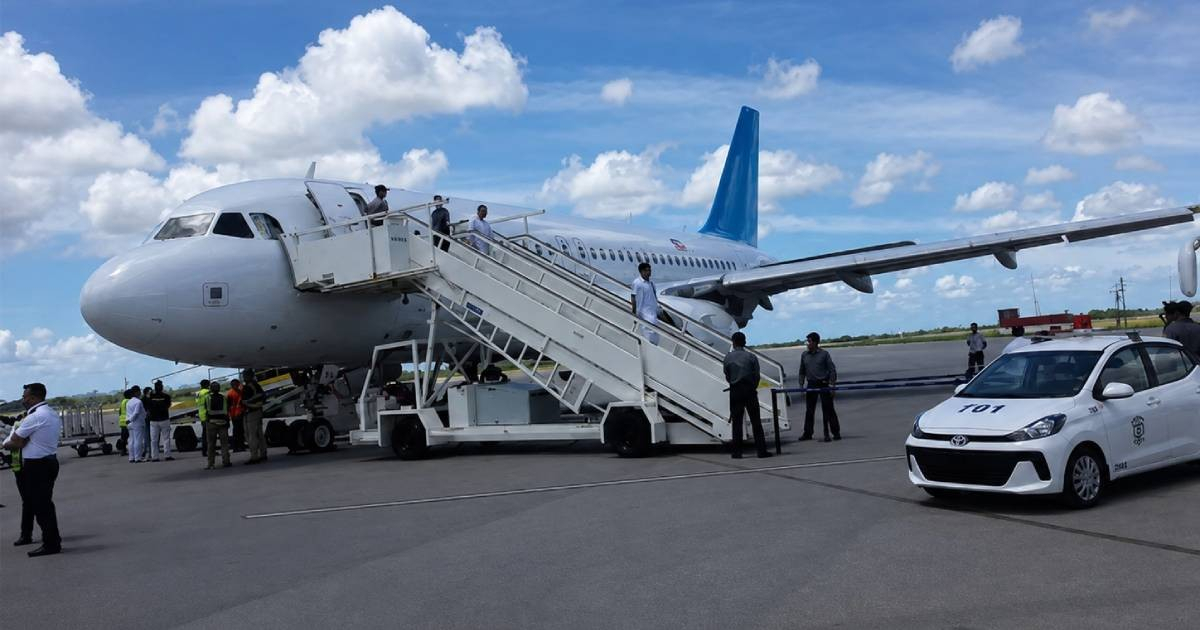
A flight originating from the United States landed at José Martí International Airport on Thursday, carrying 96 Cuban migrants—78 men and 18 women—as part of the latest deportation effort by the Trump administration.
The Cuban Ministry of the Interior reported that with this group, the total number of Cubans returned to the island in the first half of the year has reached 740 people, carried out through 25 operations from various countries in the region.
Data accumulated since the resumption of deportation flights in April 2023 show an unprecedented acceleration under the current U.S. government.
According to information compiled by Café Fuerte, which is based on the Department of Homeland Security and the Cuban Ministry of the Interior (MININT), 3,142 Cuban migrants have been deported in 32 air operations since that date, up to this recent flight.
Deportation Rates Surge Under Trump's Leadership
The contrast between administrations is stark: During President Joe Biden's term, 19 flights occurred from April 2023 to December 2024, repatriating 978 Cubans. With Donald Trump's return to the White House in January 2025, the pace skyrocketed: In just 18 months, 18 direct flights deported 2,164 individuals, more than doubling the total from the previous period.
The deportation rate in 2026 has been especially high.
U.S. deportation flights are hitting record levels, with 612 Cubans already returned in the first five months of the year before this Thursday's operation.
Lack of Transparency in Deportation Details
Neither MININT nor the U.S. Immigration and Customs Enforcement (ICE) provide details on whether the deportees have criminal records or final orders of deportation. ICE stopped detailing flights to Cuba months ago, limiting independent verification of these operations.
Direct deportations to Cuba are not the sole aspect of the phenomenon. Over 6,000 Cubans have been sent to Mexico by the Trump administration, and an unspecified number have been transferred to Honduras, Ecuador, and African nations.
Arrests of Cuban migrants by ICE increased by 463% between late 2024 and early 2026.
Challenges and Risks for Deported Cubans
The repercussions for deportees extend beyond the forced return. A Cuban who arrived on the first flight of the year, on February 9 with 170 individuals, reported being tortured at Villa Marista upon his return to the island.
This flight was the first in decades to carry individuals convicted of serious crimes, something the Cuban regime had historically resisted accepting.
Considering both of his presidential terms, Trump has overseen the deportation of the largest number of Cubans in U.S. history, with figures surpassing 5,300, compared to 978 under Biden, 416 during George W. Bush's administration, and 341 under Barack Obama.
Key Questions on Cuban Deportations
Why are Cuban deportations from the U.S. increasing?
The increase in deportations is largely attributed to the policies of the Trump administration, which has intensified efforts to return Cuban migrants compared to previous administrations.
How many Cubans have been deported under Trump's administration?
During Trump's two terms, more than 5,300 Cuban migrants have been deported, making it the highest number in U.S. history for any administration.
What challenges do deported Cubans face upon returning to the island?
Deported Cubans often face significant challenges, including potential human rights abuses, as reported by individuals who have alleged torture upon their return.