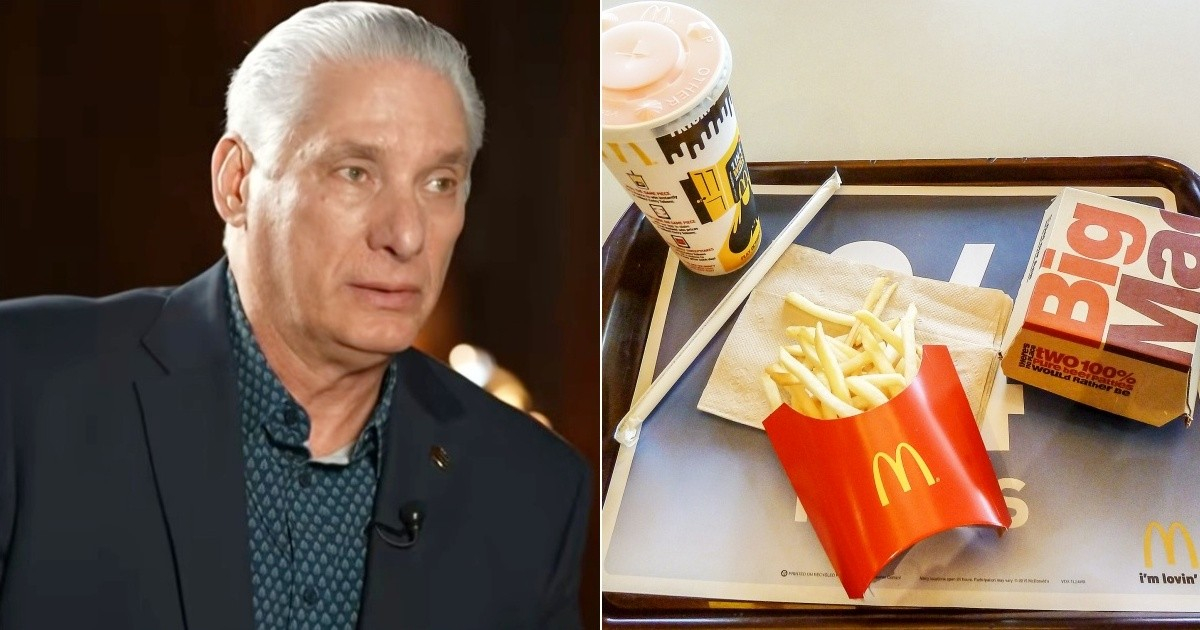
In a rare moment, Cuban leader Miguel Díaz-Canel addressed the possibility of international fast-food giants like McDonald's and Burger King setting up shop in Cuba. This discussion comes on the heels of the regime's announcement to open the island to foreign franchises.
While he avoided giving a straightforward answer, Díaz-Canel emphasized that any such move must adhere to a principle of equality between foreign and domestic investments.
Exploring the Prospects of Foreign Franchises
The comments were made during an interview with Telenoticias from the Dominican Republic, following the National Assembly's approval of 176 economic measures. These measures include allowing international franchises, among other economic shifts.
Cuban-born journalist Roberto Cavada pushed for clarity by asking if brands like Burger King or McDonald's, or even a Dominican brand like Rico Hot Dog, could establish themselves in Cuba without hurdles.
Díaz-Canel neither confirmed nor denied the possibility. Instead, he used the question to argue that any future opening should treat foreign and national capital equally.
Equality in Economic Opportunities
"Everything must be based on the same concepts: equality for all," he stated. "While we discuss foreign franchises, we must also consider Cuban franchises abroad."
He argued that if Cuba opens its doors to international franchises, it should also enable Cuban businesses to expand beyond the island.
"Supporting foreign investment is senseless if we don't support our nationals' investments in any form," Díaz-Canel noted.
He further asserted that benefits must extend beyond just foreign investors.
"If you offer opportunities for foreign investment, you must also provide avenues for national businesses, whether state-owned or private," he added.
Díaz-Canel emphasized that state-owned socialist enterprises and private or cooperative entrepreneurs should not be disadvantaged.
Challenges and Opportunities Amid Economic Struggles
"You can't offer a set of advantages to foreign investors while keeping state-owned enterprises or private entrepreneurs trapped," he insisted.
Although he stopped short of confirming that chains like McDonald's or Burger King would open in Cuba, Díaz-Canel made it clear that any foreign company entering the market must comply with the regime's conditions.
"Anyone coming to Cuba must do so without imposing anything, working within the framework of how business and investment projects are conducted globally," he stated.
He reiterated that this economic opening does not equate to abandoning the socialist model.
"We are not seeking a capitalist restoration. We aim to perfect socialist construction under our current adverse conditions," Díaz-Canel declared.
When asked if Cuba was moving towards a "one country, two systems" model, he responded:
"Cuba will remain independent, sovereign, and socialist, with a strong commitment to social justice."
A Shift in Economic Policy
The 176-measure package, approved by the National Assembly, includes the introduction of private banking, a first since 1959, greater openness to investments from Cubans abroad, transformation of state enterprises into joint-stock companies, and changes in the subsidy system.
These remarks from Díaz-Canel follow Prime Minister Manuel Marrero Cruz's official announcement of plans to allow foreign franchises.
During an Extraordinary Plenary of the Communist Party Central Committee, Marrero explained the government's intention to establish chains of restaurant stores, light gastronomy networks of recognized brands, or new ones to be created across the country.
Until now, no international franchise has officially operated in Cuba. However, Cuban private businesses have mimicked American brands with similar names, logos, and concepts.
The prospect of international chains arriving in Cuba arises amidst a severe economic downturn. The Economic Commission for Latin America and the Caribbean (CEPAL) forecasts a 6.5% GDP contraction by 2026, with the island experiencing a 23% decline since 2019. Additionally, widespread power outages, food and fuel shortages, and persistent inflation have worsened the situation.
Just a day prior, Díaz-Canel acknowledged, "There are obstacles that don't come from outside or from blockades. There is slowness, bureaucracy, regulations hindering those who wish to produce, and decisions we have postponed," a rare admission of internal problems.
If chains like McDonald's or Burger King ultimately make their way to Cuba, it would mark one of the most visible shifts in the economic model established since 1959. However, past experience shows that there's often a significant gap between official announcements and their actual implementation.
Understanding Cuba's Economic Transformation
What are the key economic changes recently approved in Cuba?
The National Assembly approved 176 economic measures, including the introduction of private banking, allowing foreign franchises, and transforming state enterprises into joint-stock companies, among others.
How is the Cuban government justifying the opening to foreign franchises?
The government claims that any opening must ensure equal treatment for both foreign and domestic investments, aiming to enhance socialist construction under current economic challenges.
What are some challenges facing Cuba's economy?
Cuba is grappling with a severe economic crisis, including a projected GDP contraction, power outages, food shortages, and persistent inflation, compounded by internal bureaucratic obstacles.