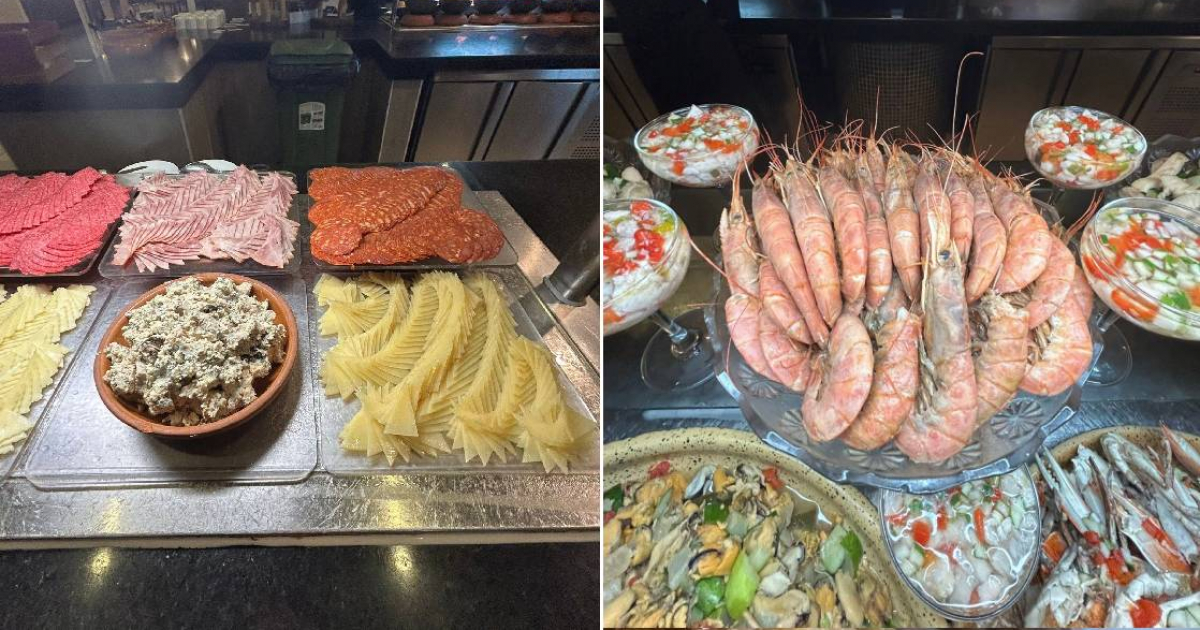
Recently, a tourist's Facebook post starkly highlighted the harsh duality of life in Cuba: while locals struggle to secure three meals a day, the regime's hotels lavishly cater to foreign visitors with grand feasts.
Mike Fisher, a guest at the Meliá Internacional Hotel in Varadero, shared several photos of the hotel's dinner buffet, where over 1,300 guests from Argentina, Portugal, Mexico, Canada, Spain, and Cuba were treated to a table overflowing with choices.
"Lamb, chicken, pork, fish, tuna... this buffet has it all," Fisher commented, also listing breadsticks, pasta, cakes, and desserts among the available offerings.
The Stark Contrast of Cuban Reality
The disparity between this scene and the reality for the Cuban population is nothing short of shocking.
According to the 2025 report "En Cuba Hay Hambre" from the Food Monitor Program, 33.9% of Cuban households recently experienced hunger, and an overwhelming 96.91% of the population lost adequate access to food due to inflation and reduced purchasing power.
Only 57.6% of Cubans manage to eat three meals a day, while 3.7% barely get by with just one meal, as per the report.
A national survey highlighted that one in three Cuban families went to bed hungry, as reported by Diario de Cuba.
Economic Discrepancies and Regime Policies
In the informal market, rice prices have soared to over 400 Cuban pesos per pound, in a country where the average state salary hovers around 7,000 pesos monthly.
This stark inequality is no accident; it results from deliberate policies by the regime.
The military conglomerate GAESA, which dominates Cuba’s economy, has funneled resources 13.8 times more into hotels than into public health over the past 15 years, allocating a total of $24.2 billion to the tourism sector.
In 2024, the regime directed nearly 40% of its total investments to tourism, while agriculture received a meager 2.7%.
Tourism Sector Faces Collapse
Meanwhile, up to 20,000 tons of food donated by the UN remain undistributed due to fuel shortages, and power outages lasting up to 22 hours daily hinder food preparation in 80.4% of households.
Despite the regime's heavy focus on tourism, the sector is in decline.
Hotel occupancy plummeted to 21.5% in 2026, and Meliá Hotels International announced on June 3 its withdrawal from 15 hotels in Cuba due to Trump administration sanctions against GAESA, stemming from Executive Order 14404 signed on May 1, 2026.
Even amid this collapse, the food crisis is forcing the regime to adjust its approach reactively and belatedly: in June 2026, the government admitted it had failed to distribute oil, chicken, or yogurt in the rationed basket.
This isn’t the first time hotel buffet images have sparked outrage. In 2025, a TikTok video by user @kary_y_jony showed a similarly abundant spread at the Meliá Paradisus Los Cayos, igniting similar outcries over the divide between tourist abundance and the scarcity faced by the Cuban people.
Infant mortality in Cuba doubled to 9.9 per 1,000 births in 2026, a stark indicator of the human cost inflicted by decades of misplaced priorities under the dictatorship.
Cuban Food Crisis: Frequently Asked Questions
Why are Cuban citizens experiencing food shortages?
Cuban citizens are facing food shortages due to inflation, reduced purchasing power, and government policies that prioritize tourism over agriculture and public health.
How has the Cuban regime's focus on tourism affected local food distribution?
The regime's investment in tourism has diverted resources away from critical sectors like agriculture, resulting in insufficient food production and distribution for the Cuban populace.
What are some of the impacts of the food crisis on Cuban households?
The food crisis has led to a significant portion of the population experiencing hunger, with many families unable to have three meals a day. Power outages also exacerbate the situation by hindering food preparation.