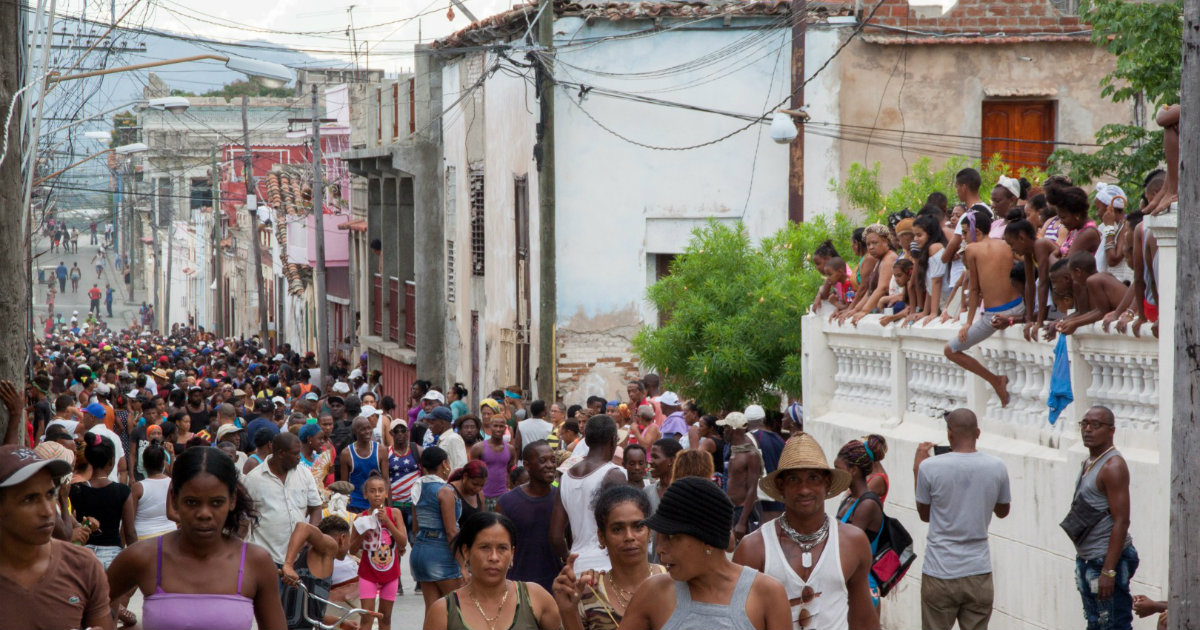
For the second consecutive year, Cuban authorities have banned the traditional street congas in Santiago de Cuba for the Day of San Juan. The decision, attributed to the "political and ideological situation" in Santiago, was communicated via an internal message circulating among group leaders.
The underlying reason is quite evident: Congas can draw thousands into the streets, and in a city already experiencing weeks of protests and banging pots, such gatherings are what the regime fears most.
The internal memo, shared among group directors, stated clearly: "Good evening Directors, we inform you that the procession on the 24th, Day of San Juan, is not authorized due to the political and ideological situation Santiago de Cuba is currently facing."
A follow-up message urged understanding and support for the decision made by the provincial party, while another clarified that performances should occur only within group premises, prohibiting those without a location from playing.
The direct precedent occurred in June 2025, when the Paso Franco ensemble paraded through the streets, and crowds loudly chanted "Súbelo Mayeta!"—turning a celebration into a collective protest.
This chant, which originated as a social media hashtag to voice grievances against independent journalist Yosmany Mayeta Labrada, had become a symbol of popular discontent, a situation the regime was keen to avoid repeating.
A similar scenario unfolded in December 2025 when Los Hoyos Conga was absent on its traditional date of December 27. Mayeta described it as "censorship without paper," as the Provincial Directorate of Culture spread rumors of cancellation without issuing a formal ban.
Wednesday's decision comes just days after Santiago experienced widespread protests in nearly all its neighborhoods—Sueño, Santa Bárbara, Antonio Maceo, Veguita de Galo, Mármol, and Altamira—protesting blackouts that lasted up to 22 consecutive hours.
Protests erupted close to the provincial headquarters of the Communist Party, highlighting the mounting tension in the city.
Despite the ban, the local spirit was undeterred. In the Flores neighborhood, residents spontaneously organized "La Conga de Porrones" to keep the tradition alive, but a police patrol quickly disbanded the gathering.
Meanwhile, at Paseo de Marte—home to the iconic Los Hoyos Conga, known as "The Train"—dozens of Santiago residents waited in vain for the group's performance.
The regime's fear isn't of the music itself. Santiago's conga has colonial roots, originating from 19th-century festivities by enslaved Africans, blending African, Spanish, and Franco-Haitian influences. It has long served as a social release valve.
"The conga is like a pressure cooker’s safety valve," a member of Los Hoyos Conga described in 2018.
Its spontaneous chants have always reflected the public's sentiment, from "Cubans eat rice, one day yes, one day no" to the current "Súbelo Mayeta!"
But today, this outlet is intolerable for the authorities. As Mayeta Labrada reported from the field: "They don't fear the drums, the Chinese horns, or the dancers who have filled Santiago’s streets for generations. They fear the crowds. They fear the congas' ability to bring thousands together in one space."
The San Juan congas traditionally kick off Santiago's July festivities, including the Festival of the Caribbean, the carnivals, and the city's anniversary on July 25, suggesting the ban might extend in the coming weeks.
Insights into the Congas Ban in Santiago de Cuba
Why did the Cuban regime ban the congas in Santiago de Cuba?
The regime banned the congas due to fears of large gatherings turning into protests, especially given the ongoing political and ideological tensions in Santiago de Cuba.
What historical significance do the congas hold in Santiago de Cuba?
Santiago's congas have colonial roots, originating from 19th-century celebrations by enslaved Africans, mixing African, Spanish, and Franco-Haitian influences, and serving as a social release valve.
How did the ban affect local residents and traditions?
The ban disrupted traditional festivities and led to spontaneous local initiatives like "La Conga de Porrones," though these were quickly disbanded by authorities.