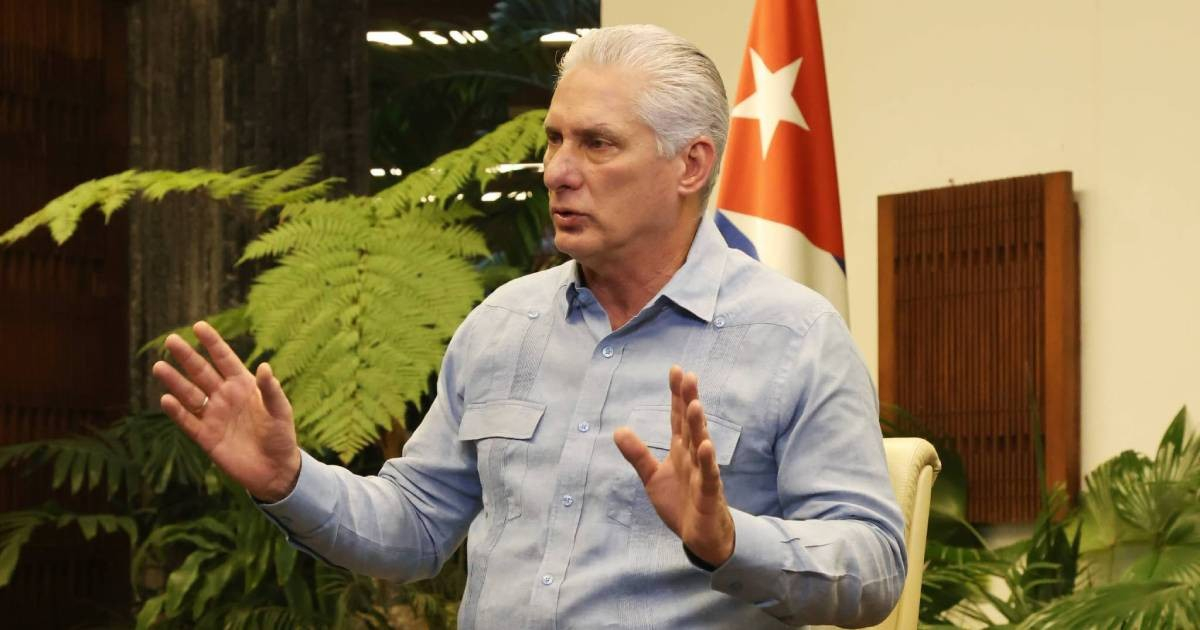
Miguel Díaz-Canel is set to return to international media this Wednesday, aiming to defend the Cuban regime's official stance regarding the ongoing crisis on the island. He will be interviewed by journalist Roberto Cavada on Dominican television.
According to Hoy, the interview is scheduled to air at 10:00 PM on Telesistema, Channel 11, as part of the prime-time broadcast of Telenoticias. The discussion will cover Cuba's economic challenges, the severe energy crisis causing prolonged blackouts, and the government's perspective on both domestic and international hurdles.
The interview will be conducted by Roberto Cavada, a prominent journalist on Dominican television and the face of Telenoticias. Born in Ciego de Ávila, Cuba, in 1971 and now a Dominican citizen, Cavada has established a significant career in the Dominican Republic, becoming a leading figure in television journalism.
Telesistema, Channel 11, one of the Caribbean nation's leading private television networks, will broadcast the segment. Through Telenoticias, its flagship news program, the channel reaches a broad national audience and often serves as a platform for interviews with political leaders, officials, and important regional figures.
This television appearance comes at a particularly turbulent time for the Cuban regime, characterized by economic decline, worsening electrical crises, and increasing public dissatisfaction due to shortages of food, medicine, and fuel.
The interview is part of a broader communication strategy that Díaz-Canel has ramped up in recent months to present his narrative to international audiences. He consistently blames U.S. sanctions for Cuba's troubles, dismisses any notion of relinquishing power, and condemns what he views as media campaigns against his government.
In 2026, Díaz-Canel has engaged with various foreign media outlets. In March, he spoke with Spanish politician Pablo Iglesias for Canal Red América Latina. A month later, he was interviewed by Newsweek, where he claimed, "there is a lot of media manipulation, a lot of hate has been sown."
He also appeared in an interview with journalist Kristen Welker on NBC News' "Meet the Press," becoming the first Cuban leader to feature on a high-profile U.S. television program since Fidel Castro's post-revolution appearance. This appearance sparked sharp criticism from exile communities and Cuban opposition. Independent journalist Mónica Baró Sánchez called it a "success of Castroist propaganda," while Republican Senator Rick Scott accused NBC of "giving Díaz-Canel a megaphone."
During that exchange, the Cuban leader was asked about stepping down to ease the Cuban crisis. His response was blunt: "Do they ask Trump that question?" He added, "resignation is not part of our vocabulary."
The Cuban government has also facilitated interviews with Al Mayadeen and the Spanish newspaper elDiario.es, where Díaz-Canel reiterated similar points about the island's political and economic situation.
The Cuban embassy in the Dominican Republic supported the promotion of this interview, sharing the announcement via social media.
The meeting with Cavada occurs amid a particularly severe energy crisis in Cuba. By May 2026, the electrical generation deficit reached 2,174 megawatts, leaving large areas without power. For this Wednesday, the Electric Union anticipates disruptions exceeding 2,000 megawatts, as over 1,200 remain offline due to fuel shortages.
In some regions, outages have reached extreme levels. In early June, residents of a circuit in Matanzas reported enduring up to 85 consecutive hours without electricity.
The interview will have an additional layer of significance: Roberto Cavada, born on July 4, 1971, in Ciego de Ávila and later becoming Dominican, will be conversing with the leader of his birth country, after having built his professional life in the Dominican Republic.
The regime's emphasis on such media engagements was highlighted by Díaz-Canel himself in April 2025, when he declared, "We will fight on social networks... and we will fight to win."
Insight into Cuba's Current Crisis
What is the main topic of Díaz-Canel's interview on Dominican TV?
The interview will primarily address Cuba's economic difficulties, the severe energy crisis, and the Cuban government's perspective on internal and international challenges.
Who is conducting the interview with Díaz-Canel?
The interview will be conducted by Roberto Cavada, a well-known journalist from Dominican television and the main face of Telenoticias.
What has Díaz-Canel attributed Cuba's crisis to?
Díaz-Canel has consistently blamed U.S. sanctions for the crisis in Cuba, rejecting any notion of stepping down and condemning perceived media campaigns against his government.