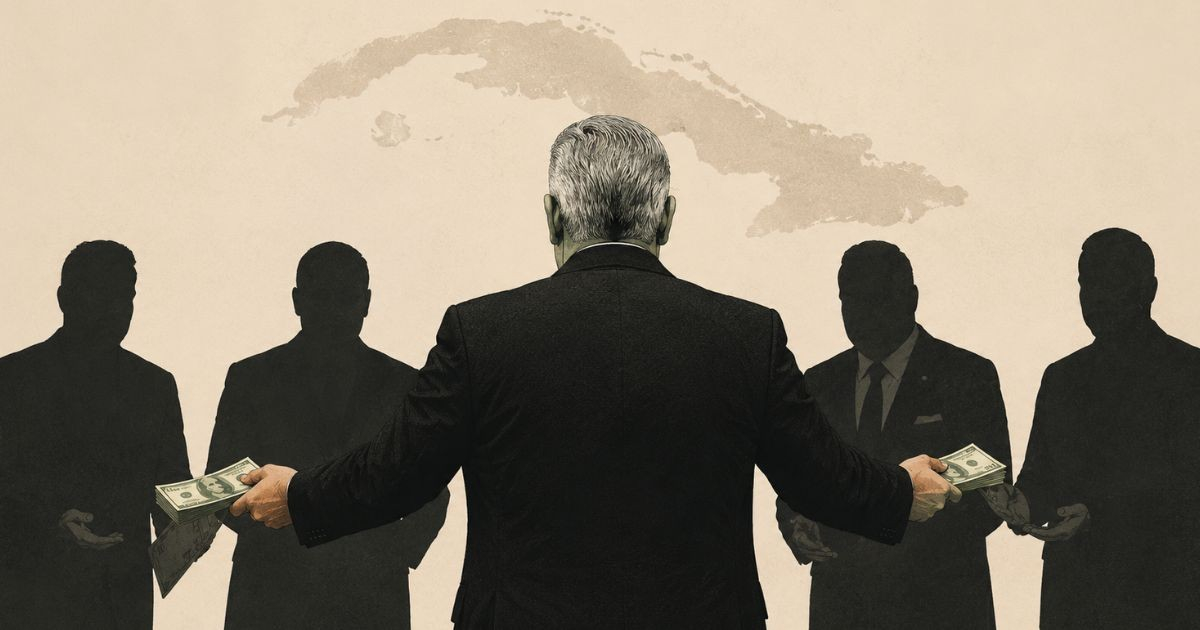
The independent organization Food Monitor Program has raised concerns that the set of 176 economic measures recently approved by the Cuban regime might lead to a form of "crony capitalism." This situation could see state-controlled assets transferred to individuals with ties to the government, effectively sidelining the general population from any benefits—a trend that has already been observed.
These measures, endorsed by the Extraordinary Plenum of the Communist Party's Central Committee on June 17 and confirmed by the National Assembly two days later, are categorized into 23 areas. They cover private banking, currency exchanges, foreign investment opportunities, subsidy reforms, and the transformation of state enterprises into joint-stock companies.
Among these, the transformation of state enterprises stands out as the most alarming for the organization. According to a press release, "Selling stakes in state companies without transparent bidding processes, independent judicial oversight, public audits, or citizen control can perpetuate known patterns of 'crony capitalism.' This transition risks moving state-controlled wealth into the hands of private individuals with governmental ties, while the population that has borne the economic burdens for decades is left out of the benefits."
Understanding the Risk of Crony Capitalism
This concept describes a system where business success hinges not on efficiency or innovation but on relationships with the government, including exclusive licenses, tax breaks, subsidies, and competitor obstructions.
In Cuba's context, this risk is exemplified by GAESA, a conglomerate managed by the Armed Forces that controls between 40% and 70% of the island's economy, with millions in assets and companies registered in Panama, Cyprus, and Liberia.
Economist Mauricio De Miranda Parrondo has described the process as a precursor to an "authoritarian patrimonial capitalism" led by the Communist Party, drawing parallels to the post-Soviet Russian transition where party elites became oligarchs through opaque privatizations.
Actor Luis Alberto García has also publicly expressed his concerns, urging that no Communist Party official, legislator, or military leader should transition into business ownership or shareholding without an independent audit of their assets.
The Broader Implications and Urgent Warnings
García noted on Facebook, "In the former Eastern Bloc countries after their dramatic collapse, we witnessed the swift transformation of high-ranking party and military officials into wealthy businessmen with money not derived from their previous salaries."
Furthermore, the Food Monitor Program highlights how the regime uses U.S. sanctions imposed by the Trump administration as a scapegoat to avoid addressing internal issues such as low agricultural productivity, state inefficiency, corporate opacity, and repression of independent social actors.
The organization argues that "External pressure does not absolve the Cuban state of its internal obligations concerning economic, social, and cultural rights."
The dire state of food security intensifies the urgency of this warning. According to the organization's data, 96.91% of the Cuban population experiences food insecurity, with 33.9% of households having at least one member who went to bed hungry in the past month, and 78% believing the current crisis is worse than the 1990s' Special Period.
To prevent the reforms from deepening exclusion, the Food Monitor Program calls for minimum guarantees: full publication of the 176 measures with timelines and accountability, public and independent audits of any state asset sales, explicit protection of the right to food in subsidy reforms, and recognition of civil society and independent media as legitimate oversight actors.
The organization concludes with a stark warning: "Without these measures, recent changes will lead to an unequal transition, benefiting an authoritarian and patrimonialist form of capitalism."
Frequently Asked Questions about Cuba's Economic Reforms
What are the new economic measures in Cuba?
The new economic measures in Cuba include private banking, currency exchanges, foreign investment opportunities, subsidy reforms, and the transformation of state enterprises into joint-stock companies.
Why is there concern about crony capitalism in Cuba?
There is concern about crony capitalism in Cuba because the new measures might lead to state-controlled assets being transferred to individuals with government ties, excluding the general population from benefits.
How does the Food Monitor Program view these economic changes?
The Food Monitor Program is critical of these economic changes, warning that without transparency and independent oversight, they could result in a system where wealth is concentrated among a few with governmental connections.