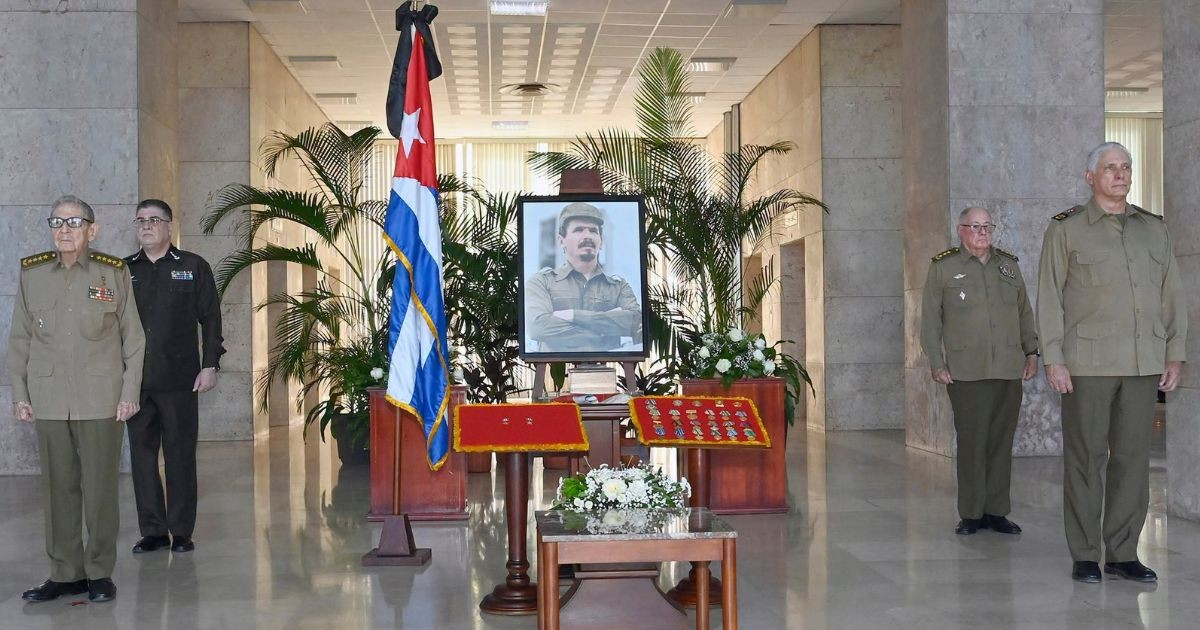
In a touching and almost nostalgic tribute on Facebook, Miguel Díaz-Canel mourned the passing of Ramiro Valdés Menéndez. Valdés, the architect of Cuba's repressive state apparatus, passed away on Sunday, June 21, at the age of 94.
Using the hashtag #ForeverRamiro, the Cuban leader expressed, "It's hard to picture the road ahead without his insightful and steady presence, without the drive that came from seeing him lead the charge in the most challenging missions, with the authority and dignity of a fighter who never allowed himself to rest, even at 94 years old."
It wasn't the first instance where Díaz-Canel employed emotional language to bid farewell to a cornerstone of the dictatorship.
Upon announcing Valdés's death on the same Sunday, June 21, he noted on X that Valdés's departure "hurts deeply, like losing a father."
Public Memories Clash with Official Mourning
The stark contrast between the official mourning and the public's memory of Valdés was evident.
Critics dubbed him "Blood Stain" and "the Butcher of Artemisa." Valdés, serving as the Minister of the Interior from the inception of the MININT in 1961, played a pivotal role in establishing the State Security and Cuban intelligence services, maintaining strong ties with the Soviet security machinery.
During his tenure at MININT, repressive policies such as the UMAP were enforced, establishing forced labor camps for homosexuals, religious individuals, dissidents, and other citizens deemed "untrustworthy" by the regime.
Even at 89, in August 2021, he personally decorated MININT officers who had suppressed the 11J demonstrators in Palma Soriano.
Reactions on Social Media
Díaz-Canel’s post sparked sarcastic and critical responses from Cubans online.
Joel Arencibia commented, "What’s hard to imagine is that you’re still breathing with the SOUTHCOM and DELTA FORCE so close."
Reina Martínez remarked, "Maybe now it's up to more of them to pay because another one left without paying what was owed."
Brian Palomino cheered, "One less communist, the generation that plunged Cuba into total misery is fading away."
Yotuel Bermúdez was more blunt: "And there are still people defending these millionaires who deceived the people for nearly 68 years. A whole lifetime. They see the people dying from hunger, misery, and need. They don't care. I always wonder how much longer. People of Cuba, open your eyes!"
The Official Ceremonial Farewell
Meanwhile, the regime orchestrated a full display of official mourning.
On Tuesday, June 23, Raúl Castro, along with Díaz-Canel, led the honor guard for Valdés at the MINFAR headquarters in Havana, where his decorations and the Cuban flag that accompanied the 1997 transfer of Che Guevara's remains from Bolivia to Santa Clara were displayed.
The regime declared an official mourning period through Presidential Decree 1247, with flags at half-mast, and Valdés's remains will be transported on Thursday, June 25, to Santa Clara for interment in the Mausoleum of the Las Villas Front, fulfilling his wish to rest near his comrades and close to Che Guevara.
With Valdés's passing, the so-called "historic generation" of the Revolution is now reduced to three figures: Raúl Castro, Guillermo García Frías, and Machado Ventura. Meanwhile, Cuban-American lawmakers María Elvira Salazar and Carlos Giménez expressed regret that Valdés died without facing justice for crimes against humanity.
Insights into Ramiro Valdés's Legacy
Who was Ramiro Valdés Menéndez?
Ramiro Valdés Menéndez was a pivotal figure in the Cuban regime, known for founding the repressive state apparatus and serving as the Minister of the Interior. He played a key role in developing Cuba's State Security and intelligence services.
What were the UMAP camps?
The UMAP camps were forced labor camps in Cuba where homosexuals, religious individuals, dissidents, and others considered "untrustworthy" by the regime were interned. These camps represented a harsh and repressive policy under Ramiro Valdés's oversight.
How did the public react to Díaz-Canel's tribute to Ramiro Valdés?
Díaz-Canel's emotional tribute on social media was met with irony and criticism from the public. Many Cubans expressed disdain for the regime's officials, highlighting the ongoing struggles and hardships faced by the Cuban populace.