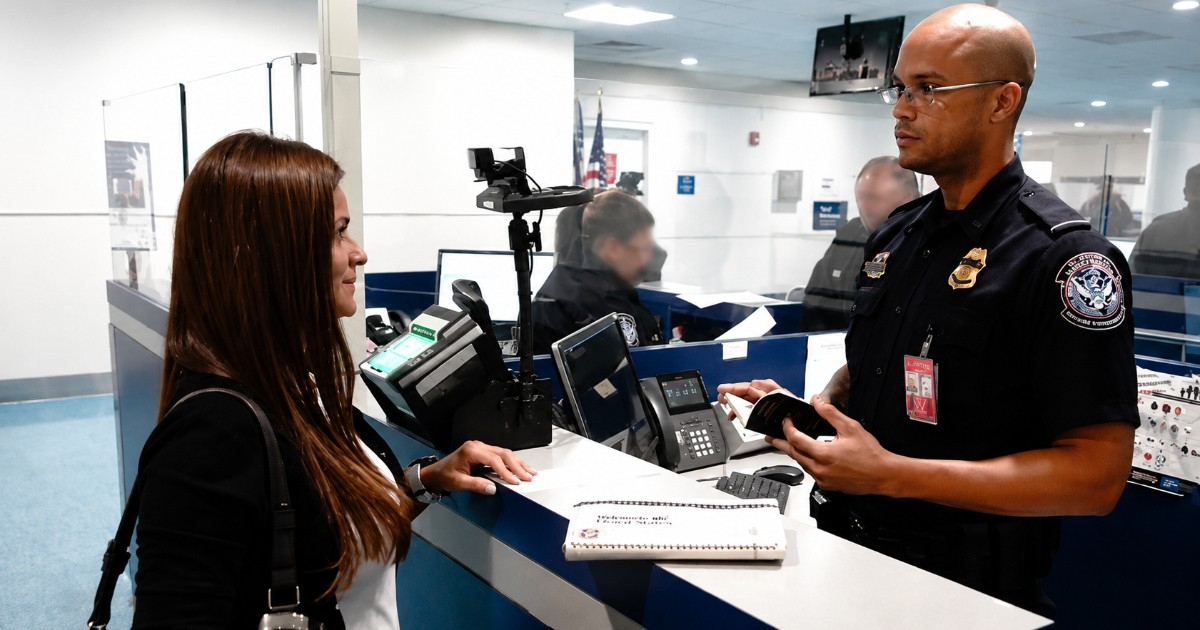
The United States Supreme Court delivered a landmark decision impacting millions of green card holders on Tuesday. In the case of Blanche v. Muk Choi Lau, the court ruled by a six-to-three vote that border agents are not required to have clear and convincing evidence of a crime committed by a permanent resident before treating them as an applicant for admission upon re-entering the country.
The majority opinion, penned by Justice Clarence Thomas and supported by Justices Roberts, Alito, Gorsuch, Kavanaugh, and Barrett, asserts that the Immigration and Nationality Act does not impose such a stringent standard of proof on border officials. These officers must make "quick decisions on the spot" without the burden equivalent to that required in a courtroom setting.
The Case of Muk Choi Lau
The case originated from the situation of Muk Choi Lau, a Chinese national and permanent resident since 2007. Lau temporarily traveled to China while facing criminal charges in New Jersey for trademark counterfeiting. Upon attempting to re-enter the United States through JFK Airport in June 2012, an immigration officer did not recognize him as a previously admitted resident. Instead, Lau was allowed entry on parole while his criminal case was pending. After pleading guilty in 2013, the government initiated removal proceedings on grounds of inadmissibility.
Legal Implications of the Ruling
The legal distinction is crucial in understanding the ruling's impact. If a permanent resident is classified as "already admitted," the government must demonstrate deportability. However, if treated as an "applicant for admission," the burden of proving admissibility falls on the immigrant, a generally more disadvantageous process. The majority established a two-step mechanism: initially, it's sufficient that the resident has "committed" a crime outlined in the law to potentially reclassify them. In the next stage, a conviction or admission of guilt is required to declare them inadmissible.
The ruling's most contentious aspect is that a conviction obtained months or years after re-entry can retroactively justify the decision made at the border. Justice Ketanji Brown Jackson, joined by Justices Sotomayor and Kagan, expressed strong dissent. "I am concerned that the Court has handed the government a massive blank check," Jackson wrote, cautioning that the decision allows the government to reclassify a permanent resident upon arrival at the border, later justifying that decision with evidence gathered afterward.
Consequences for Affected Individuals
The case of Lau exemplifies the concrete consequences of such reclassification. When placed on parole, authorities confiscated his physical green card, providing only a temporary I-94 form. According to the dissenting opinion, this document was "the sole proof of his status for the past 14 years," leaving Lau in an immigration limbo. Having only this temporary paper complicates working, opening bank accounts, securing health insurance, or enrolling in educational institutions.
The ruling directly impacts the Cuban community in the United States. ICE arrested Yaima Suárez, a Cuban mother of five and permanent resident, in Miami upon her return from Cuba due to a 2013 criminal record. Immigration attorney Willy Allen warns that any resident with a criminal record traveling abroad may be detained upon return, regardless of the destination. "If you have a criminal offense and are a resident, do not travel without consulting an attorney," he advises.
ICE estimates that between 42,000 and 46,000 Cubans in the United States have final deportation orders due to criminal offenses and are under supervision with form I-220B—a figure gaining new significance in light of this precedent.
The Court did not determine whether Lau's specific offense constitutes a "crime of moral turpitude," remanding the case to the Second Circuit for further examination. Justice Jackson encapsulated the gravity of the precedent: "By law, permanent residents are the closest to citizenship one can achieve without naturalizing. Today, the majority disregards that crucial fact."
FAQs on the Supreme Court Immigration Ruling
What was the Supreme Court's recent decision regarding permanent residents?
The Supreme Court ruled that border agents do not need clear and convincing evidence of a crime committed by a permanent resident before treating them as an applicant for admission upon re-entry into the U.S.
How does this ruling affect permanent residents?
Permanent residents may now be treated as applicants for admission when re-entering the U.S. if they have committed a crime, shifting the burden of proof for admissibility onto them, which is a less favorable process.
What are the implications for the Cuban community in the U.S.?
The ruling has significant implications for Cubans with criminal records, as they might face detention upon returning to the U.S., emphasizing the need for legal consultation before traveling.