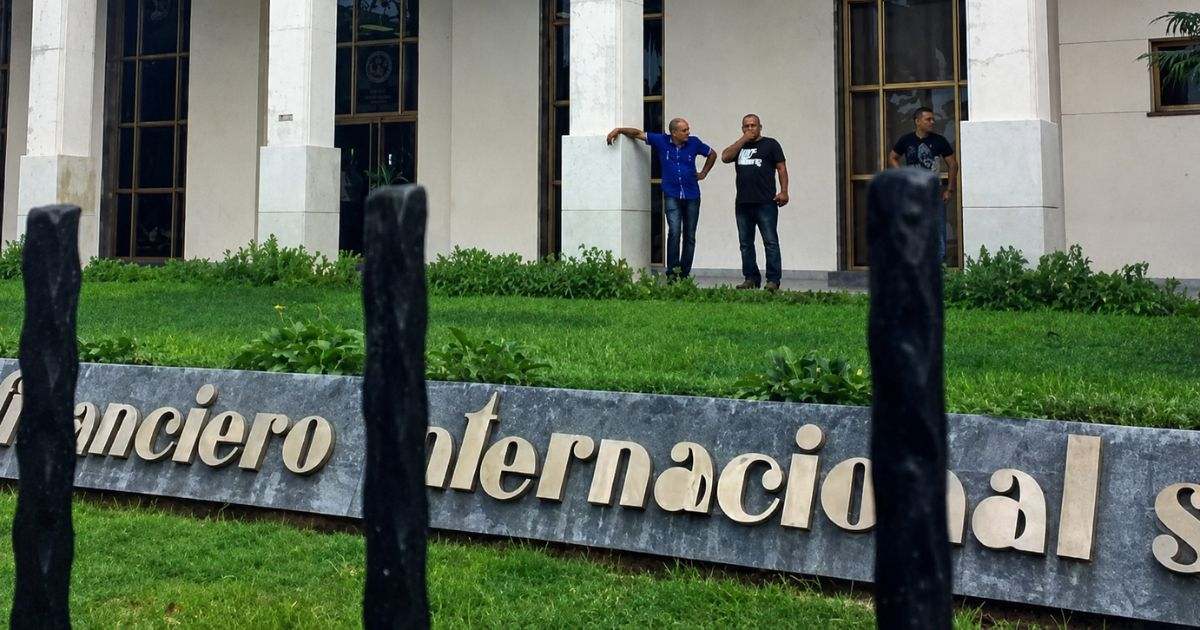
The United States has imposed sanctions on Banco Financiero Internacional S.A. (BFI) and RAFIN S.A., two entities connected to GAESA that Washington identifies as pivotal in handling and managing funds for the Cuban regime.
According to statements from the State Department and Secretary Marco Rubio, these designations were enacted under Executive Order 14404, signed by President Donald Trump, aimed at penalizing individuals and entities involved in repression in Cuba and threats to U.S. national security and foreign policy.
Crucial Financial Network Targeted
This action directly targets the financial network controlled by the military conglomerate, as BFI manages, according to the State Department, the vast majority of transactions with foreign entities operating inside and outside of Cuba.
The official record indicates that Banco Financiero Internacional is a commercial banking institution absorbed by GAESA in 2016, now sanctioned for its operations within the financial services sector of the Cuban economy.
Key Players in Financial Management
RAFIN S.A. also faced sanctions for its role in this sector. Washington describes it as a critical component of GAESA's financial management, a structure Rubio labeled as the "financial muscle" behind Cuba's repressive apparatus.
In his statement, Rubio highlighted that two designated entities are financial institutions tied to GAESA and involved in money movement for the regime, while another is a logistics company linked to the military conglomerate.
This third entity, Almacenes Universales S.A. (AUSA), a GAESA subsidiary, specializes in logistics services, storage, handling, and transportation, including port activities. According to the State Department, AUSA controls container traffic in the Mariel Special Development Zone.
Escalating Concerns Over Cuba's Situation
Rubio asserted on X that the situation in Cuba is "deteriorating" as the "corrupt, brutal, and anti-American" regime prioritizes its complete control over the Cuban people's freedom, opportunities, and basic welfare.
The Secretary of State accused GAESA of being "the main conduit" for the regime elites to siphon the island's scarce resources for repression, anti-American subversion, and espionage, rather than allocating them to schools, power plants, and essential needs.
Additional Sanctions in Mining and Metals
Washington's sanctions also extend to GeoMinera S.A. and Empresa Siderúrgica José Martí, known as Antillana de Acero, for their operations in Cuba's metals and mining sector.
The State Department noted that GeoMinera is a state-owned company under the Ministry of Energy and Mines, utilizing foreign investments, including those from Australia's Antilles Gold and other companies, to manage non-nickel metallic mineral assets in Cuba.
Empresa Siderúrgica José Martí is described as Cuba's largest producer of crude steel and has recently undergone modernization and expansion with Russian entities.
Broader Implications of Sanctions
The sanctions also affect Annalie Lilliam Rueda Cardero, identified by the State Department as an adult relative of Alejandro Castro Espín, former head of Cuban intelligence services and son of Raúl Castro. In his statement, Rubio identified her as Castro Espín's wife.
As a result of these measures, all assets and interests of the designated individuals and entities located in the U.S. or under the control of U.S. persons are frozen and must be reported to the Office of Foreign Assets Control of the Department of the Treasury.
The State Department also warned that foreign persons, including financial institutions, engaging in transactions with those sanctioned under Executive Order 14404, or operating in sectors like energy, defense, metals and mining, financial services, or security of the Cuban economy, may also face exposure to sanctions.
Rubio cautioned that anyone providing services to these sanctioned actors risks being sanctioned themselves, advising foreign banks and businesses involved with these entities to freeze their activities immediately.
Understanding the Impact of U.S. Sanctions on Cuba
What entities were sanctioned by the United States?
The United States sanctioned Banco Financiero Internacional S.A. (BFI), RAFIN S.A., GeoMinera S.A., and Empresa Siderúrgica José Martí, among others, due to their roles in Cuba's financial and industrial sectors.
What is the significance of these sanctions?
These sanctions aim to target the financial networks supporting the Cuban regime, cutting off resources that could be used for repression and anti-U.S. activities.
How might these sanctions affect foreign entities?
Foreign entities, including banks, that engage with the sanctioned Cuban entities risk facing U.S. sanctions themselves, potentially affecting their operations and financial dealings.