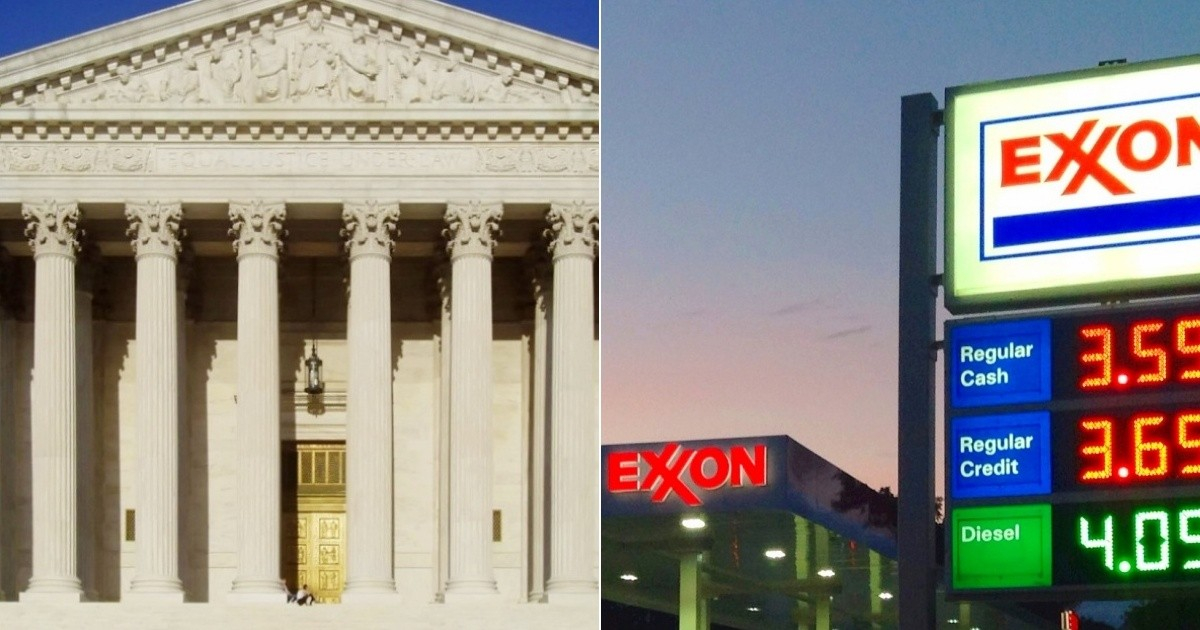
The United States Supreme Court ruled on Tuesday in favor of Exxon Mobil, allowing the energy giant to proceed with its lawsuit against Cuban state-owned companies. This legal battle aims to secure compensation for assets seized by Fidel Castro's revolutionary government over six decades ago, as reported by the Associated Press.
This landmark decision expands the reach of the Helms-Burton Act, potentially paving the way for additional billion-dollar claims related to the nationalizations that took place after 1959.
The Supreme Court's Decisive Ruling
In a 6-3 vote, the Supreme Court overturned a lower court's decision that had deemed Cuban state entities immune from lawsuits in U.S. courts due to sovereign immunity protections.
The case involves properties once owned by Standard Oil, the predecessor of Exxon Mobil, which included over a hundred gas stations and an oil refinery that were nationalized by the Cuban government in 1960. Exxon Mobil argues that state-run companies like CIMEX Corporation and Unión Cuba-Petróleo (CUPET) continue to profit from these assets without compensating the original owners.
Debating Sovereign Immunity
The legal debate focuses on the interpretation of Title III of the Helms-Burton Act, passed by the U.S. Congress in 1996. This legislation permits U.S. citizens and companies to sue individuals or entities benefitting from properties confiscated by the Cuban government.
The Supreme Court needed to determine whether this law removes the protection normally granted by the Foreign Sovereign Immunities Act to foreign governments and their state enterprises. The conservative majority affirmed this interpretation.
Justice Brett Kavanaugh, who authored the majority opinion, argued that it "would make little sense" for Congress to grant the U.S. president the authority to allow lawsuits against Cuban interests while preserving immunity that would prevent such claims.
However, the three liberal justices of the court opposed this view. In her dissent, Justice Elena Kagan contended that the 1996 legislation contains no explicit provision to strip Cuba or its state entities of sovereign immunity. According to Kagan, the majority's interpretation broadens the law's scope beyond what Congress originally intended.
A Claim Exceeding a Billion Dollars
This ruling marks a significant triumph for Exxon Mobil, which has pursued legal action since 2019 to recover the value of the expropriated assets. The U.S. Foreign Claims Settlement Commission determined in 1969 that Exxon suffered losses amounting to $71.6 million. With accrued interest over more than six decades, the amount now exceeds $1 billion, as highlighted by Kavanaugh in his opinion.
Exxon's case is part of a much larger array of claims. The same commission certified nearly 6,000 claims from U.S. citizens and businesses valued at approximately $1.9 billion before interest and other compensations.
Trump's Support for the Legal Offensive
The controversy gained political traction earlier this year. In January 2026, Donald Trump's administration formally supported Exxon before the Supreme Court with a brief filed by the Department of Justice. The Court even allowed the federal government to share argument time with Exxon during the case hearing, indicating the political interest the litigation attracted.
The U.S. government argued that sovereign immunity imposed "undue burdens" on plaintiffs and maintained that the Helms-Burton Act should suffice to allow claims. The Solicitor General justified this stance as a matter of "paramount foreign policy interests," aligning with Trump's strategy to intensify policy toward Cuba following his return to the White House.
The Helms-Burton Act Reemerges in Conflict
Congress enacted the Helms-Burton Act in 1996 after Cuba shot down two civilian planes piloted by Cuban exiles living in Miami. Its controversial Title III allows Americans to sue companies or individuals profiting from properties confiscated by the Cuban government after the Revolution.
For over two decades, both Republican and Democratic presidents systematically suspended the enforcement of this provision due to objections from U.S. allies with investments in Cuba and concerns that it might hinder potential negotiations with Havana.
The situation shifted in 2019 when Trump lifted the suspension, allowing lawsuits to proceed in U.S. courts.
A Precedent Affecting Hundreds of Claims
This Tuesday's decision comes just a month after the Supreme Court issued another ruling favorable to American claimants. In May, the court reactivated Havana Docks Corporation's lawsuit against several cruise companies—Carnival, Norwegian, Royal Caribbean, and MSC Cruises—for using port facilities in Havana confiscated by the Cuban government.
Both cases are seen as crucial in defining the real scope of the Helms-Burton Act and could facilitate new legal actions related to properties nationalized during the early years of the Revolution.
Although some experts caution that a judicial victory does not guarantee the effective collection of compensation due to the scarcity of Cuban assets on U.S. soil, the ruling significantly strengthens the position of thousands of claimants seeking restitution for properties seized over six decades ago.
Beyond its economic implications, the decision provides a new tool to pressure Havana amid renewed tensions between Washington and the Cuban government, reinforcing the Trump administration's strategy of using the Helms-Burton Act as a mechanism to increase the economic and political cost for the Cuban regime.
Understanding the Implications of the Supreme Court's Decision
What does the Supreme Court ruling mean for Exxon Mobil?
The ruling allows Exxon Mobil to pursue compensation claims against Cuban state-owned companies for assets seized by the Cuban government in 1960. This decision strengthens Exxon's legal position and could potentially lead to a financial restitution that exceeds $1 billion.
How does the Helms-Burton Act play a role in this case?
The Helms-Burton Act, specifically Title III, permits U.S. citizens and companies to sue for benefits derived from properties confiscated by the Cuban government. This law is central to Exxon's claim and the broader legal context of seeking compensation for nationalized properties.
What are the broader implications of the ruling?
The decision could open the door for numerous other claims against the Cuban government and its entities, potentially leading to significant financial and political repercussions. It also reinforces the Trump administration's strategy to apply economic pressure on Cuba.