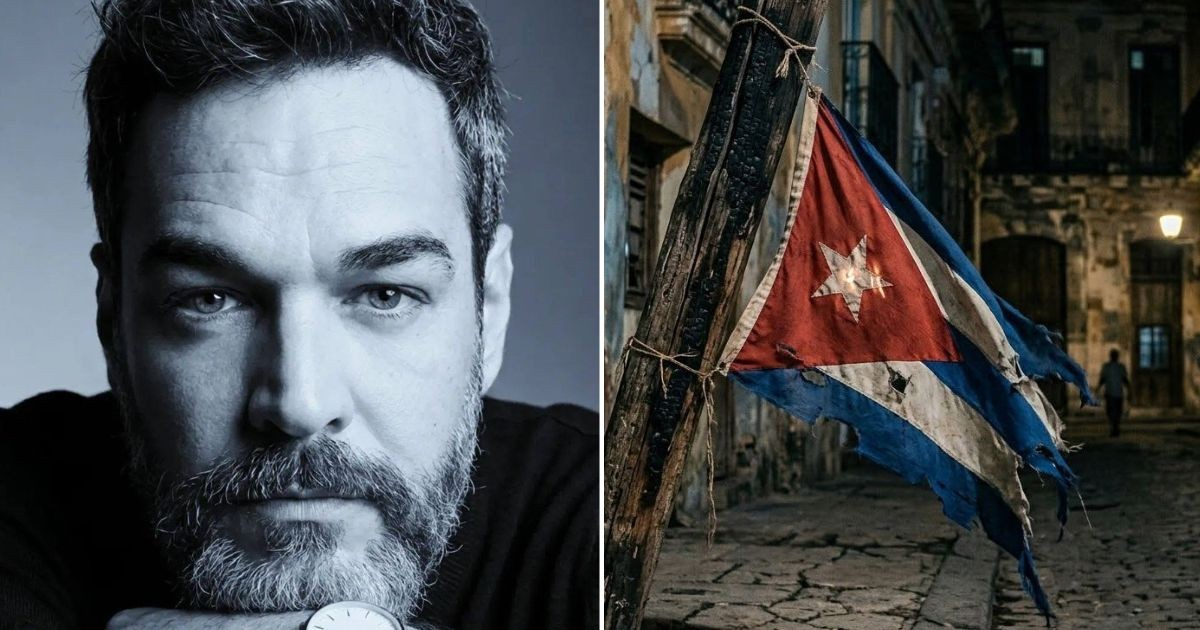
L. Eduardo Domínguez, who previously worked as a journalist and editor for the pro-government portal Cubadebate, shared a lengthy account on his Facebook profile about a blackout in Havana. This narrative turned into a direct critique of the Cuban government and the state-run electric company, encapsulated in a telling phrase: "When you pay for private efficiency, you get it immediately; when you rely on the State, you're left in the lurch."
The account, grounded in real events, describes how his building endured more than 42 hours of continuous blackout until a spark burned a cable in the meter room, plunging his apartment into complete darkness.
A System Unable to Respond
In his attempts to report the outage via the electric company's Telegram bot, Domínguez found no resolution as the system failed to generate a report number. "My complaint vanished into a digital black hole," he commented.
Neighbors accumulated what he refers to as "phantom reports": no one had documentation, no one had confirmation.
Even the intervention of a neighbor described as a "former deputy minister and current member of the National Assembly" failed to summon a repair truck. "Even power is powerless against a burned cable," noted the journalist.
Private Initiative Brings Resolution
The remedy came from two sources outside the state's influence. The chief engineer of the private company that installed his solar kit personally called him that Sunday morning—Father's Day—to diagnose the problem remotely: "You've got a dropped phase, and the system is trying to start a 220v machine using only 110v. The cable connections need to be reversed."
A retired electrician from a neighboring building completed the repair with nothing but his own hands and a pair of pliers, without a crew or work order.
"The issue is resolved, but not by those paid to fix it, rather by a private engineer over the phone and a retired man with pliers," wrote Domínguez.
Stark Contrast of Efficiency
The journalist draws a stark comparison: "On one hand, you have a private company—well-stocked with panels, cables, supplies, and spare parts—where the main boss calls you on a Sunday morning, concerned about solving a client's issue. On the other hand, there's the state-run socialist electric company, legally obligated to provide this public service, which lacks resources, doesn't respond, and essentially doesn't exist."
The narrative also touches on a human dimension that exacerbates the situation. Domínguez's mother has been waiting over a month for a surgery on an undiagnosed lump on her head, with the procedure indefinitely postponed due to a lack of anesthesia.
She resorts to paracetamol bought on the black market and Clonazepam "priced like oil."
Father's Day was reduced to a video call with his son, unable to take him to the National Aquarium.
"It's been a long time since we shopped for weeks; today, Cubans buy just enough to survive two or three days. The blackout has stolen our right to plan for tomorrow," he penned.
A Testimony of Collapse
Domínguez's piece emerges amidst the worst of Cuba's electrical crisis. As of June 2026, the power generation deficit exceeds 2,000 MW, with seven out of the country's 16 thermoelectric plants inoperative, and blackouts in some areas lasting over 20 hours daily. Matanzas recorded 85 consecutive hours without electricity between June 14 and 17.
For a journalist from Cubadebate to publicly criticize the state's inefficacy on personal social media, while the regime blames the crisis on the U.S. embargo, is itself a testament to the collapse's magnitude.
"The only certainty is that this weekend, we learned the hard way that the State has abandoned us. And that in this country, true darkness sets in not when the power goes out, but when you realize uncertainty is your only companion," Domínguez concluded.
Understanding Cuba's Power Crisis
What triggered the blackout described by Domínguez?
The blackout was due to a burned cable in the meter room, which left Domínguez's apartment without power.
How did Domínguez eventually resolve the power issue?
The issue was resolved with the help of a private company's engineer who diagnosed the problem over the phone and a retired electrician who fixed it with basic tools.
What does Domínguez's story highlight about Cuba's state-run services?
His story highlights the inefficiency and lack of resources of state-run services, in contrast to the proactive response from private entities.
What broader crisis does this narrative reflect?
This narrative reflects the broader crisis of Cuba's electrical grid, exacerbated by insufficient power generation and prolonged blackouts.