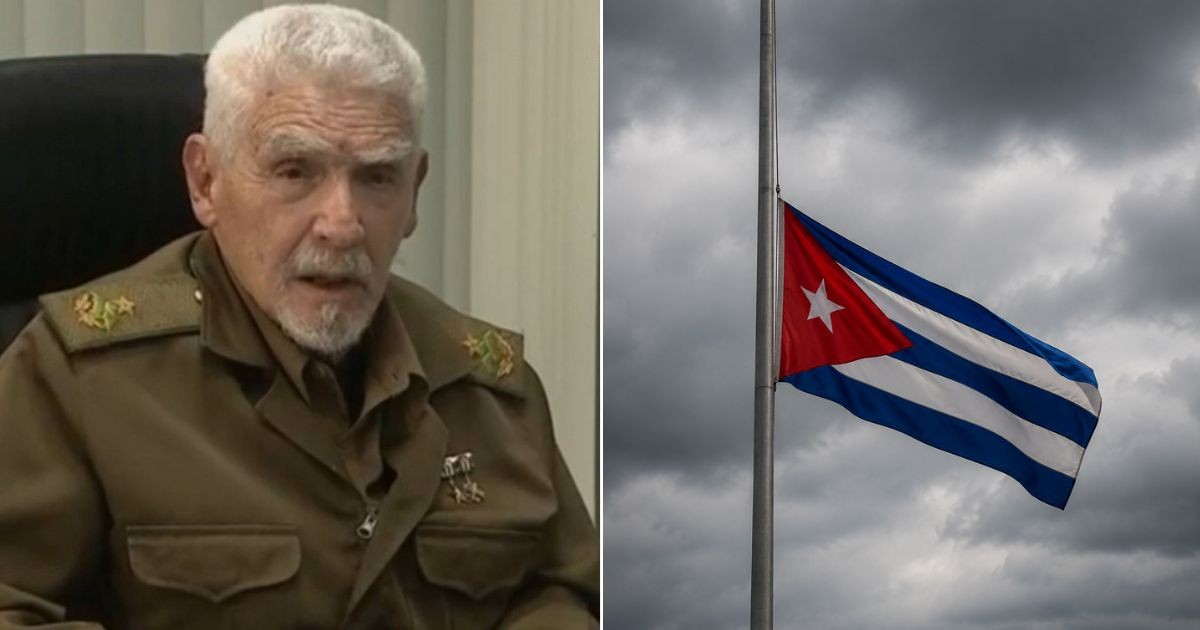
The Cuban government has announced an official mourning period following the death of Ramiro Valdés Menéndez, a key figure of the Cuban Revolution and the architect of the nation's oppressive state apparatus. Valdés passed away on Sunday at the age of 94.
Presidential Decree 1247, issued by Miguel Díaz-Canel on the day of Valdés's death and published in the Official Gazette on Monday, designates June 23 as a day of mourning, from 6:00 a.m. until midnight.
During this time, the Cuban flag is to be flown at half-mast on public buildings and military installations nationwide, as stipulated by the decree.
Responsibility for implementing the decree has been assigned to the ministers of the Revolutionary Armed Forces, the Interior, and Foreign Affairs.
The decree pays homage to Valdés, describing him as a "hero of the Republic of Cuba and Labor" and highlighting his revolutionary credentials: he participated in the 1953 Moncada Barracks assault, was an expeditionary on the Granma yacht in 1956, fought in the Sierra Maestra, and served as the second-in-command of the No. 8 "Ciro Redondo" invasion column alongside Che Guevara at the Battle of Santa Clara.
Born on April 28, 1932, in Artemisa, Valdés was the inaugural head of the Ministry of the Interior (MININT), established in 1961, and founded both the Department of State Security and the General Directorate of Intelligence, which have upheld the regime's political control for over six decades.
He served as Minister of the Interior twice—from 1961 to 1968 and again from 1979 to 1985—and was also Vice President of the Councils of State and Ministers. From 2006 to 2011, he was the Minister of Informatics and Communications, overseeing the state's control over telecommunications and internet access on the island.
Journalistic investigations have revealed that Valdés maintained structural ties with the Soviet KGB, turning Cuba into an intelligence platform for Moscow in the Western Hemisphere.
To his critics—including opposition members, exiles, and Cuban-American lawmakers—Valdés was the mastermind behind internal surveillance and political repression, earning him nicknames such as "Blood Puddle" and "the Butcher of Artemisa."
Reactions from Cuban-American congress members were strong. Representative María Elvira Salazar remarked, "Another one dies without paying on earth for all the harm he caused," adding, "In hell alongside Fidel."
Representative Carlos A. Giménez expressed regret that "henchman Ramiro Valdés died without facing justice for countless crimes against humanity, torture, and atrocities against the Cuban people."
Valdés had been absent from public life for several months without any official explanation. His last verifiable public appearance was in October 2025, during the 60th-anniversary celebrations of the first Central Committee of the Cuban Communist Party, alongside Raúl Castro, the only surviving founding member of the Castro regime, who remains politically influential at 95.
Key Figures and Historical Context of Ramiro Valdés
Who was Ramiro Valdés Menéndez?
Ramiro Valdés Menéndez was a prominent figure in the Cuban Revolution, known for his role in establishing the country's repressive state apparatus. He held significant positions, including Minister of the Interior and Vice President of the Councils of State and Ministers.
What were Ramiro Valdés's contributions to the Cuban Revolution?
Valdés was involved in key revolutionary activities such as the Moncada Barracks assault and the Granma yacht expedition. He also played a vital role in battles like the one at Santa Clara and was instrumental in forming Cuba's intelligence and security agencies.
How did Ramiro Valdés impact Cuba's political landscape?
Valdés significantly influenced Cuba's political scene by establishing the nation's security and intelligence infrastructure, which has been pivotal in maintaining the regime's control. His actions and policies have been subject to criticism for their role in political repression.