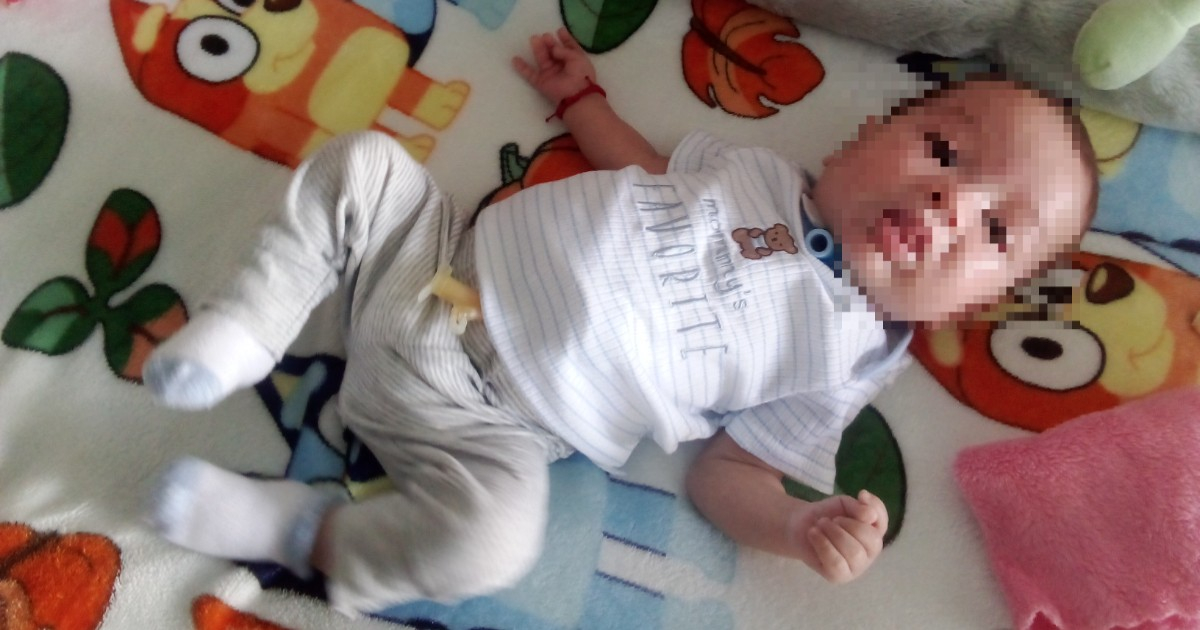
A mother from Santa Clara, Villa Clara, is raising concerns over her seven-month-old son's prolonged hospitalization at the José Luis Miranda Provincial Pediatric Hospital, alleging that a medical oversight during childbirth is to blame.
"What they did to us was a total and brutal negligence. My child could be healthy and at home," she lamented in a direct message to the CiberCuba editorial team.
The baby, according to the mother, suffers from cerebral palsy, uncontrolled epilepsy, and grade two hypoxic-ischemic encephalopathy, and requires both a tracheostomy and a gastrostomy.
Difficult Medical Conditions and Required Equipment
Hypoxic-ischemic encephalopathy in newborns is a brain injury caused by a lack of oxygen during or immediately after delivery. Even its moderate form can lead to permanent neurological damage, similar to what this child experiences, often linked to claims of obstetric negligence.
To discharge the baby, hospital physicians demand the mother secure equipment that is nearly unattainable under current Cuban circumstances: a solar panel kit — crucial due to frequent power outages — along with air conditioning, a suction device for secretions, and an emergency oxygen tank.
"Doctors tell me that to bring him home, I must have a solar panel kit because his condition cannot withstand power interruptions," the mother explained, noting that any respiratory infection, even a common cold, could destabilize the child and necessitate intensive care.
Hospital Shortages and Community Support
Beyond equipment, the hospital itself lacks essential supplies: "The hospital doesn't even provide my son's medications, and no one questions it," she criticized.
The baby's gastrostomy tube, urgently needing replacement due to deterioration, was not supplied by the hospital, despite another patient receiving the same aid. The mother managed to obtain it only thanks to an individual's generosity.
Wider Health Crisis and Government Inaction
This case is emblematic of a broader health crisis affecting pediatric hospitals across Cuba. In July 2025, José Ángel Portal Miranda, the Health Minister, acknowledged before the National Assembly that the country's medicine inventory was at a mere 30% of its basic requirements.
In April 2026, a baby in Granma died after not receiving a critical antibiotic on time, and in May, reports emerged of over 15 newborns dying in Camagüey due to poor sanitary conditions.
Similarly, in October 2025, another mother in Holguín voiced her struggle, as her son with hypoxic-ischemic encephalopathy and epilepsy remained hospitalized without adequate provisions for his seizures at the "Octavio de la Concepción de la Pedraja" Pediatric Hospital.
Social Welfare and Legal Challenges
With no income and another two-year-old daughter to care for, the mother is also demanding recognition of her rights under the 2025 Decree-Law 121. This law theoretically grants her a caregiver's pension, acknowledging her role as remunerated work for caring for children with severe, irreversible disabilities.
However, the gap between legal provisions and their practical implementation remains a persistent issue in Cuba. She claims to have sought help from all possible avenues without receiving any concrete response.
"Living off beans and squash is unsustainable, and there’s hardly anything left to scrape by with," she concluded, calling for justice: "Enough with the lies and injustices; I hope for some answers because this is unbearable."
Understanding Medical and Social Issues in Cuba
What is hypoxic-ischemic encephalopathy?
Hypoxic-ischemic encephalopathy is a type of brain injury in newborns caused by insufficient oxygen supply during or right after birth, often leading to long-term neurological issues.
Why is medical equipment hard to obtain in Cuba?
Cuba faces significant economic challenges and resource shortages, making advanced medical equipment scarce and difficult for the average citizen to acquire.
What are the legal rights for caregivers in Cuba?
Under Decree-Law 121/2025, caregivers of children with severe disabilities are entitled to a pension as recognition of their caregiving as paid work. However, practical execution of this law is inconsistent.