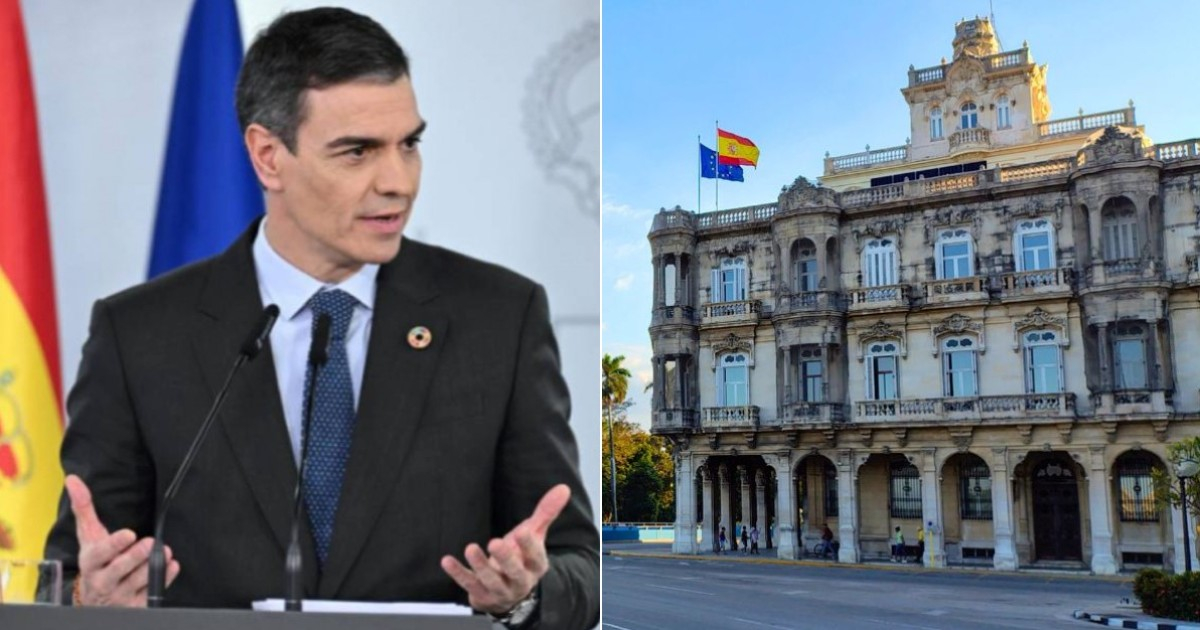
An investigative report by Spanish journalist Isabel Durán, featured in El Debate, exposes the questionable implementation of the so-called Grandchildren's Law in Cuba. It reveals that over 350,000 Cubans have applied for Spanish citizenship—accounting for one out of every seven applications worldwide—while the regime maintains total control over the required documentation.
The report highlights a contract signed on January 1, 2025, by the Spanish consulate in Havana. This agreement, amounting to 1,131,295 euros, was made with Grupo PALCO, a state-owned monopoly authorized by the regime to supply personnel to foreign diplomatic bodies on the island. The intention was to hire 88 workers to expedite the backlog of applications.
The Association of Descendants of Spaniards in the World (ADEM), led by attorney Estela Marina Pérez Cabrera, has criticized this contract, arguing that the ultimate beneficiary is GAESA—Cuba's military conglomerate that controls between 40% and 70% of the island's economy without public accounts or audits.
It's essential to note that the United States imposed sanctions on GAESA on May 7, 2026, labeling it as "the core of Cuba's kleptocratic communist system," with opaque assets estimated at up to 20 billion dollars.
The Complicated Citizenship Process
The mechanism under scrutiny involves Cuban applicants needing to prove their Spanish ancestry with birth, marriage, or death certificates from civil and church registries under state control, with no independent verification possible from Spain.
The situation is further complicated by Cuba not being a signatory to the Hague Convention, meaning its documents lack apostilles and instead bear a unique stamp issued arbitrarily by the dictatorship, making it impossible to verify the authenticity of the 350,000 applicants' records independently of the regime.
Public Outcry and Political Reactions
According to the report, many applicants face stalled processes and irregularities, a situation described by Pérez Cabrera as a "Kafkaesque labyrinth of endless waits."
"The Sánchez government pays a dictatorship-owned company to impose its staff on its own consulate, accelerating the incorporation of new nationalized citizens under the Grandchildren's Law into the electoral roll," Durán explains. "In other words, for a Cuban to prove Spanish descent, Spain ends up paying the state company that holds the key to the supposed Spanish identity of the applicants. Essentially, the document that opens Europe's door passes through the regime's cash register."
Concluding, the journalist states: "Cuba thus possesses two conditions that make it the true drain through which hundreds of thousands of votes sought by Pedro Sánchez slip through, allowing him to manipulate the electoral roll to his advantage and rapidly change Spain forever: a vast universe of alleged descendants and documentation impossible to verify without the regime's support."
The leader of the right-wing party VOX, Santiago Abascal, reacted to the report with a Facebook post claiming, "Only in Cuba will Sánchez's mafia access hundreds of thousands of votes controlled by Castroism. Only in Cuba! Sánchez is preparing the final blow to stay in power."
However, Abascal's statement sparked widespread backlash from Cubans who firmly rejected this premise.
"I'm Cuban and got my Spanish citizenship through the Grandchildren's Law. If Sánchez thinks we'll vote for him out of gratitude, he's mistaken. We don't want a socialist Spain; we want a free and prosperous one," wrote one individual.
Another was more blunt: "I'm a Cuban from the Grandchildren's Law, and I won't vote for PSOE. You'd have to be pretty stupid to escape one system only to vote for it."
Some nuanced Abascal's stance while maintaining their opposition to socialism: "I assure you no Cuban would ever vote for the left in Spain. I voted PP in Andalusia, and I didn't vote for you (VOX) because of these ridiculous and implausible comments... We fled a leftist communist dictatorship."
A comment summarizing the majority sentiment stated: "There's a greater chance Spaniards will vote for Sánchez than Cubans. Those fleeing Cuba do so because of socialism. Moving to another country to vote for what ruined our lives and homeland simply doesn't make sense. We vote based on experience."
The General Council of Spanish Citizens Abroad warned in October 2024 that at the current processing rate, it could take up to 20 years to resolve all the accumulated applications globally.
Understanding the Grandchildren's Law and Its Implications
What is the Grandchildren's Law in Spain?
The Grandchildren's Law allows descendants of Spaniards to apply for Spanish citizenship. It was designed to recognize and restore rights to the descendants of those who left Spain, often due to political or economic reasons.
Why is the Grandchildren's Law controversial in Cuba?
The controversy arises from the Cuban government's control over the documentation process required for citizenship applications, leading to concerns about transparency and potential manipulation.
How does the Spanish government ensure the authenticity of documents from Cuba?
Due to Cuba's non-adherence to the Hague Convention, Spanish authorities face challenges verifying documents, which lack the standard apostille and instead carry a regime-issued stamp.